openPR Recherche & Suche
Presseinformation

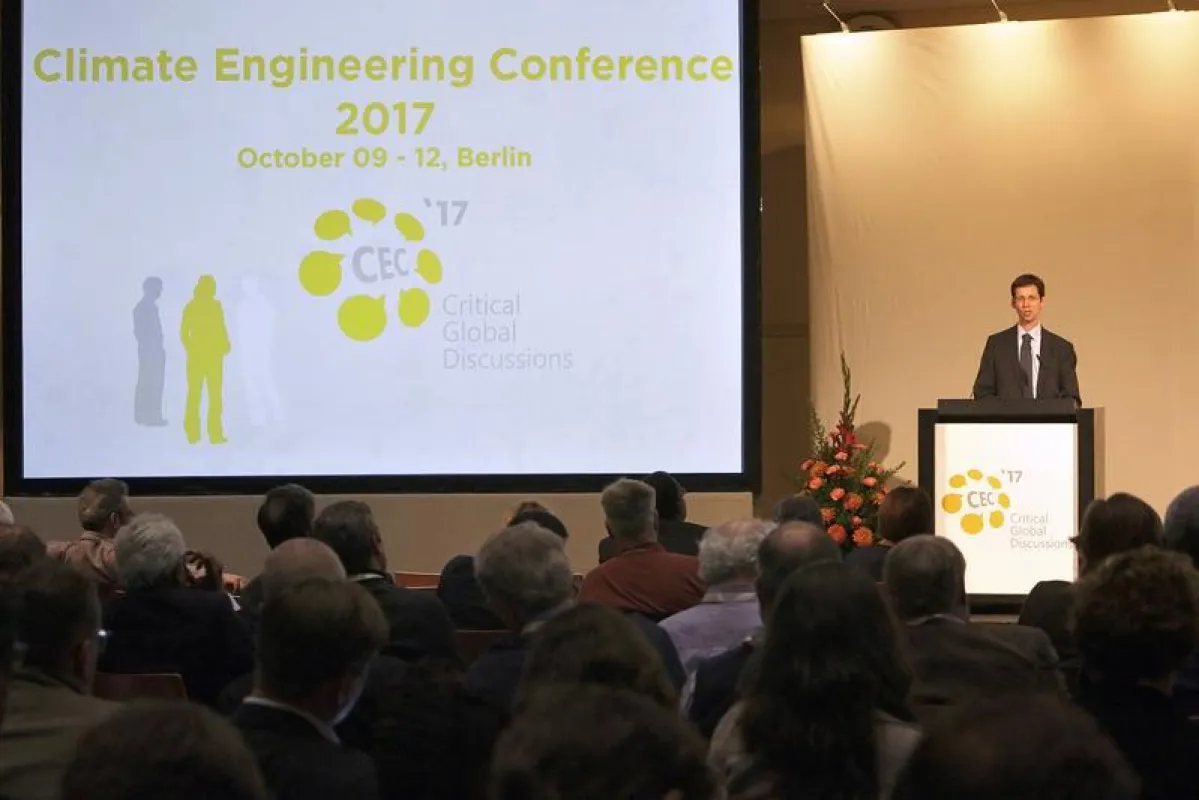
Climate Engineering Conference 2017 Opens in Berlin

10.10.201714:00 UhrWissenschaft, Forschung, Bildung
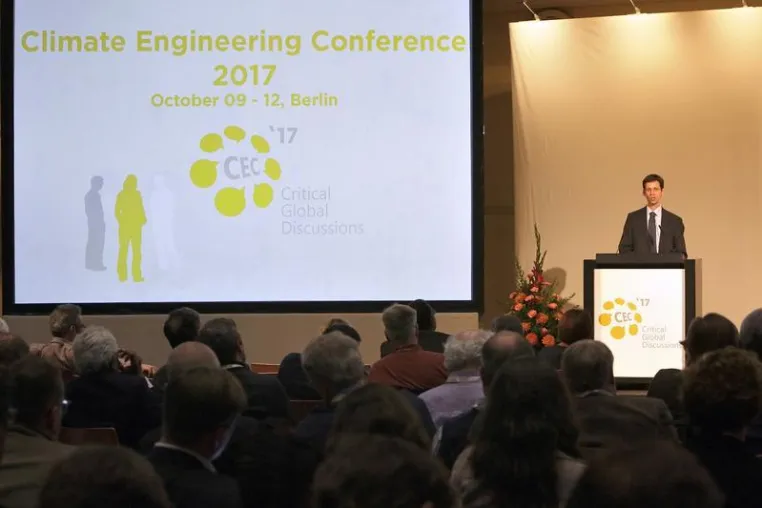
Bild: Climate Engineering Conference 2017 Opens in Berlin
The opening of the Climate Engineering Conference 2017 in Berlin. © IASS/Dirk Enters ()

(openPR) On Monday evening the Climate Engineering Conference (CEC17) was opened in Berlin by Mark Lawrence, Scientific Director at the Institute for Advanced Sustainability Studies (IASS). The international conference explores the potentials and risks of possible measures to intervene in the climate system. Over four days, experts from academia, political institutions, and civil society are engaging in intensive debates about the study, risks, and governance of geoengineering.


---
The international community has set itself ambitious climate goals in the Paris Agreement. But how can those goals be achieved? The Intergovernmental Panel on Climate Change (IPCC) assumes that in addition to reducing greenhouse gas emissions to almost zero, massive quantities of carbon dioxide will need to be removed from the atmosphere by the year 2100. “It will be very difficult to achieve the Paris Agreement targets without resorting to some form of climate engineering. So we urgently need an open and critical debate on the different forms and consequences of such interventions in the climate system,” said Mark Lawrence at the opening of the conference.

A forum for international, critical and transparent exchange

With this in mind, the climate engineering research team at the IASS invited around 250 experts to this year’s Climate Engineering Conference in Berlin. “The CEC17 is probably the most important platform for the global, critical, and transparent exchange of ideas on this highly controversial issue,” explained Stefan Schäfer, head of the Climate Engineering project at the IASS and one of the conference organisers.

The conference participants include researchers, policymakers and civil society actors, all of whom bring very different views and perspectives to the table. CEC17 brings the scientists conducting research into climate engineering face to face with environmental activists and political actors. Around fifty participants have travelled to the conference from developing countries and emerging economies. They are also due to participate in a meeting of the Solar Radiation Management Governance Initiative (SRMGI) organised on the sidelines of the conference.

Discussion of planned solar radiation management field experiment

The question of whether research should leave the laboratory is a major bone of contention in discussions of geoengineering. At CEC17 Harvard University physicist David Keith will discuss his planned field experiment and the governance activities associated with it (Wednesday at 2 pm).

In over thirty further conference events the focus will be on carbon dioxide removal (CDR) and solar radiation management (SRM) measures. Among other things, participants will discuss whether the Paris Agreement goals can be achieved without climate engineering (Tuesday at 11 am), how climate policy should deal with the propagators of fake news (“Trumped!”, Wednesday at 9 am), and what rules should be set for research in a code of conduct (Thursday, 2 pm). Interactive events like the game “To Gabon or not to Gabon” (Tuesday at 4 pm) are designed to encourage an open exchange of views.

Politically relevant: Developing international governance

For Mark Lawrence, there is an urgent need for internationally binding rules in this area: “At the IASS we are elaborating concepts for the governance of climate engineering and also advise political actors on how they can develop corresponding measures.” The question of how geoengineering is perceived in the political sphere is another major theme of CEC17. Janos Pasztor, Executive Director of the Carnegie Climate Geoengineering Governance Initiative (C2G2) and former climate advisor to UN Secretary General Ban Ki-moon, is also playing an active role at the conference.

Like its predecessor held in 2014, this Climate Engineering Conference is organised by the Institute for Advanced Sustainability Studies (IASS), Potsdam. The conference partners are the Haus der Kulturen der Welt (HKW) and the SRMGI and C2G2 initiatives. The CEC17 media partner is Der Tagespiegel.

The conference programme and press kit can be found at http://www.ce-conference.org/

Twitter hashtag #DiscussCEC

Statements of speakers at the press briefing on 10 October

Lili Fuhr, Heinrich Böll Foundation

“To limit global temperature rise to 1.5°C we must be prepared to follow radical emissions reduction pathways that go far beyond conventional economic thinking. They include a politically driven premature phase-out of fossil fuels, sustainable peasant agriculture, and absolute reductions in global resource and energy consumption through circular-economy and zero-waste approaches. Proven and locally adapted technologies that support these objectives already exist. We also need to act to restore our ecosystems, first and foremost our rainforests, moors and oceans. If we’re serious about engaging in a rigorous discussion of ecologically sustainable and socially just alternatives to confront the root causes of climate change, then there is no reason to believe that geoengineering is needed.”

David Keith, Harvard University

“Cutting emissions to zero is necessary to enable a stable climate. It’s possible to make very fast emissions cuts while preserving energy services for the wealthy and increasing access for the poor. However, even the immediate elimination of emissions does not eliminate climate risks; it simply stops the accumulation of carbon and thus the increase in climate impacts. In my view, solar geoengineering is – at best – a supplement to emissions cuts, not a substitute for them. It is possible that a combination of emissions cuts, carbon removal, and solar geoengineering could provide a significantly safer climate than emissions cuts alone or emissions cuts and carbon removal combined. Possible but unproven. The central political challenge is how to learn more about solar geoengineering – a potentially useful and potentially dangerous technology – given that research will likely be overhyped and exploited by forces opposed to emissions cuts.”

Pablo Suarez, Red Cross Red Crescent Climate Centre

“The humanitarian sector is active at the global frontline of climate impacts. Geoengineering is a humanitarian concern: The potential for deliberate large-scale intervention in the Earth’s climate system has major implications in terms of impacts on the most vulnerable. Those who can suffer the worst outcomes need to be involved, especially given the plausibility of ‘predatory geoengineering’, where recklessly self-concerned actions may result in harmful consequences to others. It is imperative to link science, policy and humanitarian practice, creating a geoengineering risk-management framework to ensure that the interests of the most vulnerable are considered and addressed.”

For further information or to arrange an interview, please contact

Eva Söderman / Anja Krieger
Press & Communications
Institute for Advanced Sustainability Studies e.V. (IASS)
Berliner Straße 130, 14467 Potsdam
Tel. +49 (0)331 288 22-340/479
Fax +49 (0)331 288 22-310

E-mail E-Mail / E-Mail
http://www.iass-potsdam.de/

The Institute for Advanced Sustainability Studies (IASS) conducts research with the goal of identifying, advancing, and guiding transformation processes towards sustainable societies in Germany and abroad. Its research practice is transdisciplinary, transformative, and co-creative. The institute cooperates with partners in academia, political institutions, administrations, civil society, and the business community to understand sustainability challenges and generate potential solutions. A strong network of national and international partners supports the work of the institute. Among its central research topics are the energy transition, emerging technologies, climate change, air quality, systemic risks, governance and participation, and cultures of transformation. The IASS is funded by the research ministries of the Federal Government of Germany and the State of Brandenburg.

Weitere Informationen:
- http://www.ce-conference.org/

Quelle: idw

Diese Pressemeldung wurde auf openPR veröffentlicht.

Verantwortlich für diese Pressemeldung:

News-ID: 973346
 594

Kostenlose Online PR für alle

Jetzt Ihren Pressetext mit einem Klick auf openPR veröffentlichen

Jetzt gratis starten

Pressebericht „Climate Engineering Conference 2017 Opens in Berlin“ bearbeiten oder mit dem "Super-PR-Sparpaket" stark hervorheben, zielgerichtet an Journalisten & Top50 Online-Portale verbreiten:

PM löschen PM ändern
Disclaimer: Für den obigen Pressetext inkl. etwaiger Bilder/ Videos ist ausschließlich der im Text angegebene Kontakt verantwortlich. Der Webseitenanbieter distanziert sich ausdrücklich von den Inhalten Dritter und macht sich diese nicht zu eigen. Wenn Sie die obigen Informationen redaktionell nutzen möchten, so wenden Sie sich bitte an den obigen Pressekontakt. Bei einer Veröffentlichung bitten wir um ein Belegexemplar oder Quellenennung der URL.

Pressemitteilungen KOSTENLOS veröffentlichen und verbreiten mit openPR

Stellen Sie Ihre Medienmitteilung jetzt hier ein!

Jetzt gratis starten

Weitere Mitteilungen von Institute for Advanced Sustainability Studies e.V.

Bild: Zeit der Verunsicherung: das neue Buch des Risikoforschers Ortwin RennBild: Zeit der Verunsicherung: das neue Buch des Risikoforschers Ortwin Renn
Zeit der Verunsicherung: das neue Buch des Risikoforschers Ortwin Renn
In seinem neuen Buch untersucht Risikoforscher Ortwin Renn, was Menschen in den Populismus treibt --- Welche Macht hat die Angst, und was macht sie mit unserer Gesellschaft? Diesen Fragen geht der Technik- und Umweltsoziologe Ortwin Renn in seinem gerade erschienenen Buch „Zeit der Verunsicherung“ auf den Grund. Der wissenschaftliche Direktor am Institut für transformative Nachhaltigkeitsforschung (IASS) beschäftigt sich mit den Ursachen und Wirkungen, der Wahrnehmung und dem Umgang mit Ängsten in unserer Gesellschaft. Populistische Strömun…
Bild: Soziales Nachhaltigkeitsbarometer zur Energiewende zeigt Zustimmung, aber Zweifel an der UmsetzungBild: Soziales Nachhaltigkeitsbarometer zur Energiewende zeigt Zustimmung, aber Zweifel an der Umsetzung
Soziales Nachhaltigkeitsbarometer zur Energiewende zeigt Zustimmung, aber Zweifel an der Umsetzung
Sozialwissenschaftliche Studie misst erstmals, für wie gerecht die Deutschen die Energiewende halten --- Potsdam/Berlin, 14. November 2017. 88 % der deutschen Bürgerinnen und Bürger befürworten die Energiewende, quer durch alle Bildungs-, Einkommens- und Altersgruppen und politischen Präferenzen, auf dem Land wie in den Städten. Rund zwei Drittel der Deutschen sehen jedoch eine soziale Schieflage bei der Energiewende. Über 65 % sind der Meinung, dass die kleinen Leute die Kosten der Energiewende tragen, während Unternehmen und Wohlhabendere …

Das könnte Sie auch interessieren:

Bild: Green Cities-Green Industries - Die China-Konferenzen Beijing, Harbin, Qingdao, Zibo, Dalian & JinanBild: Green Cities-Green Industries - Die China-Konferenzen Beijing, Harbin, Qingdao, Zibo, Dalian & Jinan
Green Cities-Green Industries - Die China-Konferenzen Beijing, Harbin, Qingdao, Zibo, Dalian & Jinan
… Geosystems [3.868 KB] - The Brandenburg Solution Energy Efficiency - The East German Experience: [17.404 KB] Case Study Magdeburg Faber Magdeburg - Energy [954 KB] Engineering Agrobusiness- Agro Institute [8.815 KB] Potsdam Agro Business: Tracking Systems for Food Safety [4.311 KB] by Fraunhofer Institute Berlin Food Processing: Fish & Poultry …
Bild: anthropoSCENE: Film and Climate Justice in Asia and Africa - Film festival, 21-24/09/2017Bild: anthropoSCENE: Film and Climate Justice in Asia and Africa - Film festival, 21-24/09/2017
anthropoSCENE: Film and Climate Justice in Asia and Africa - Film festival, 21-24/09/2017
… intervention that seeks to inform public debate in the midst of fierce controversies on climate change from a non-European perspective and the build up to the next UN climate conference, hosted by Germany in Bonn from 6 to 17 November, presided over by the Government of Fiji. By a panel discussion featuring leading scholar Berin Golonu from the United …
Bild: Climate Engineering: A Tool for Climate Protection?Bild: Climate Engineering: A Tool for Climate Protection?
Climate Engineering: A Tool for Climate Protection?
International experts will debate controversial interventions in the Earth System at the Climate Engineering Conference 2017 in October Is climate engineering necessary in order to protect the climate and successfully implement the Paris Agreement? What are the potential risks and side effects of climate engineering, and who would govern its use? International …
The IASS at the World Climate Conference in Bonn
… play on the way to achieving the Paris goals? How do climate protection and sustainable development go hand in hand? What risks and potential benefits would climate engineering bring? And can a broad societal dialogue advance the energy transition? Experts from the IASS will provide information. --- The Paris Agreement has been adopted and ratified by …
Bild: Climate Engineering-Konferenz 2017 in Berlin eröffnetBild: Climate Engineering-Konferenz 2017 in Berlin eröffnet
Climate Engineering-Konferenz 2017 in Berlin eröffnet
Am Montagabend hat Mark Lawrence, wissenschaftlicher Direktor am Institut für transformative Nachhaltigkeitsforschung (IASS), in Berlin die Climate Engineering Conference (CEC17) eröffnet. Die internationale Konferenz befasst sich mit Maßnahmen für mögliche Eingriffe ins Klimasystem, ihren Potenzialen und Risiken. Vier Tage lang diskutieren Expertinnen …
“We need you”: UN climate chief to Potsdam climate scientists
… health or migration already within the next few decades, sectors that so far often get overlooked in this context. This is one of the insights of the Impacts World Conference organised by the Potsdam Institute for Climate Impact Research (PIK) in Germany this week. At the same time, the institute celebrated its 25th anniversary hosting this meeting of …
Ministerin Ute Schäfer übernimmt Schirmherrschaft für erste Kids Climate Conference in Deutschland
Medebach, 11. Juni 2015. Ute Schäfer, Ministerin für Familie, Kinder, Jugend, Kultur und Sport in Nordrhein-Westfalen, übernimmt die Schirmherrschaft der ersten Kids Climate Conference in Deutschland, die vom 19. bis 21. Juni 2015 im Center Parcs Park Hochsauerland stattfindet. Die Konferenz hat sich zudem kürzlich, nach eingehender Prüfung der Eignung, …
“Software Engineering 2009” at the Fraunhofer Center in Kaiserslautern
Software Technology made in Germany Experiences, innovation, and trends in software and systems engineering will be the focus at Fraunhofer IESE in Kaiserslautern when the conference “Software Engineering 2009” opens on 02 March. “Guaranteed Quality – A Requirement of Industrial Software Development” is the motto of this meeting of experts from research …
Counting the true costs of climate change: Impacts World Conference in Potsdam
… poor. To investigate effects in these four areas, close to 500 researchers will meet on 11-13 October in Potsdam, Germany. --- Counting the true costs of climate change – this is the conference title – is quite a challenge since the social costs in particular are sometimes hard to calculate and also come in terms of human suffering. It is as part of …
Bild: Climate Engineering Conference 2017: Geoengineering für den Klimaschutz?Bild: Climate Engineering Conference 2017: Geoengineering für den Klimaschutz?
Climate Engineering Conference 2017: Geoengineering für den Klimaschutz?
Auf der Climate Engineering Conference 2017 diskutieren internationale Experten im Oktober über kontroverse Eingriffe ins Erdsystem Ist Geoengineering für den Klimaschutz und die Umsetzung des Pariser Abkommens notwendig? Welche Risiken und Nebenwirkungen wären mit Interventionen ins Klima verbunden und wer würde über ihren Einsatz entscheiden? Vom 9. …
Sie lesen gerade: Climate Engineering Conference 2017 Opens in Berlin