openPR Recherche & Suche
Presseinformation

Climate Engineering: A Tool for Climate Protection?

07.09.201710:00 UhrWissenschaft, Forschung, Bildung
Bild: Climate Engineering: A Tool for Climate Protection?
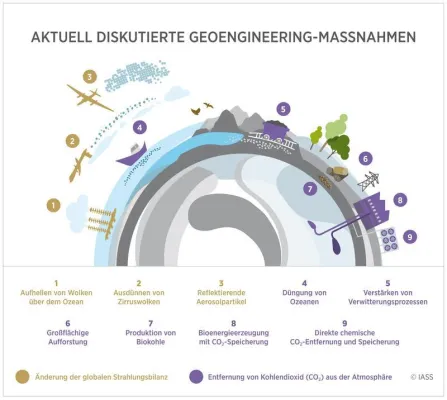
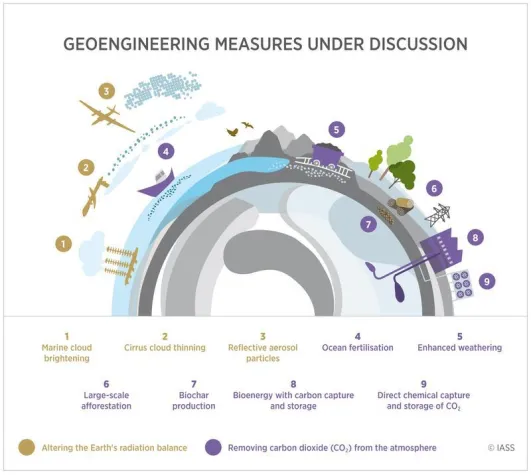
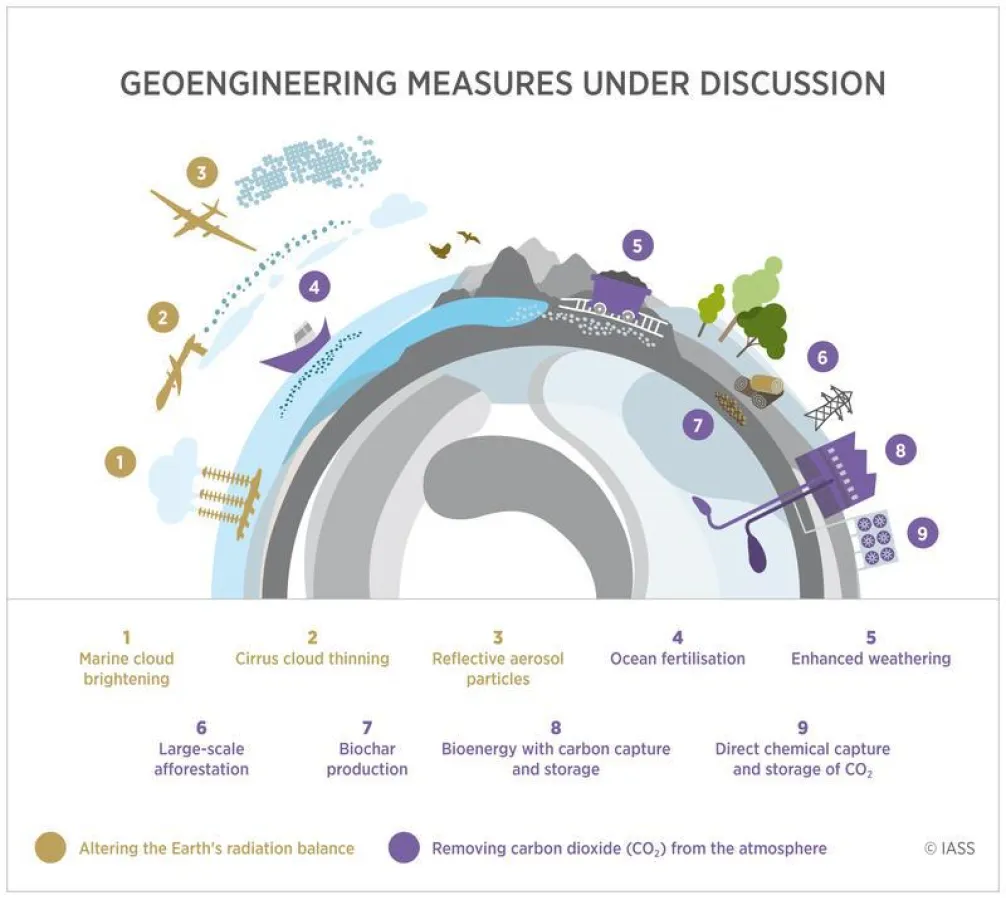
Geoengineering measures to reflect sunlight (mustard) and remove CO2 from the atmosphere (purple) (Graphic © IASS)

(openPR) International experts will debate controversial interventions in the Earth System at the Climate Engineering Conference 2017 in October

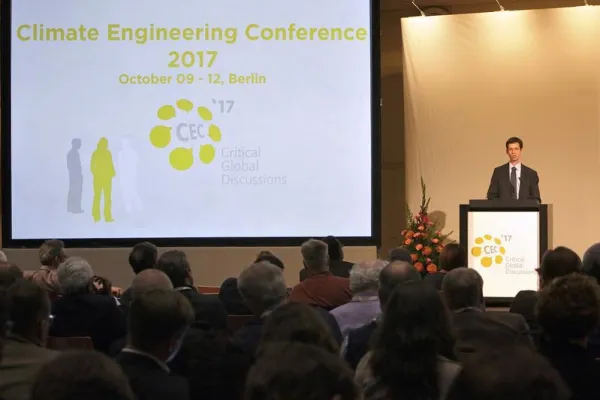
Is climate engineering necessary in order to protect the climate and successfully implement the Paris Agreement? What are the potential risks and side effects of climate engineering, and who would govern its use? International experts from the fields of science, policymaking, and civil society will meet in Berlin on 9 – 12 October at the world’s largest conference on this topic – Climate Engineering Conference 2017 (CEC17) – to explore the complex ethical, political and scientific issues raised by climate engineering approaches.


---
The IASS invites journalists to a press briefing:

“Climate engineering: a useful tool in the fight against climate change?”
When: Tuesday, 10 October 2017 from 12.45 p.m. to 1.45 p.m.
Where: Umweltforum, Pufendorfstr. 11, 10249 Berlin (2nd floor)

With Mark Lawrence, Managing Scientific Director at the Institute for Advanced Sustainability Studies (IASS) in Potsdam: an atmospheric scientist, Mark Lawrence oversees the research effort on climate engineering at the IASS.
David Keith is Professor of Applied Physics and Professor of Public Policy at Harvard University. His work is focused on the science, technology and public policy of solar geoengineering. He is founder of Carbon Engineering, a company developing technology to capture CO2 from ambient air.
Lili Fuhr is a geographer and Head of the Ecology and Sustainable Development Department at the Heinrich Böll Foundation. She campaigns for climate justice, radical emission reductions, and restoration of ecosystems.
Pablo Suarez leads research and innovation at the Red Cross Red Crescent Climate Centre. The Argentinian system dynamics modeler stresses that the rights and needs of those most affected by climate change should feature more prominently in the debate on climate engineering.
Language: English (German interpretation available)

Background: Capturing carbon and dimming the sun

In the wake of the Paris Climate Agreement, efforts to reduce global greenhouse gas emissions are progressing sluggishly and strategies for climate change adaptation are still in the early stages of development. Is climate engineering set to play a growing role in the struggle against climate change, and if so, how can the potential risks be determined and guarded against?

Two different types of technologies are currently under discussion: Carbon Dioxide Removal (CDR) approaches aim to remove greenhouse gases from the atmosphere by various methods. Solar Radiation Management (SRM) approaches, on the other hand, seek to alter the Earth’s energy budget by ensuring that less sunlight reaches the planet’s surface.

Will energy crops be cultivated on a massive scale in the future in order to capture CO2 so that it can subsequently be stored underground? Almost all of the ambitious emissions scenarios in the reports of the Intergovernmental Panel on Climate Change (IPCC) that aim to limit global warming to two degrees Celsius by the end of the century are based on the assumption that this so-called Bio-energy with Carbon Capture and Storage (BECCS) method will be applied on a large scale. However, growing the energy crops required for BECCS would necessitate the conversion of huge areas of farmland, presenting societies with a major problem.

Methods to reflect sunlight back into space could quickly slow or stop rising temperatures, if they could ever be implemented technically and politically. However, approaches such as the injection of aerosols into the atmosphere in order to scatter sunlight back into space entail considerable risks and difficult political implications, which may be even more problematic than the technical questions that surround them. For example, the occurrence of extreme weather events in connection with SRM could result in heightened political tensions and become a source of conflict.

CEC 2017: A forum for critical, global and transparent discussion

In light of the uncertainties, potentials and global impacts of climate engineering, there is an urgent need for a critical, transparent, and open discussion of the research, regulation, and the arguments in favour of and against large-scale technical interventions in the climate system.

Building on the success of CEC14, this second Climate Engineering Conference will bring together 250 experts from science, the business community, and civil society for four days of intensive exchange and discussion in Berlin. Among them, approximately 50 participants from developing and newly industrialised countries, including numerous representatives of non-governmental organisations, are expected at CEC17 and will attend the meeting of the Solar Radiation Management Governance Initiative being held in conjunction with this event.

Climate engineering in the context of the Paris Agreement will be the focus of a panel discussion with experts David Keith (Harvard), Janos Pasztor (Carnegie Climate Geoengineering Governance Initiative), Lili Fuhr (Heinrich Böll Foundation), Pablo Suarez (Red Cross Red Crescent Climate Centre), Oliver Geden (German Institute for International and Security Affairs, SWP), H. Elizabeth Thompson (Former Assistant Secretary General of the United Nations) and Oliver Morton (author of the book “A Planet Remade”) at Haus der Kulturen der Welt at 6:30 p.m. on 10 October.

The Climate Engineering Conference Series is hosted by the Institute for Advanced Sustainability Studies (IASS). The conference partners are Haus der Kulturen der Welt (HKW), the Solar Radiation Management Governance Initiative (SRMGI) and the Carnegie Climate Geoengineering Governance Initiative (C2G2).

For more information and the conference programme, please see www.ce-conference.org

To attend our press briefing and CEC17, please register by email (E-Mail) as soon as possible and no later than 4.00 p.m. on 4 October. Please note that only a limited number of places are available due to capacity constraints at the conference venue.

For further information or to arrange an interview, please contact:
Eva Söderman / Anja Krieger
Press & Communications
Institute for Advanced Sustainability Studies e.V. (IASS)
Berliner Straße 130, 14467 Potsdam
Tel. +49 (0)331 288 22-340/479
Fax +49 (0)331 288 22-310

Email E-Mail / E-Mail
http://www.iass-potsdam.de/en

The Institute for Advanced Sustainability Studies (IASS) conducts research with the goal of identifying, advancing, and guiding transformation processes towards sustainable societies in Germany and abroad. Its research practice is transdisciplinary, transformative, and co-creative. The institute cooperates with partners in academia, political institutions, administrations, civil society, and the business community to understand sustainability challenges and generate potential solutions. A strong network of national and international partners supports the work of the institute. Among its central research topics are the energy transition, emerging technologies, climate change, air quality, systemic risks, governance and participation, and cultures of transformation. The IASS is funded by the research ministries of the Federal Government of Germany and the State of Brandenburg.

Weitere Informationen:
- http://www.ce-conference.org More information and the conference programme
- http://www.ce-conference.org/reporting-the-conference Reporting on CEC17 / Accreditation

Quelle: idw

Diese Pressemeldung wurde auf openPR veröffentlicht.

Verantwortlich für diese Pressemeldung:

News-ID: 967368
 536

Kostenlose Online PR für alle

Jetzt Ihren Pressetext mit einem Klick auf openPR veröffentlichen

Jetzt gratis starten

Pressebericht „Climate Engineering: A Tool for Climate Protection?“ bearbeiten oder mit dem "Super-PR-Sparpaket" stark hervorheben, zielgerichtet an Journalisten & Top50 Online-Portale verbreiten:

PM löschen PM ändern
Disclaimer: Für den obigen Pressetext inkl. etwaiger Bilder/ Videos ist ausschließlich der im Text angegebene Kontakt verantwortlich. Der Webseitenanbieter distanziert sich ausdrücklich von den Inhalten Dritter und macht sich diese nicht zu eigen. Wenn Sie die obigen Informationen redaktionell nutzen möchten, so wenden Sie sich bitte an den obigen Pressekontakt. Bei einer Veröffentlichung bitten wir um ein Belegexemplar oder Quellenennung der URL.

Pressemitteilungen KOSTENLOS veröffentlichen und verbreiten mit openPR

Stellen Sie Ihre Medienmitteilung jetzt hier ein!

Jetzt gratis starten

Weitere Mitteilungen von Institute for Advanced Sustainability Studies e.V.

Bild: Zeit der Verunsicherung: das neue Buch des Risikoforschers Ortwin RennBild: Zeit der Verunsicherung: das neue Buch des Risikoforschers Ortwin Renn
Zeit der Verunsicherung: das neue Buch des Risikoforschers Ortwin Renn
In seinem neuen Buch untersucht Risikoforscher Ortwin Renn, was Menschen in den Populismus treibt --- Welche Macht hat die Angst, und was macht sie mit unserer Gesellschaft? Diesen Fragen geht der Technik- und Umweltsoziologe Ortwin Renn in seinem gerade erschienenen Buch „Zeit der Verunsicherung“ auf den Grund. Der wissenschaftliche Direktor am Institut für transformative Nachhaltigkeitsforschung (IASS) beschäftigt sich mit den Ursachen und Wirkungen, der Wahrnehmung und dem Umgang mit Ängsten in unserer Gesellschaft. Populistische Strömun…
Bild: Soziales Nachhaltigkeitsbarometer zur Energiewende zeigt Zustimmung, aber Zweifel an der UmsetzungBild: Soziales Nachhaltigkeitsbarometer zur Energiewende zeigt Zustimmung, aber Zweifel an der Umsetzung
Soziales Nachhaltigkeitsbarometer zur Energiewende zeigt Zustimmung, aber Zweifel an der Umsetzung
Sozialwissenschaftliche Studie misst erstmals, für wie gerecht die Deutschen die Energiewende halten --- Potsdam/Berlin, 14. November 2017. 88 % der deutschen Bürgerinnen und Bürger befürworten die Energiewende, quer durch alle Bildungs-, Einkommens- und Altersgruppen und politischen Präferenzen, auf dem Land wie in den Städten. Rund zwei Drittel der Deutschen sehen jedoch eine soziale Schieflage bei der Energiewende. Über 65 % sind der Meinung, dass die kleinen Leute die Kosten der Energiewende tragen, während Unternehmen und Wohlhabendere …

Das könnte Sie auch interessieren:

Importance of solar energy underestimated  by a factor of three
Importance of solar energy underestimated by a factor of three
… at Fraunhofer ISE. “Our study indicates that, under realistic assumptions, photovoltaics will become the most important power source in the world – at least if we take climate protection seriously and focus on the most affordable kind of technology.” This is also true for the United States. “Our results also show that the current US administration is …
Bild: inspira: cosmetics überweist 2500 Euro an WWFBild: inspira: cosmetics überweist 2500 Euro an WWF
inspira: cosmetics überweist 2500 Euro an WWF
Mit einem Scheck über 2500 Euro unterstützt der Beauty Engineering Experte inspira: cosmetics die Aktion „Bringen Sie die Eisbären zurück aufs Eis“ der Umweltstiftung WWF Deutschland.Ganz im Zeichen des Haut- und Klimaschutzes steht die Climate Protection Linie „Skin Accents“ des  Aachener Kosmetikunternehmens. Mit 2,5 Prozent des Erlöses aus verkauften …
Bild: Climate Engineering-Konferenz 2017 in Berlin eröffnetBild: Climate Engineering-Konferenz 2017 in Berlin eröffnet
Climate Engineering-Konferenz 2017 in Berlin eröffnet
Am Montagabend hat Mark Lawrence, wissenschaftlicher Direktor am Institut für transformative Nachhaltigkeitsforschung (IASS), in Berlin die Climate Engineering Conference (CEC17) eröffnet. Die internationale Konferenz befasst sich mit Maßnahmen für mögliche Eingriffe ins Klimasystem, ihren Potenzialen und Risiken. Vier Tage lang diskutieren Expertinnen …
Bild: Climate Engineering Conference 2017: Geoengineering für den Klimaschutz?Bild: Climate Engineering Conference 2017: Geoengineering für den Klimaschutz?
Climate Engineering Conference 2017: Geoengineering für den Klimaschutz?
Auf der Climate Engineering Conference 2017 diskutieren internationale Experten im Oktober über kontroverse Eingriffe ins Erdsystem Ist Geoengineering für den Klimaschutz und die Umsetzung des Pariser Abkommens notwendig? Welche Risiken und Nebenwirkungen wären mit Interventionen ins Klima verbunden und wer würde über ihren Einsatz entscheiden? Vom 9. …
Dekarbonisierung der Supply Chain: The Climate Choice und HiPP starten Partnerprogramm
… in der LieferketteKlimarelevante Datenerfassung entlang der Lieferkette rückt somit zunehmend ins Zentrum unternehmerischer Strategien für die KlimatransformationSoftware-Tool von The Climate Choice erfasst und analysiert Klimareifegrad ausgewählter Lieferanten von HiPP zur Reduktion ihrer CO2-EmissionenBerlin, 8. Dezember 2021 – Die Software-Plattform …
Bild: Ending tax breaks after the diesel scandalBild: Ending tax breaks after the diesel scandal
Ending tax breaks after the diesel scandal
… prohibitions rather than looking at the tax break currently granted to diesel drivers. The diesel scandal shows that emission standards alone are not sufficient to achieve climate protection targets and improved air quality. In contrast to emission standards and thresholds, a different diesel tax policy would provide significant revenues to EU countries. In …
The IASS at the World Climate Conference in Bonn
… play on the way to achieving the Paris goals? How do climate protection and sustainable development go hand in hand? What risks and potential benefits would climate engineering bring? And can a broad societal dialogue advance the energy transition? Experts from the IASS will provide information. --- The Paris Agreement has been adopted and ratified by …
Bild: Climate Engineering Conference 2017 Opens in BerlinBild: Climate Engineering Conference 2017 Opens in Berlin
Climate Engineering Conference 2017 Opens in Berlin
On Monday evening the Climate Engineering Conference (CEC17) was opened in Berlin by Mark Lawrence, Scientific Director at the Institute for Advanced Sustainability Studies (IASS). The international conference explores the potentials and risks of possible measures to intervene in the climate system. Over four days, experts from academia, political institutions, …
Mitel gehört zu den ersten Berichterstattern der „Climate Registry“
… Angestellten von Mitel in Nordamerika arbeiten von zu Hause aus oder haben die Möglichkeit, auf regelmäßiger Basis von zu Hause aus zu arbeiten. Statistiken der US Environmental Protection Agency (EPA) zeigen, dass in den USA pro Woche mehr als 4,5 Millionen Liter Kraftstoff eingespart werden könnten, wenn nur 10 Prozent der arbeitenden Bevölkerung einen …
Sie lesen gerade: Climate Engineering: A Tool for Climate Protection?