openPR Recherche & Suche
Presseinformation

With relentless pressure towards superconductivity: Award for Max Planck scientist and new insights

07.09.201715:00 UhrWissenschaft, Forschung, Bildung
Bild: With relentless pressure towards superconductivity: Award for Max Planck scientist and new insights
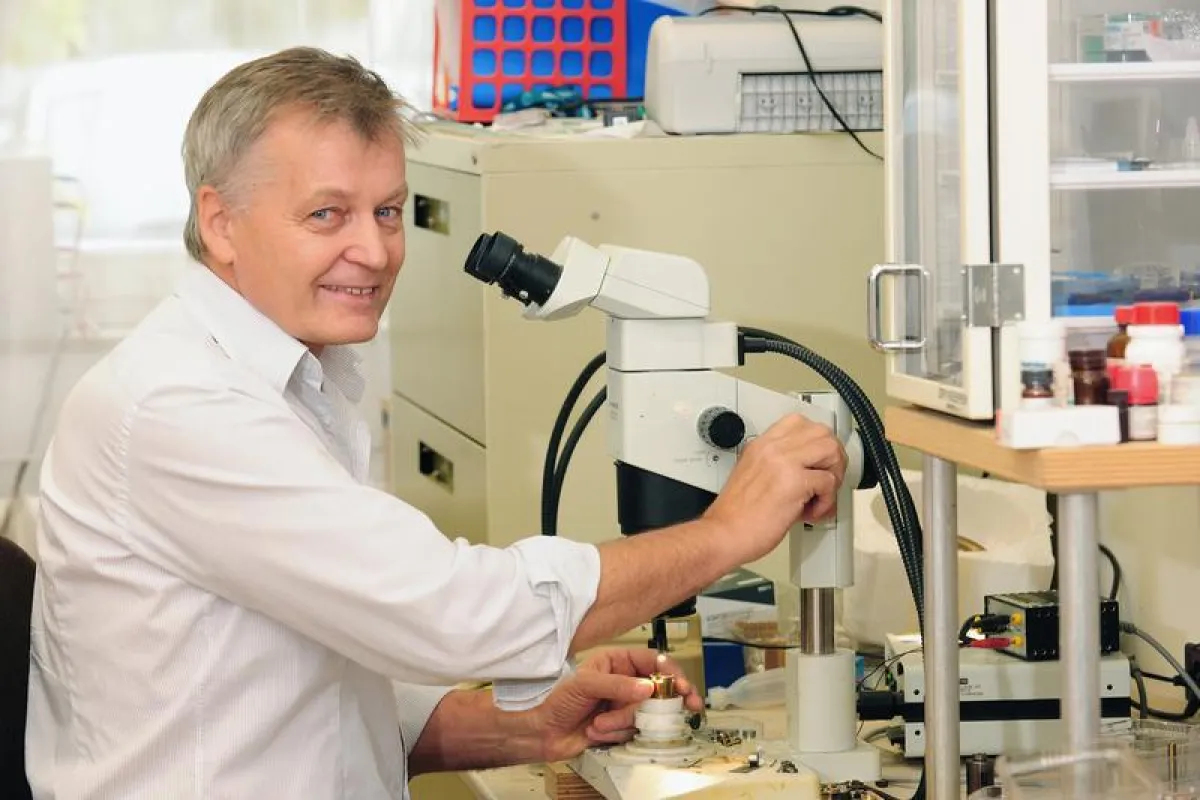
Mikhail Eremets received the Bridgman Award for his excellent work and technical developments in the field of high-pressure research. (Carsten Costard + MPI for Chemistry)

(openPR) Mikhail Eremets from the Max Planck Institute for Chemistry is honored for his accomplishments in high-pressure research with the Bridgman Award and demonstrates progress in synthesizing metallic hydrogen.

---
Mainz, September 6, 2017


The Mainz-based physicist Mikhail I. Eremets was honored with the Bridgman Awarded during the 26th Conference of the International Association for the Advancement of High Pressure Science and Technology (AIRAPT). The prize, one of the most prestigious in the field of high-pressure sciences, was awarded mid-August in the Chinese capital Beijing. Eremets received the award for his excellent work and technical developments in the field of high-pressure research.

Mikhail Eremets has been researching at the Max Planck Institute for Chemistry in Mainz since 2001. He leads the 'High-Pressure Chemistry and Physics' Group, which studies matter under extremely high pressures. In the summer of 2015 he published a scientific paper in the high valued journal “Nature”, in which he describes how hydrogen sulfide conducts electricity with no resistance at 70 degrees Celsius and a pressure of 1.5 million bar. This represented not only a superconductivity record for Eremets himself, but also points the way to a possible new method for the loss-free transmission of electricity at room temperature.

Mikhail Eremets is currently working on the important subject metallic hydrogen. Recently, he published a paper (arXiv:1708.05217), in which he shows that his team may have already achieved a metallic hydrogen state. In the experiments, however, hydrogen does not abruptly transition to the atomic metallic state, as was predicted more than 80 years ago. Instead, it remains in molecular form and only gradually changes from a semimetallic state into a metal when the pressure is increased. The next aim of Mikhail Eremets' team is to achieve pressures greater than five million bar, at which point metallic hydrogen should become a high-temperature superconductor.

Vitae
Michail Ivanovitsch Eremets was born in 1949 in the Pinsk region of Belarus. He studied physics at the Moscow Engineering Physics Institute and gained his doctorate in 1978 at Moscow's Institute of General Physics of the Russian Academy of Sciences. He went on to perform research at the High-pressure Physics Institute of the Russian Academy of Sciences in Troitsk, where he eventually headed the high-pressure physics department as director. After 1991 he worked in the world's leading high-pressure laboratories: France (Paris University), Japan (NIMS and Osaka University), USA (Geophysical Laboratory), UK (Clarendon Laboratory) and others. From 2001 until today, Mikhail Eremets has been researching at the Max Planck Institute for Chemistry in Mainz, Germany, and leads the 'High-pressure Chemistry and Physics' Working Group. In 2010, he was awarded the European Research Council's 'Advanced Grant' for research into conductive and metallic hydrogen, which is endowed with1.9 million euros. The Rome International Center for Materials Science of Superstripes (RICMASS) awarded him the Ugo Fano Medal in late 2015 for his basic research work in the field of high-pressure chemistry and for discovering the superconductivity of hydrogen sulfide at record temperatures. In January 2016, he was awarded an honoris cause doctorate by the University of Leipzig.

Bridgman Award
The International Association for the Advancement of High Pressure Science and Technology (AIRAPT) grants the Bridgman Award every two years on outstanding scientists in the field of high-pressure research. The prize is named after the US physicist Percy Williams Bridgman. Bridgman was awarded the Nobel Prize for Physics in 1946 for his work in the field of high-pressure physics. He was one of the founders of modern high-pressure research.

Quelle: idw

Diese Pressemeldung wurde auf openPR veröffentlicht.

Verantwortlich für diese Pressemeldung:

News-ID: 967530
 568

Kostenlose Online PR für alle

Jetzt Ihren Pressetext mit einem Klick auf openPR veröffentlichen

Jetzt gratis starten

Pressebericht „With relentless pressure towards superconductivity: Award for Max Planck scientist and new insights“ bearbeiten oder mit dem "Super-PR-Sparpaket" stark hervorheben, zielgerichtet an Journalisten & Top50 Online-Portale verbreiten:

PM löschen PM ändern
Disclaimer: Für den obigen Pressetext inkl. etwaiger Bilder/ Videos ist ausschließlich der im Text angegebene Kontakt verantwortlich. Der Webseitenanbieter distanziert sich ausdrücklich von den Inhalten Dritter und macht sich diese nicht zu eigen. Wenn Sie die obigen Informationen redaktionell nutzen möchten, so wenden Sie sich bitte an den obigen Pressekontakt. Bei einer Veröffentlichung bitten wir um ein Belegexemplar oder Quellenennung der URL.

Pressemitteilungen KOSTENLOS veröffentlichen und verbreiten mit openPR

Stellen Sie Ihre Medienmitteilung jetzt hier ein!

Jetzt gratis starten

Weitere Mitteilungen von Max-Planck-Institut für Chemie

Bild: Weniger Dünger reduziert die FeinstaubbelastungBild: Weniger Dünger reduziert die Feinstaubbelastung
Weniger Dünger reduziert die Feinstaubbelastung
Die Senkung landwirtschaftlicher Ammoniakemissionen kann die Sterblichkeit durch Luftverschmutzung erheblich reduzieren. Mainz, 27. Oktober 2017 --- Für Feinstaub gibt es viele Quellen – nicht nur den Verkehr, der dafür derzeit besonders viel Aufmerksamkeit erfährt. Auch eine Reduktion landwirtschaftlicher Emissionen könnte die Menge an gesundheitsschädlichem Feinstaub erheblich senken, wie eine Studie von Forschern des Max-Planck-Instituts für Chemie in Mainz zeigt. Die Wissenschaftler berechneten, dass speziell in Europa und Nordamerika d…
Bild: Reducing manure and fertilizers decreases atmospheric fine particlesBild: Reducing manure and fertilizers decreases atmospheric fine particles
Reducing manure and fertilizers decreases atmospheric fine particles
A decrease of agricultural ammonia emissions avoids mortality attributable to air pollution Mainz, 27 Oktober 2017 --- Fine particulates have numerous sources – not only traffic, which is currently under particular scrutiny. Reducing agricultural emissions could also considerably reduce the particulate levels that are hazardous to health, concludes a study by researchers at the Max Planck Institute for Chemistry in Mainz, Germany. The scientists calculated that especially in Europe and North America, the atmospheric fine particle concentrat…

Das könnte Sie auch interessieren:

Bild: Christiane Nüsslein-Volhard  - passion, creativity and verve for biological researchBild: Christiane Nüsslein-Volhard  - passion, creativity and verve for biological research
Christiane Nüsslein-Volhard - passion, creativity and verve for biological research
… winner currently works on the molecular and genetic background of colour pattern formation in animals and is the leader of an Emeritus-research group at the Max Planck Institute for Developmental Biology in Tübingen, Germany. In 2016 Christiane Nüsslein-Volhard received one of the coveted Advanced Grants of the European Research Council (ERC). The ERC …
Migration: The long path to becoming part of society
Six Max Planck Institutes explore social and legal exclusion as a result of migration Social scientists have long been interested in the subject of social integration and inclusion. However, there has been much less attention given to the ways that legal provisions, social behaviours, and economic conditions can lead to exclusion. A joint project of …
Bild: Max Planck research kicked off in WürzburgBild: Max Planck research kicked off in Würzburg
Max Planck research kicked off in Würzburg
Studying the immune system: That is the goal of a new Max Planck Research Group at the University of Würzburg which is currently being set up. --- With the cooperation agreement signed four years ago, work in the laboratories is now picking up momentum: With the appointment of Professor Georg Gasteiger, the new Max Planck Research Group for System Immunology …
Graduate school ANARCHIE begins its fourth cycle
Joint doctoral school of the Max Planck Institute for Social Anthropology and Martin Luther University Halle On 1 November 2017 the Max Planck Institute for Social Anthropology (MPI) and Martin Luther University Halle-Wittenberg (MLU) will welcome the newest cohort of doctoral students in their joint graduate school ANARCHIE. The school was established …
Memory for Details Matures Gradually
… contrast to previous assumptions, the hippocampus, a brain structure that is central to learning and memory, does not complete its maturation until adolescence. Scientists of the Max Planck Institute for Human Development, the Max Planck UCL Centre for Computational Psychiatry and Ageing Research, and the University of Stirling were able to show this for …
Bild: The pyrenoid is a carbon-fixing liquid dropletBild: The pyrenoid is a carbon-fixing liquid droplet
The pyrenoid is a carbon-fixing liquid droplet
… electron microscopy studies suggesting that the pyrenoid is a highly ordered solid crystal. To answer this question, the team lead by Benjamin Engel at the Max Planck Institute of Biochemistry used cryo-electron tomography to examine the molecular organization of the pyrenoid within Chlamydomonas cells that were frozen in their native state, avoiding …
Humboldt Professorship for animal behaviour scientist Margaret C. Crofoot
… Behaviour as one of our university’s key research and teaching areas, which is dedicated to the data-based analysis of collective decision-making processes. Working with the Max Planck Institute for Ornithology in Radolfzell, we are in the process of creating a cutting-edge international research facility to further promote studies in this field, the …
Bild: Patrick Müller receives the „EMBO Young Investigator” AwardBild: Patrick Müller receives the „EMBO Young Investigator” Award
Patrick Müller receives the „EMBO Young Investigator” Award
… biophysical, and theoretical approaches. From 1999 to 2004, Müller studied molecular biology in Göttingen, Berkeley, and New York. In 2007, he received his PhD from the Max Planck Institute for Biophysical Chemistry and worked as a postdoc and research associate at Harvard University until 2013. Müller has already received several awards for his work, …
Bild: World´s smallest jet engine invented in StuttgartBild: World´s smallest jet engine invented in Stuttgart
World´s smallest jet engine invented in Stuttgart
For the second time, Dr. Samuel Sánchez from the Max Planck Institute for Intelligent Systems in Stuttgart receives the Guinness World Record for the smallest nanotube travelling through fluid like a jet engine. --- Stuttgart (lb) - Dr. Samuel Sánchez is thrilled, just like last time he received a Guinness World Record for the smallest jet engine ever …
Bild: ERC Starting Grant ARTIST for Seraphine Wegner at the Max Planck Institute for Polymer ResearchBild: ERC Starting Grant ARTIST for Seraphine Wegner at the Max Planck Institute for Polymer Research
ERC Starting Grant ARTIST for Seraphine Wegner at the Max Planck Institute for Polymer Research
The European Research Council (ERC) awarded Dr. Seraphine Wegner at the Max Planck Institute for Polymer Research (MPI-P) an ERC Starting Grant of 1.9 million euros for her project ARTIST. This project on bottom-up tissue engineering wants to control cell-cell interactions with visible light to assemble cells into functional tissues. --- The bottom-up …
Sie lesen gerade: With relentless pressure towards superconductivity: Award for Max Planck scientist and new insights