openPR Recherche & Suche
Presseinformation

Bacteria have a sense of touch

26.10.201721:00 UhrWissenschaft, Forschung, Bildung
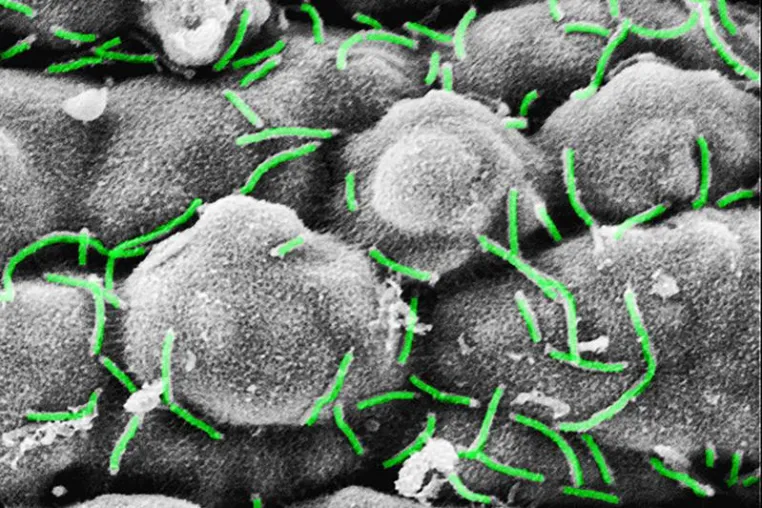
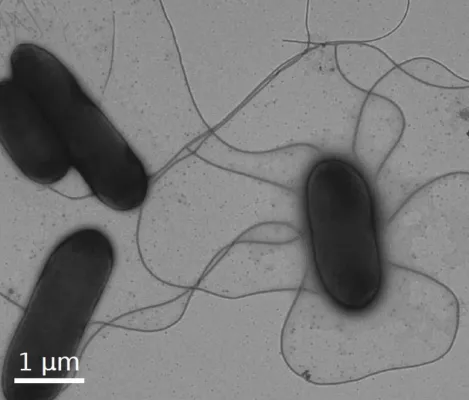
Bild: Bacteria have a sense of touch
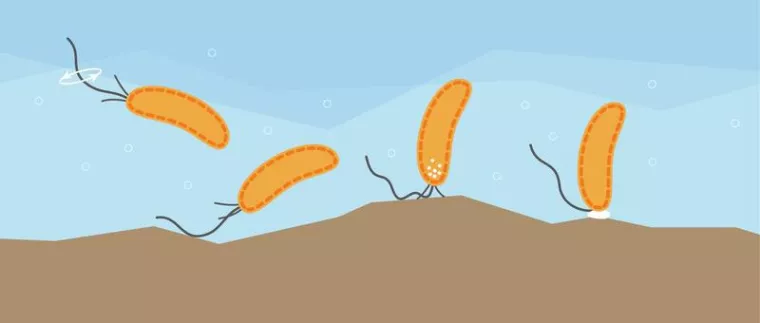
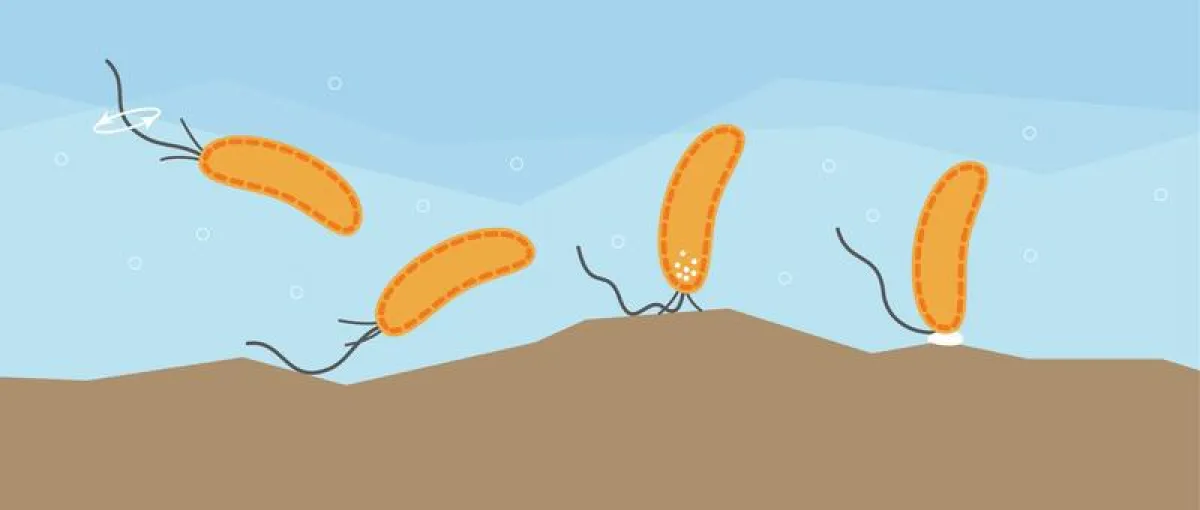
Sense of touch: Swimming bacteria can sense surfaces with the flagellum. (University of Basel, Biozentrum)

(openPR) Although bacteria have no sensory organs in the classical sense, they are still masters in perceiving their environment. A research group at the University of Basel’s Biozentrum has now discovered that bacteria not only respond to chemical signals, but also possess a sense of touch. In their recent publication in “Science”, the researchers demonstrate how bacteria recognize surfaces and respond to this mechanical stimulus within seconds. This mechanism is also used by pathogens to colonize and attack their host cells.


---
Be it through mucosa or the intestinal lining, different tissues and surfaces of our body are entry gates for bacterial pathogens. The first few seconds – the moment of touch – are often critical for successful infections. Some pathogens use mechanical stimulation as a trigger to induce their virulence and to acquire the ability to damage host tissue. The research group led by Prof. Urs Jenal, at the Biozentrum of the University of Basel, has recently discovered how bacteria sense that they are on a surface and what exactly happens in these crucial first few seconds.

Research focused only on chemical signals

In recent decades, research has made enormous progress in exploring how bacteria perceive and process chemical signals. “However, we have little knowledge of how bacteria read out mechanical stimuli and how they change their behavior in response to these cues,” says Jenal. “Using the non-pathogenic Caulobacter as a model, our group was able to show for the first time that bacteria have a ‘sense of touch’. This mechanism helps them to recognize surfaces and to induce the production of the cell's own instant adhesive.”

How bacteria recognize surfaces and adhere to them

Swimming Caulobacter bacteria have a rotating motor in their cell envelope with a long protrusion, the flagellum. The rotation of the flagellum enables the bacteria to move in liquids. Much to the surprise of the researchers, the rotor is also used as a mechano-sensing organ. Motor rotation is powered by proton flow into the cell via ion channels. When swimming cells touch surfaces, the motor is disturbed and the proton flux interrupted.

The researchers assume that this is the signal that sparks off the response: The bacterial cell now boosts the synthesis of a second messenger, which in turn stimulates the production of an adhesin that firmly anchors the bacteria on the surface within a few seconds. “This is an impressive example of how rapidly and specifically bacteria can change their behavior when they encounter surfaces,” says Jenal.

Better understanding of infectious diseases

“Even though Caulobacter is a harmless environmental bacterium, our findings are highly relevant for the understanding of infectious diseases. What we discovered in Caulobacter also applies to important human pathogens,” says Jenal. In order to better control and treat infections, it is mandatory to better understand processes that occur during these very first few seconds after surface contact.

Original article

Isabelle Hug, Siddharth Deshpande, Kathrin S. Sprecher, Thomas Pfohl, Urs Jenal
Second messenger-mediated tactile response by a bacterial rotary motor
Science (2017). doi: 10.1126/science.aan5353
https://doi.org/10.1126/science.aan5353

Further Information

Prof. Dr. Urs Jenal, University of Basel, Biozentrum, Tel. +41 61 207 21 35, email: E-Mail

Dr. Katrin Bühler, University of Basel, Biozentrum, Communications, Tel. +41 61 207 09 74, email: E-Mail

Weitere Informationen:
- https://unibas.ch/en/News-Events/News/Uni-Research/Bacteria-have-a-sense-of-touch.html

Quelle: idw

Diese Pressemeldung wurde auf openPR veröffentlicht.

Verantwortlich für diese Pressemeldung:

News-ID: 976924
 494

Kostenlose Online PR für alle

Jetzt Ihren Pressetext mit einem Klick auf openPR veröffentlichen

Jetzt gratis starten

Pressebericht „Bacteria have a sense of touch“ bearbeiten oder mit dem "Super-PR-Sparpaket" stark hervorheben, zielgerichtet an Journalisten & Top50 Online-Portale verbreiten:

PM löschen PM ändern
Disclaimer: Für den obigen Pressetext inkl. etwaiger Bilder/ Videos ist ausschließlich der im Text angegebene Kontakt verantwortlich. Der Webseitenanbieter distanziert sich ausdrücklich von den Inhalten Dritter und macht sich diese nicht zu eigen. Wenn Sie die obigen Informationen redaktionell nutzen möchten, so wenden Sie sich bitte an den obigen Pressekontakt. Bei einer Veröffentlichung bitten wir um ein Belegexemplar oder Quellenennung der URL.

Pressemitteilungen KOSTENLOS veröffentlichen und verbreiten mit openPR

Stellen Sie Ihre Medienmitteilung jetzt hier ein!

Jetzt gratis starten

Weitere Mitteilungen von Universität Basel

Bild: Bei Zuckermangel in der Zelle leben Boten-RNAs längerBild: Bei Zuckermangel in der Zelle leben Boten-RNAs länger
Bei Zuckermangel in der Zelle leben Boten-RNAs länger
Leidet eine Zelle unter Zuckermangel, speichert sie bestimmte Boten-RNAs, um so ihr Leben zu verlängern. Wie eine Forschungsgruppe am Biozentrum der Universität Basel nun herausfand, entscheidet das Protein Puf5p bei Zuckermangel in der Zelle darüber, ob eine Boten-RNA aufbewahrt oder abgebaut wird. Wie die in eLife veröffentlichte Studie zeigt, schickt das Protein die Boten-RNAs dazu in eine Zellorganelle, wo ihr Schicksal besiegelt wird. --- Ist eine Zelle Stress ausgesetzt, sei es durch Mangel an Nährstoffen oder einem Zuviel an Spurenele…
Akshay Venkatesh erhält Ostrowski-Preis für höhere Mathematik
Der US-Mathematiker Akshay Venkatesh erhält den mit 100'000 Franken dotierten internationalen Ostrowski-Preis für höhere Mathematik 2017. Die Auszeichnung geht auf den Mathematikprofessor Alexander M. Ostrowski zurück, der an der Universität Basel gelehrt hat. --- Akshay Venkatesh, Professor an der Stanford University, erhält die Auszeichnung für seine bahnbrechenden Leistungen auf den Gebieten der Zahlentheorie, der Theorie der automorphen Formen, der Repräsentationstheorie, der homogenen Dynamik und der arithmetischen Geometrie. Ein wicht…

Das könnte Sie auch interessieren:

Bild: Nerves control the body’s bacterial communityBild: Nerves control the body’s bacterial community
Nerves control the body’s bacterial community
… system and the microbial population of the body A central aspect of life sciences is to explore the symbiotic cohabitation of animals, plants and humans with their specific bacterial communities. Scientists refer to the full set of microorganisms living on and inside a host organism as the microbiome. Over the past years, evidence has accumulated that …
How Caries-Causing Bacteria Can Survive in Dental Plaque
Extracellular polysaccharides play a central role in the survival capabilities of caries-causing bacteria in dental plaque, report researchers from the University of Basel’s Preventative Dentistry and Oral Microbiology Clinic and Department of Biomedical Engineering in the journal Plos One. --- Cariogenic bacteria live in biofilm and attack dental enamel …
Bild: Silencing bacteriaBild: Silencing bacteria
Silencing bacteria
HZI researchers pave the way for new agents that render hospital pathogens mute --- Pathogenic bacteria are becoming resistant to common antibiotics to an ever increasing degree. One of the most difficult germs is Pseudomonas aeruginosa, a pathogen that elicits serious infections in humans and is resistant to a range of antibiotics. Researchers are therefore …
The Vitamin Ergothioneine: An Antioxidant for Oxygen-Free Areas?
Chemists at the University of Basel have been able to show for the first time that anaerobic bacteria can produce the vitamin ergothioneine in the absence of oxygen. This suggests that bacteria were forming this compound even before there was oxygen in the Earth’s atmosphere. The vitamin’s function therefore remains a mystery, as it was previously ascribed …
Bild: Researchers discover Achilles' heel of bacteriaBild: Researchers discover Achilles' heel of bacteria
Researchers discover Achilles' heel of bacteria
… antibiotics since they possess not only one, but two membranes that protect them from harmful substances. This makes them members of the so-called Gram-negative bacteria. Since Salmonella infections are becoming increasingly difficult to treat with antibiotics, researchers are looking for alternative agents to control these pathogens. One possible target …
Bild: Cnidarians remotely control bacteriaBild: Cnidarians remotely control bacteria
Cnidarians remotely control bacteria
CAU research team proves for the first time that host organisms can control the function of their bacterial symbionts. In modern life sciences, a paradigm shift is becoming increasingly evident: life forms are no longer considered to be self-contained units, but instead highly-complex and functionally-interdependent communities of organisms. The exploration …
Bild: "Bacteria Hysteria" – ansteckender Spielspaß bei King.comBild: "Bacteria Hysteria" – ansteckender Spielspaß bei King.com
"Bacteria Hysteria" – ansteckender Spielspaß bei King.com
… Gliederschmerzen, Fieber – in der kalten Jahreszeit haben Erkältungen wieder Hochsaison. Passend zur einsetzenden Erkältungswelle präsentiert King.com sein aktuelles Spiel "Bacteria Hysteria". Hier gilt es, die Spieloberfläche schnellstmöglich von bösartigen Krankheitserregern zu befreien. Allein muss bei diesem Spiel niemand sein Krankenlager hüten, …
Bild: Salmonella as a tumour medicationBild: Salmonella as a tumour medication
Salmonella as a tumour medication
HZI researchers developed a bacterial strain that can be used in cancer therapy --- Salmonellae are dangerous pathogens that enter the body via contaminated food and can cause severe infections. But these bacteria are also known to target tumours and to colonise them. Researchers are aiming to make use of this property for cancer therapy, but they are …
Bild: Versatile marine bacteria could be an influence on global warming, scientists discoverBild: Versatile marine bacteria could be an influence on global warming, scientists discover
Versatile marine bacteria could be an influence on global warming, scientists discover
Scientists have discovered that a ‘rare’ type of marine bacteria is much more widespread than previously thought – and possesses a remarkable metabolism that could contribute to greenhouse gas production. EMBARGOED UNTIL WEDNESDAY NOVEMBER 1, 18:00 LONDON TIME (19:00 BERLIN TIME) --- An international team of scientists now shows that the previously little-studied …
Bild: Giant bacterium contains genomes for an entire populationBild: Giant bacterium contains genomes for an entire population
Giant bacterium contains genomes for an entire population
… larger than its “normal” counterparts that live in water and owing to its calcite deposits it is visible to the naked eye. It has long been known – at least among bacteria fans – that some sulphur bacteria such as Achromatium can be extremely large and may contain several genome copies. But the fact that a single bacterial cell harbours hundreds of different(!) …
Sie lesen gerade: Bacteria have a sense of touch