
openPR Recherche & Suche
Presseinformation

Silencing bacteria

12.09.201716:00 UhrWissenschaft, Forschung, Bildung
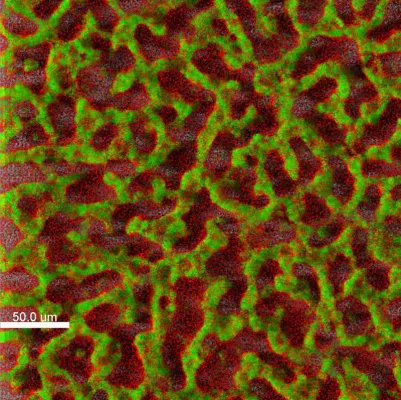
Bild: Silencing bacteria
Pseudomonas aeruginosa bacteria (left) often develop resistance to antibiotics and seek protection from external influences in biofilms. (HZI/Manfred Rohde)

(openPR) HZI researchers pave the way for new agents that render hospital pathogens mute

---
Pathogenic bacteria are becoming resistant to common antibiotics to an ever increasing degree. One of the most difficult germs is Pseudomonas aeruginosa, a pathogen that elicits serious infections in humans and is resistant to a range of antibiotics. Researchers are therefore actively looking for targets for alternative agents that attenuate the bacteria. Pseudomonads can survive in so-called biofilms, which are dense constructs in which the individual bacteria are protected from the immune system and medications. In order to be able to produce a biofilm, the bacteria first have to communicate with each other by means of chemical signals. Scientists from the Helmholtz Centre for Infection Research (HZI) in Braunschweig determined the three-dimensional structure of a protein that is involved in the production of the signalling molecules. Based on this structure, it is now possible to model perfectly fitting inhibitory substances that interrupt the signalling pathway to render the bacteria "mute". The scientists published their results in the international journal ChemBioChem.


In a way, bacteria do talk to each other. They do not communicate by words, but rather by chemical signals. This allows them, for example, to coordinate the penetration into a host or their proliferation. This special type of communication is called "quorum sensing". The term, "quorum", originates from the time of the Roman Empire and corresponds to the smallest number of Senate members needed to win a vote. Pseudomonads use this system to trigger the production of biofilms, whereby the individual bacteria release signalling molecules and measure how many of their kind are in their vicinity at any given time. Once a threshold is exceeded, they commence their attack. After the pseudomonads have aggregated into a biofilm, they are very difficult to eradicate – by the immune system or by medications alike, because even antibiotics are often ineffective against pathogens in biofilms. However, the bacterial communication system that contributes to the production of biofilm offers a suitable point of attack for alternative agents: These substances can suppress the communication, effectively making the bacteria remain accessible to the immune system and to antibiotics.

"Conventional antibiotics attack vital processes of the bacteria, which kills the bacteria and generates a selection pressure that forces the bacteria to develop resistance to the antibiotics," says Florian Witzgall, who is a doctoral student at the "Structure and Function of Proteins" department of the HZI directed by Prof Wulf Blankenfeldt. "But if an agent only attacks the communication of the bacteria, they stay alive and are only rendered harmless. Presumably, there is a lower pressure to develop resistance."

Bacteria utilise different systems to communicate with each other. Pseudomonas aeruginosa possesses three different communication systems, one of which is specific for this pathogen and is called pqs system (an acronym of Pseudomonas quinolone signal). Approximately ten percent of all genes of Pseudomonas aeruginosa are regulated by intercellular communication and this includes many genes that the bacteria need for infection of a host. "The pqs system is an expedient target for medications, since it is fairly specific for Pseudomonas, it regulates a multitude of processes such as the production of virulence factors or biofilms, and there is no homologous system in humans," says Witzgall. The function of the pqs system is already known in much detail: In multiple steps, a number of proteins produce a signal molecule through which the bacteria communicate with each other and that regulates a multitude of genes, including the infection programme of Pseudomonas, through the activation of a DNA-binding receptor.

The HZI researchers recently looked at the first protein of this production chain and deciphered its three-dimensional structure. They used harmless Escherichia coli bacteria to produce the protein – called PqsA – in the laboratory and then isolated, purified and crystallised the protein. Especially the production of crystals is a protracted process, in the course of which the scientists tested more than 1000 different conditions to get to the desired result. Subsequently, they exposed these protein crystals to X-rays and recorded the diffraction patterns. They calculated the three-dimensional molecular structure of the protein from thousands of diffraction images. In all, the entire process took eight months to complete.

"Based on the elucidated structure, we now know where and how the PqsA protein binds to the starting substance for the later signal molecule," says Wulf Blankenfeldt. "This allows us to specifically design artificial molecules on the computer that firmly bind to PqsA and cannot detach again. This would block its function such that no signal molecules could be produced any longer." The result: The bacteria, lacking the signal molecule, would no longer be able to sense each other – they would basically be deaf and mute. The development of a molecule of this kind is now a task for active-substance research that can be based closely on the results of the structural biologists from the HZI.

The press release and a picture are also available on our website:

Original publication:
Florian Witzgall, Wiebke Ewert, Wulf Blankenfeldt: Structures of the N-terminal domain of PqsA in complex with anthraniloyl- and 6-fluoroanthraniloyl-AMP: substrate activation in Pseudomonas Quinolone Signal (PQS) biosynthesis. ChemBioChem, 2017, DOI: 10.1002/cbic.201700374

Helmholtz Centre for Infection Research:
Scientists at the Helmholtz Centre for Infection Research (HZI) in Braunschweig, Germany, are engaged in the study of different mechanisms of infection and of the body’s response to infection. Helping to improve the scientific community’s understanding of a given bacterium’s or virus’ pathogenicity is key to developing effective new treatments and vaccines.

Contact:
Susanne Thiele, Press Officer

Dr Andreas Fischer, Editor


Helmholtz Centre for Infection Research
Press and Communications
Inhoffenstr. 7
D-38124 Braunschweig
Germany

Phone: +49 531 6181-1404

Quelle: idw

Diese Pressemeldung wurde auf openPR veröffentlicht.

Verantwortlich für diese Pressemeldung:

News-ID: 968307
 178

Kostenlose Online PR für alle

Jetzt Ihren Pressetext mit einem Klick auf openPR veröffentlichen

Jetzt gratis starten

Pressebericht „Silencing bacteria“ bearbeiten oder mit dem "Super-PR-Sparpaket" stark hervorheben, zielgerichtet an Journalisten & Top50 Online-Portale verbreiten:

PM löschen PM ändern
Disclaimer: Für den obigen Pressetext inkl. etwaiger Bilder/ Videos ist ausschließlich der im Text angegebene Kontakt verantwortlich. Der Webseitenanbieter distanziert sich ausdrücklich von den Inhalten Dritter und macht sich diese nicht zu eigen. Wenn Sie die obigen Informationen redaktionell nutzen möchten, so wenden Sie sich bitte an den obigen Pressekontakt. Bei einer Veröffentlichung bitten wir um ein Belegexemplar oder Quellenennung der URL.

Pressemitteilungen KOSTENLOS veröffentlichen und verbreiten mit openPR

Stellen Sie Ihre Medienmitteilung jetzt hier ein!

Jetzt gratis starten

Weitere Mitteilungen von Helmholtz-Zentrum für Infektionsforschung

Bild: Neues Epidemie-Management-System bekämpft Affenpocken-Ausbruch in NigeriaBild: Neues Epidemie-Management-System bekämpft Affenpocken-Ausbruch in Nigeria
Neues Epidemie-Management-System bekämpft Affenpocken-Ausbruch in Nigeria
Mobiles System ermöglicht in entlegenen Regionen frühzeitige Schutzmaßnahmen gegen Epidemien – Wanka: „Deutsche Forschung trägt dazu bei, globale gesundheitliche Herausforderungen zu lösen“ --- Mit einem neuen mobilen Informationssystem bekämpfen deutsche Wissenschaftler vom Braunschweiger Helmholtz-Zentrum für Infektionsforschung (HZI) und dem Deutschen Zentrum für Infektionsforschung (DZIF) sowie nigerianische Forscher erstmals einen Affenpocken-Ausbruch in Nigeria. Seit September 2017 hat sich die Epidemie von Affenpocken mit bislang 128 …
Bild: Bakterielle Biofilme detektieren und bekämpfenBild: Bakterielle Biofilme detektieren und bekämpfen
Bakterielle Biofilme detektieren und bekämpfen
HIPS-Forscher haben ein Molekül hergestellt, das Infektionen mit Pseudomonaden im Körper sichtbar machen kann --- Der Problemkeim Pseudomonas aeruginosa kann schwere Infektionen in verschiedenen Organen des menschlichen Körpers auslösen. Besonders gefährlich wird es, wenn sich die Bakterien zu Biofilmen zusammenlagern: So entziehen sie sich nicht nur Angriffen des Immunsystems, sondern schützen sich sogar vor der Wirkung von Antibiotika. Die Folge ist eine kaum behandelbare chronische Infektion. Wissenschaftler des Helmholtz-Instituts für Ph…

Das könnte Sie auch interessieren:

Medikamente jetzt revolutionär anders entwickeln: Wirksam bei den meisten bekannten Krankheiten
… Innsbruck ansässige Unternehmen mit zahlreichen chemischen und pharmazeutischen Alleinstellungsmerkmalen nutzt die zugeflossenen Finanzmittel zunächst, um ihre neuartigen Gene-Silencing-Wirkstoffe, die sogenannten Ugimere, hinsichtlich relevanter pharmazeutischer und therapeutischer Parameter zu validieren. Die UGICHEM Gesellschaft für organische Chemie …
KI-Zwillinge und mikro-RNAs: Zwei ERC Advanced Grants für LMU-Forscher
… einleitet. Damit entdeckte Weber eine völlig neue Funktion von mikro-RNAs, von denen man bis dahin annahm, dass sie typischerweise im Zytoplasma agieren und in einem Silencing-Komplex Boten-RNAs unterdrücken oder abbauen. Vermittelt wird der neue Signalweg durch das RNA-bindende Protein MEX3A, das nun im Fokus von Webers ERC-Projekt MONOFUN-CV steht.In seinem …
Bild: How cells hack their own genesBild: How cells hack their own genes
How cells hack their own genes
… active in germ cells and utilizes small snippets of RNA—so called piRNAs—which fit like mirror images onto the transcripts of selfish sequences and thereby initiate silencing with their associated Argonaut proteins. The Brennecke lab at IMBA has been rigorously exploring these RNA-based self-defense mechanisms in fruit flies, using cutting-edge next …
Bild: Mutter-Gen aktiv - Vater-Gen stillgelegt.Bild: Mutter-Gen aktiv - Vater-Gen stillgelegt.
Mutter-Gen aktiv - Vater-Gen stillgelegt.
… Entdeckung des ersten geprägten Gens in Säugetieren, das für den „Insulin-like Growth Factor Typ-2“ (IGF2R)-Rezeptor kodiert. Das von ihr entdeckte Prinzip des „epigenetic silencing“ mit langen, nichtkodierenden RNA-Molekülen stellte sich später als wichtiger Mechanismus der Genregulation heraus. Denise Barlow erhielt für ihre Forschung zahlreiche Preise und …
Wie sich das embryonale Epigenom selbst organisiert
… Differenzierung von Stammzellen oder bei der Entstehung von Krankheiten, die mit epigenetischen Veränderungen einhergehen. Insbesondere die frühe Vorhersagbarkeit von Genstilllegungen (Gene Silencing) eröffnet neue Perspektiven für die regenerative Medizin und die Krebsforschung.Die Studie zeigt aber auch, wie eng Biologie und Physik miteinander verknüpft …
Hautkrebs - Bekämpfung an zwei Fronten gleichzeitig
… Nature Medicine, published online: 02.11.08; doi: 10.1038/nm1887 Hendrik Poeck, Robert Besch, Cornelius Maihoefer, Marcel Renn, et al. 5´-triphosphate-siRNA: turning gene silencing and Rig-I activation against melanoma Interviewpartner auf Anfrage! Infokasten: Malignes Melanom Am Malignen Melanom - dem Schwarzen Hautkrebs - erkranken in Deutschland …
Neurobiologie - Die Chemie der Erinnerung
… schließt Kiebler. „Dieser Ansatz ermöglicht uns völlig neue Einblicke in die molekularen Mechanismen des Lernens.“ Genome Biology 2017 Publikation: Forebrain specific, conditional silencing of Staufen2 alters synaptic plasticity, learning and memory in rats Stefan M. Berger, Iván Fernández-Lamo, Kai Schönig, Sandra M. Fernández Moya, Janina Ehses, …
Krebs-Gene bald abschaltbar?
… operativen Eingriffen, Bestrahlungen und Chemotherapie. Auch wenn oft erfolgreich, ziehen diese Methoden auch gesundes Gewebe in Mitleidenschaft. Die RNA-Interferenz oder auch Gen-Silencing (Gen-Stilllegung) könnte hier Abhilfe schaffen und schwere Nebenwirkungen vermeiden. Die mit dem Nobelpreis ausgezeichnete Methode wurde in den 1990er Jahren entwickelt. …
Bild: RNA-Interferenz: Entscheidungsprozesse auf molekularer EbeneBild: RNA-Interferenz: Entscheidungsprozesse auf molekularer Ebene
RNA-Interferenz: Entscheidungsprozesse auf molekularer Ebene
… Department für Biochemie der Universität Wien: "Ein entscheidender Schritt der RNA-Interferenz ist die Bindung der zu eliminierenden RNA durch den so genannten RISC, den RNA-Induced Silencing Complex. Über die anschließende Zerstörung der Ziel-RNA durch den RISC weiß man recht viel – über die davor erfolgende Entscheidung, welche RNA gebunden wird und …
Anfeindungen gehören für viele Parlamentsmitglieder zum Alltag
… Anfeindungen. Im Vergleich zu Männern und Mehrheitsangehörigen meiden sie deutlich häufiger öffentliche Auftritte, um Anfeindungen zu entgehen – ein Phänomen, das als «Silencing» bezeichnet wird. «Das kann die politische Teilhabe und Sichtbarkeit bestimmter Gruppen verringern – mit möglichen Folgen für ihre Repräsentation und die demokratische Teilhabe …
Sie lesen gerade: Silencing bacteria