openPR Recherche & Suche
Presseinformation

Researchers discover Achilles' heel of bacteria

03.08.201721:00 UhrWissenschaft, Forschung, Bildung
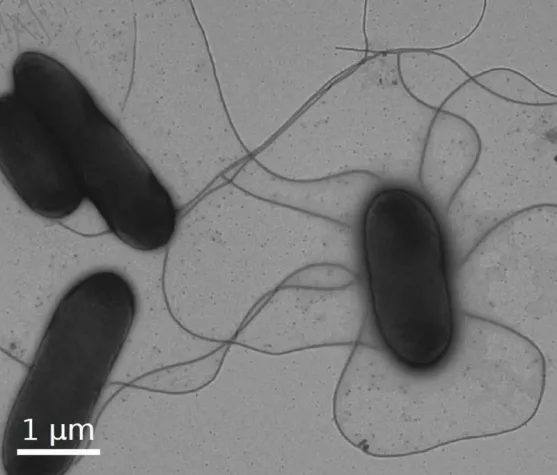
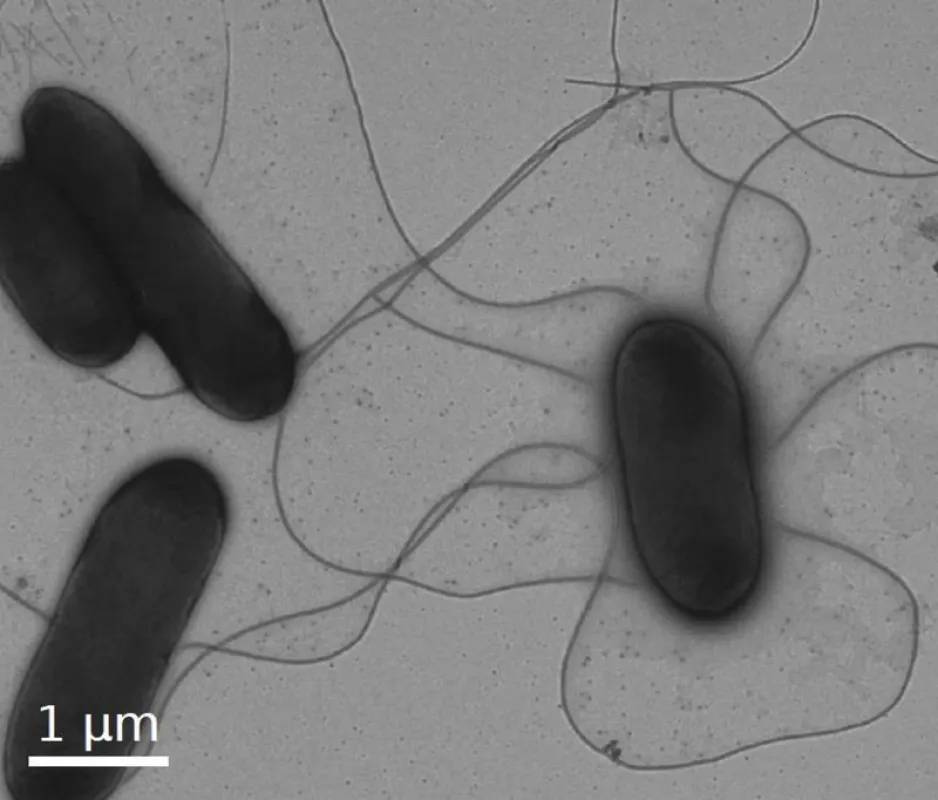
Bild: Researchers discover Achilles' heel of bacteria
Salmonella and many other bacteria use long filaments - so-called flagella - for directed movement. (HZI/Manfred Rohde)

(openPR) HZI researchers identify a protein in Salmonella that contributes to the assembly of the motility apparatus – a possible target for novel medications

---
Salmonellae are particularly resistant to antibiotics since they possess not only one, but two membranes that protect them from harmful substances. This makes them members of the so-called Gram-negative bacteria. Since Salmonella infections are becoming increasingly difficult to treat with antibiotics, researchers are looking for alternative agents to control these pathogens. One possible target is the motility apparatus of the bacteria: Many Gram-negative bacteria produce long filaments – so-called flagella, which they make rotate in order to move in a directed manner. In the absence of intact flagella, the bacteria cannot move towards food sources or preferred sites of infection in the host – in effect, they would no longer be infectious. Scientists of the Helmholtz Centre for Infection Research (HZI) in Braunschweig and their partners have discovered that a certain protein organises the first steps of the assembly of the flagellum. Once this protein was turned off, the bacteria were no longer able to produce flagella and would therefore be impaired in infecting a host. The scientists published their results in PLOS Biology.


In their search for food or a suitable host, many bacteria produce flagella – i.e. long filaments made up of thousands of proteins that the bacteria can use like a propeller for targeted movement. An early step in the production of a new flagellum is that various components in the cell membrane jointly form a pore from which the flagellum then grows. This pore functions as a protein channel and is the central component of a complicated, widespread protein transport system – the so-called type III secretion system. This complex system is responsible for transport of the building blocks of the flagellum and also in a needle-like structure that is found in many pathogenic bacteria: This molecular syringe is used by pathogenic bacteria to inject toxins into host cells during an infection, which makes the host cells die. Researchers suspect that the layout of the syringe apparatus has developed from the flagellum in the course of evolution.

Both flagella and the molecular syringes are tools the bacteria need for successful infection. "If we managed to switch these tools off, the bacteria would be harmless to humans," says Dr Marc Erhardt, who is the head of the "Infection Biology of Salmonella" Young Investigator group at the HZI. Working collaboratively with cooperation partners from the University of Osnabrück, the Max-Planck-Institute for Infection Biology, the University of Tübingen and the German Center for Infection Research, Erhardt's team has studied the assembly process of flagella in detail using Salmonella enterica bacteria. "Many different proteins contribute to the assembly of the initial pore of the type III secretion system, but their individual role was not known," says Erhardt.

To start out, the researchers used fluorescent dyes to visualise the sites at which the different proteins reside. They noticed that one of the contributing proteins, abbreviated FliO, does not permanently reside at the anchoring of the flagellum. It moves freely in the cell membrane and migrates to the proper site only when a new pore is initiated. Then it forms a complex with the FliP protein, which is the major component of the protein channel. In one experiment, the researchers switched off the genetic information for FliO in the Salmonellae. The result: The bacteria were no longer able to produce functional pores and therefore no flagellum either. "Since the FliO protein itself is not a component of the pore, it appears to work more like an organiser: It helps other proteins to combine correctly for assembly of the pore," Marc Erhardt says.

In further studies, the researchers showed that the FliP protein formed complexes even without the FliO organiser. But these were disordered such that no further components could be added to the pore – and, ultimately, the complexes were discarded. Since FliO helps the individual FliP proteins form complexes correctly, it functions as a so-called chaperone. "This function of FliO was not known before," Erhardt says. It opens new targets for future agents that might be used against a whole range of pathogenic bacteria.

"An agent that prevents the formation of the pores of type III secretion systems would be a double success," Marc Erhardt says. "It would hit bacteria that produce flagella and also those that use molecular syringes." For example, Salmonellae, Escherichia coli, Yersinia and Pseudomonads are typical Gram-negative pathogens that use a syringe apparatus to infect their host. In contrast, bacteria of the genera, Campylobacter and Helicobacter, which cause intestinal and gastric diseases, do not possess molecular syringes. But they do form flagella and are therefore also a target for an alternative agent. "Another advantage of this type of agent as compared to an antibiotic would be that the pathogens stay alive and are therefore not under any pressure to develop resistance against the substance," says Erhardt. "In addition, the useful bacteria in the body would also survive."

The press release and a picture are also available on our website:

Original publication:
Florian D. Fabiani, Thibaud T. Renault, Britta Peters, Tobias Dietsche, Eric J.C. Gálvez, Alina Guse, Karen Freier, Emmanuelle Charpentier, Till Strowig, Mirita Franz-Wachtel, Boris Macek, Samuel Wagner, Michael Hensel, Marc Erhardt: A flagellum-specific chaperone facilitates assembly of the core type III export apparatus of the bacterial flagellum. PLOS Biology, 2017, DOI: 10.1371/journal.pbio.2002267

Helmholtz Centre for Infection Research:
Scientists at the Helmholtz Centre for Infection Research (HZI) in Braunschweig, Germany, are engaged in the study of different mechanisms of infection and of the body’s response to infection. Helping to improve the scientific community’s understanding of a given bacterium’s or virus’ pathogenicity is key to developing effective new treatments and vaccines.

Contact:
Susanne Thiele, Press Officer

Dr Andreas Fischer, Editor


Helmholtz Centre for Infection Research
Press and Communication
Inhoffenstr. 7
D-38124 Braunschweig
Germany

Phone: +49 531 6181-1404

Quelle: idw

Diese Pressemeldung wurde auf openPR veröffentlicht.

Verantwortlich für diese Pressemeldung:

News-ID: 962105
 565

Kostenlose Online PR für alle

Jetzt Ihren Pressetext mit einem Klick auf openPR veröffentlichen

Jetzt gratis starten

Pressebericht „Researchers discover Achilles' heel of bacteria“ bearbeiten oder mit dem "Super-PR-Sparpaket" stark hervorheben, zielgerichtet an Journalisten & Top50 Online-Portale verbreiten:

PM löschen PM ändern
Disclaimer: Für den obigen Pressetext inkl. etwaiger Bilder/ Videos ist ausschließlich der im Text angegebene Kontakt verantwortlich. Der Webseitenanbieter distanziert sich ausdrücklich von den Inhalten Dritter und macht sich diese nicht zu eigen. Wenn Sie die obigen Informationen redaktionell nutzen möchten, so wenden Sie sich bitte an den obigen Pressekontakt. Bei einer Veröffentlichung bitten wir um ein Belegexemplar oder Quellenennung der URL.

Pressemitteilungen KOSTENLOS veröffentlichen und verbreiten mit openPR

Stellen Sie Ihre Medienmitteilung jetzt hier ein!

Jetzt gratis starten

Weitere Mitteilungen von Helmholtz-Zentrum für Infektionsforschung

Bild: Neues Epidemie-Management-System bekämpft Affenpocken-Ausbruch in Nigeria
Neues Epidemie-Management-System bekämpft Affenpocken-Ausbruch in Nigeria
Mobiles System ermöglicht in entlegenen Regionen frühzeitige Schutzmaßnahmen gegen Epidemien – Wanka: „Deutsche Forschung trägt dazu bei, globale gesundheitliche Herausforderungen zu lösen“ --- Mit einem neuen mobilen Informationssystem bekämpfen deutsche Wissenschaftler vom Braunschweiger Helmholtz-Zentrum für Infektionsforschung (HZI) und dem Deutschen Zentrum für Infektionsforschung (DZIF) sowie nigerianische Forscher erstmals einen Affenpocken-Ausbruch in Nigeria. Seit September 2017 hat sich die Epidemie von Affenpocken mit bislang 128 …
Bild: Bakterielle Biofilme detektieren und bekämpfenBild: Bakterielle Biofilme detektieren und bekämpfen
Bakterielle Biofilme detektieren und bekämpfen
HIPS-Forscher haben ein Molekül hergestellt, das Infektionen mit Pseudomonaden im Körper sichtbar machen kann --- Der Problemkeim Pseudomonas aeruginosa kann schwere Infektionen in verschiedenen Organen des menschlichen Körpers auslösen. Besonders gefährlich wird es, wenn sich die Bakterien zu Biofilmen zusammenlagern: So entziehen sie sich nicht nur Angriffen des Immunsystems, sondern schützen sich sogar vor der Wirkung von Antibiotika. Die Folge ist eine kaum behandelbare chronische Infektion. Wissenschaftler des Helmholtz-Instituts für Ph…

Das könnte Sie auch interessieren:

„Crazy und cool“
„Crazy und cool“
Bei dem Gestaltungswettbewerb der Achilles Gruppe können kreative Köpfe und ambitionierte Medienproduktioner ein Stipendium zur Weiterbildung „Geprüfter Medienproduktioner/f:mp.®“ - Schwerpunkt DRUCKVEREDELUNG gewinnen. Die Achilles Gruppe, der führende Papierveredler und Entwickler von innovativen Präsentationsprodukten, startet unter dem Motto „crazy …
Bild: Drei Stipendien für drei kreative IdeenBild: Drei Stipendien für drei kreative Ideen
Drei Stipendien für drei kreative Ideen
… Thema „Es fühlt sich an, wie echt!“ förderte die Kreativität. Beim Wettbewerb zur Vergabe von Stipendien zum „Geprüfter Medienproduktioner/f:mp.®“ Schwerpunkt DRUCKVEREDELUNG der Werner Achilles GmbH & Co. KG gab es gleich drei Gewinner. Als Veredelungsexperte ist es für Achilles ein wichtiges Anliegen, Kreativität zu fördern. Deshalb wurden über …
Bild: Wechsel in der Chefetage - Karriere-Portal Jobware beruft neuen GeschäftsführerBild: Wechsel in der Chefetage - Karriere-Portal Jobware beruft neuen Geschäftsführer
Wechsel in der Chefetage - Karriere-Portal Jobware beruft neuen Geschäftsführer
Paderborn, 1. Februar 2007 - Der Gründer und vormalige Vorstandsvorsitzende der refline AG, Dr. Wolfgang Achilles, ist zum neuen Geschäftsführer der Jobware Online-Service GmbH berufen worden. In dieser Funktion tritt er die Nachfolge des Jobware-Gründers Dr. Randolph Vollmer an, der am 1. Mai 2007 - dem elfjährigen Firmenjubiläum von Jobware - auf eigenen …
Bild: VOM FASS Erfolgs-Showküche geht in die vierte Runde
VOM FASS Erfolgs-Showküche geht in die vierte Runde
Am 13.09.2015 findet ein weiteres Event der „VOM FASS Stars- und Sterneküche“ mit Spitzenkoch Daniel Achilles statt Hamburg, im Juli 2015 Die Erfolgsreihe geht weiter: Nachdem bereits Frank Oehler, Stefan Hermann und Tim Raue in der VOM FASS Showküche ihre Kochkünste unter Beweis stellen konnten, kommt jetzt Daniel Achilles, deutscher Spitzenkoch, in …
Bild: Wenn eine Sache Anklang findet - „DRUCKSACHE“ von Annette Bierwirth in der artisanGalerie Achilles
Wenn eine Sache Anklang findet - „DRUCKSACHE“ von Annette Bierwirth in der artisanGalerie Achilles
[Kassel, artisan e. V.] Bis zum 15. März 2013 gibt es in der artisanGalerie Achilles noch eine tolle Ausstellung zu entdecken: DRUCKSACHE von Annette Bierwirth. Darin zu sehen ist auch das Werk „Das Urteil des Paris“, eine Hommage an den Ausstellungsort. Die Gäste wissen den künstlerisch-kulinarischen Rahmen der artisanGalerie Achilles ebenfalls zu schätzen. …
Bild: Annette Bierwirth: DrucksacheBild: Annette Bierwirth: Drucksache
Annette Bierwirth: Drucksache
[Kassel, artisan e. V.] DRUCKSACHE ist der Titel der dritten Kunstausstellung des sowohl kunst- als auch kulturinitiativ umtriebigen Vereins artisan e. V. in der artisanGalerie Achilles, die am 28.11.2012 um 19.00 Uhr von Brigitte Bergholter, Stadträtin der Stadt Kassel, eröffnet wird. Erneut bietet sich die Möglichkeit, ein kulinarisches Erlebnis mit …
Bild: Dodo Achilles zeigt Grünzeug auf Quadrat im Bio-Hotel MiramarBild: Dodo Achilles zeigt Grünzeug auf Quadrat im Bio-Hotel Miramar
Dodo Achilles zeigt Grünzeug auf Quadrat im Bio-Hotel Miramar
Die zweite Frühjahrsausstellung im Bio-Hotel Miramar im Eiderstedter Tönning zeigt Gemälde der Hamburger Künstlerin Dodo Achilles. Unter dem Titel „Grünzeug auf Quadrat“ präsentiert die Künstlerin ab dem 6. Mai formatgebundene - quadratische – Ölbilder, in denen Themenwelten rund um Gemüse, Obst oder Blüten die Hauptrolle spielen. Mal sind es Einzelporträts, …
Bild: Schutz von Steuerungssystemen vor Stuxnet & Co.
Schutz von Steuerungssystemen vor Stuxnet & Co.
Wind River ist als erster RTOS-Hersteller jetzt Wurldtech Achilles Communications Certification Partner Ismaning, 22. November 2011 - SPS/IPC/DRIVES, Nürnberg, 22. Nov. 2011 -Wind River, Spezialist für embedded und mobile Software, ist offizieller Partner des Wurldtech Achilles Communications Certification Program für den Schutz von Industrieanlagen …
Bild: Schutz von Industrie-Kontrollsystemen vor Cyber-AttackenBild: Schutz von Industrie-Kontrollsystemen vor Cyber-Attacken
Schutz von Industrie-Kontrollsystemen vor Cyber-Attacken
Wind River VxWorks als erstes RTOS für Wurldtech Achilles zertifiziert Ismaning, 14. Juli 2010 - Wind Rivers Echtzeit-Betriebssystem VxWorks in Version 6.8.1 erhält eine Zertifizierung des kanadischen Cyber Security-Spezialisten Wurldtech. Das Wurldtech Achilles-Zertifizierungsprogramm ist international als Standard für industrielle Cyber Security anerkannt. …
Bild: Lehre auf internationalem Niveau: 17 Auszubildende im Mercure Hotel Garmisch-PartenkirchenBild: Lehre auf internationalem Niveau: 17 Auszubildende im Mercure Hotel Garmisch-Partenkirchen
Lehre auf internationalem Niveau: 17 Auszubildende im Mercure Hotel Garmisch-Partenkirchen
… den höchsten Stand seit der Wiedervereinigung gestiegen ist: Nach Angaben der Bundesagentur für Arbeit (BA) waren im August noch 161 200 Jugendliche ohne Lehrstelle. Marko Achilles ist sich der Verantwortung gegenüber der jungen Generation bewusst: "Gerade in einer Zeit, in der die Wirtschaft über einen Mangel an qualifizierten Fachkräften klagt, müssen …
Sie lesen gerade: Researchers discover Achilles' heel of bacteria