openPR Recherche & Suche
Presseinformation

Electrons surfing on a laser beam

10.10.2017 • 10:00 Uhr • Wissenschaft, Forschung, Bildung

(openPR) The largest particle accelerator in the world – the Large Hadron Collider at CERN in Switzerland – has a circumference of around 26 kilometres. Researchers at Friedrich-Alexander Universität Erlangen-Nürnberg (FAU), Germany, are attempting to go to the other extreme by building the world's smallest machine of this kind – a particle accelerator that fits on a microchip. The research team has now taken another step towards achieving this ambition.


---
The fundamental idea behind the miniature particle accelerator’s development is to enable scientists to use laser beams to accelerate electrons. What sounds deceptively simple in theory raises a whole series of challenges in practice, extending across various fields of physics. For example, the scientists need to be able to control the oscillation of light and the movement of electrons with great precision in order to ensure that they meet each other at just the right moment.

One way of envisaging this is to imagine a ship on a stormy sea; to safely ascend the wave and come down on its other side, the helmsman has to watch the oncoming wave and judge when it will meet the vessel. It is equally crucial for the FAU’s team of scientists to ascertain when and where the maximum crest of a light wave will hit a packet of electrons so that they can influence the outcome to a highly specific degree. This means they need to enable light and electrons to coincide within ‘attoseconds’ – that is, a billionth of a billionth of a second.

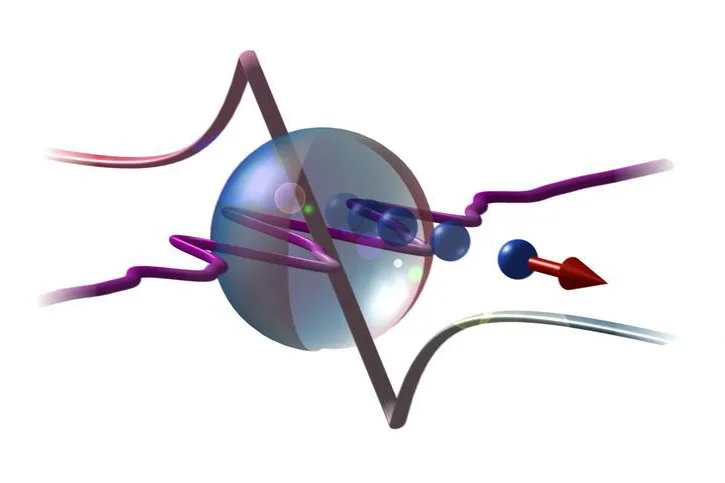
In an exciting first, this is exactly what the research group around FAU’s Prof. Dr. Peter Hommelhoff have succeeded in achieving. The team has developed a new technique involving the intersection of two laser beams oscillating at different frequencies in order to generate an optical field whose properties the researchers can influence to an extremely precise degree. The key property of this optical field is that it retains contact with the electrons, effectively moving with them – hence its being termed a travelling wave – so the electrons can continuously sense, or ‘surf’, the optical field. In this way, the optical field transmits its properties exactly to the particles.

Not only does this process cause the particles to precisely reflect the field structure, it also accelerates them – to a strikingly high degree. This effect is crucial to the miniature particle accelerator’s practical application, as it relates to how much energy can be transferred to the electrons across what distance. The acceleration gradient, which indicates the maximum measured electron energy gain versus distance covered, reaches the extremely high value of 2.2 giga-electron-volts per metre, much higher than that attained by conventional accelerators. However, the acceleration distance of only 0.01 millimetres currently available to the research team in Erlangen is not sufficient for them to generate the energy needed for achieving results of relevance to practical applications. ‘Despite this, for particle accelerators in medicine, we would only need a tiny acceleration length of less than a millimetre,’ explains Dr Martin Kozák, who carried out the laboratory experiment.

Particle accelerator on a microchip

Project lead Prof. Dr. Peter Hommelhoff of the Chair of Laser Physics at FAU considers accelerator miniaturisation to be a technical revolution analogous to the development of computers, which went from occupying entire rooms to fitting on people’s wrists. ‘This approach will hopefully enable us to make this innovative particle acceleration technique usable in a range of research areas and fields of application such as materials science, biology and medicine; one example might be particle therapies for cancer patients.’

In 2015, the FAU researchers teamed up with scientists from Stanford University and eight other international partner institutions in the Accelerator on a Chip International Program (ACHIP). The Gordon and Betty Moore Foundation has generously provided five years’ funding to the project; of the total grant of 13.5 million dollars (approximately 12.5 million euro), 2.44 million dollars (approximately 2.26 million euro) went to FAU.

The research team’s findings have now been published in the leading scientific journal Nature Physics (doi: 10.1038 / nphys4282).

Further information:
Prof. Dr. Peter Hommelhoff
Phone: +49 9131 8527090

E-Mail

Quelle: idw

Diese Pressemeldung wurde auf openPR veröffentlicht.

Verantwortlich für diese Pressemeldung:

News-ID: 973226
 291

Kostenlose Online PR für alle

Jetzt Ihren Pressetext mit einem Klick auf openPR veröffentlichen

Jetzt gratis starten

Pressebericht „Electrons surfing on a laser beam“ bearbeiten oder mit dem "Super-PR-Sparpaket" stark hervorheben, zielgerichtet an Journalisten & Top50 Online-Portale verbreiten:

PM löschen PM ändern
Disclaimer: Für den obigen Pressetext inkl. etwaiger Bilder/ Videos ist ausschließlich der im Text angegebene Kontakt verantwortlich. Der Webseitenanbieter distanziert sich ausdrücklich von den Inhalten Dritter und macht sich diese nicht zu eigen. Wenn Sie die obigen Informationen redaktionell nutzen möchten, so wenden Sie sich bitte an den obigen Pressekontakt. Bei einer Veröffentlichung bitten wir um ein Belegexemplar oder Quellenennung der URL.

Pressemitteilungen KOSTENLOS veröffentlichen und verbreiten mit openPR

Stellen Sie Ihre Medienmitteilung jetzt hier ein!

Jetzt gratis starten

Weitere Mitteilungen von Friedrich-Alexander-Universität Erlangen-Nürnberg

Mit Müsli gegen Arthritis
Dass eine gesunde Ernährung unser allgemeines Wohlbefinden steigert, ist altbekannt. Jetzt haben Forscher der Friedrich-Alexander-Universität Erlangen-Nürnberg (FAU) herausgefunden, dass eine ballaststoffreiche Kost den Krankheitsverlauf von chronisch-entzündlichen Gelenkerkrankungen positiv beeinflussen und zu einer Stärkung der Knochen führen kann. Ihre Ergebnisse haben die Wissenschaftler im renommierten Fachmagazin Nature Communications (DOI: 10.1038/s41467-017-02490-4) veröffentlicht. --- Schlüssel für die Wirkung unserer Ernährung auf …
„Kulturhauptstädte in Europa“: Brückenbauer oder Marketinginstrument?
Können internationale kulturpolitische Initiativen, wie das EU-Programm „Kulturhauptstädte Europas“, ein Gegengewicht zu der derzeit viel beschworenen politischen Krise in der europäischen Union schaffen und Bürgerinnen und Bürgern eine gemeinsame europäische Zugehörigkeit vermitteln? Oder werden die Initiativen als reine Marketinginstrumente und zur Tourismusförderung zweckentfremdet? Kulturgeographen der Friedrich-Alexander-Universität Erlangen-Nürnberg (FAU) erforschen in einem von der Deutschen Forschungsgemeinschaft (DFG) finanziertem Pr…

Das könnte Sie auch interessieren:

Bild: Quantum Sensors Decipher Magnetic Ordering in a New Semiconducting MaterialBild: Quantum Sensors Decipher Magnetic Ordering in a New Semiconducting Material
Quantum Sensors Decipher Magnetic Ordering in a New Semiconducting Material
… kind would consume very little power and operate at very high speeds. They could also be used in spintronics – a new form of electronics that uses electrons’ spin as well as electrical charge. Spiral magnetic ordering Bismuth ferrite is a multiferroic material that exhibits electric and magnetic properties even at room temperature. While its electrical …
Bild: Water – valuable and worth protecting! Accelerated electrons assist in the treatment.
Water – valuable and worth protecting! Accelerated electrons assist in the treatment.
… and will present their fields of expertise for effective water treatment during a workshop on 6th and 7th November 2017 at IPEN, in São Paulo, Brazil: AcEL - ACCELERATED ELECTRONS FOR LIFE --- Our wastewater passes a difficult treatment process with the aim of receiving clean drinking water at the end. However, in a recent press release (see the link …
Bild: Stable magnetic bit of three atomsBild: Stable magnetic bit of three atoms
Stable magnetic bit of three atoms
… information in individual atoms. A particular challenge for the use of such small storage elements was the destabilization of their magnetization by the interaction with the electrons of the substrate they are positioned on. Consequently, the prevalent approach in order to stabilize the magnetization was to strongly decouple the magnetic bit from the …
Bild: Lightwave controlled nanoscale electron acceleration sets the pace
Lightwave controlled nanoscale electron acceleration sets the pace
… from Rostock University, the Max Born Institute in Berlin, the Ludwig-Maxmilians-Universität Munich, and the Max Planck Institute of Quantum Optics in Garching has now shown how electrons can be accelerated in an extreme and well-controlled way with laser light, while crossing a silver particle of just a few nanometers. --- Of particular importance for …
Bild: An international team of physicists a coherent amplification effect in laser excited dielectricsBild: An international team of physicists a coherent amplification effect in laser excited dielectrics
An international team of physicists a coherent amplification effect in laser excited dielectrics
… high intensities that such laser pulses provide, different interaction mechanisms are able to transfer the transparent material into a metallic like state. The created “free” electrons, similar to a metal, play a significant role in the change of the optical properties associated to the excitation of the material. Accordingly, pump-probe experiments, …
Bild: The fastest light-driven current source
The fastest light-driven current source
Controlling electronic current is essential to modern electronics, as data and signals are transferred by streams of electrons which are controlled at high speed. Demands on transmission speeds are also increasing as technology develops. Scientists from the Chair of Laser Physics and the Chair of Applied Physics at Friedrich-Alexander-Universität Erlangen-Nürnberg …
Bild: Describing the behaviour of electrons under extreme conditions for the first time
Describing the behaviour of electrons under extreme conditions for the first time
Electrons are an elementary component of our world: they surround the core of all atoms, are essential to the formation of molecules, and primarily determine the properties of solids and liquids. They are also the charge carriers of electrical current, without which our high-tech environment with smartphones, computers and even the traditional light …
Bild: Nanomagnets Levitate Thanks to Quantum Physics
Nanomagnets Levitate Thanks to Quantum Physics
… despite Earnshaw’s theorem, nanomagnets can be stably levitated in an external static magnetic field owing to quantum mechanical principles. The quantum angular momentum of electrons, which also causes magnetism, is accountable for this mechanism. --- Already in 1842, British mathematician Samuel Earnshaw proved that there is no stable configuration of …
Bild: Physicists find strange state of matter in superconducting crystalBild: Physicists find strange state of matter in superconducting crystal
Physicists find strange state of matter in superconducting crystal
New research published this week shows a rare state of matter in which electrons in a superconducting crystal organize collectively. The findings lay the groundwork for answering one of the most compelling questions in physics: How do correlated electron systems work, and are they related to one another? --- The paper, Electronic in-plane symmetry breaking …
Bild: Wasser – wertvoll und schützenswert! Beschleunigte Elektronen helfen bei der Aufbereitung.
Wasser – wertvoll und schützenswert! Beschleunigte Elektronen helfen bei der Aufbereitung.
… Kompetenzen zur effektiven Abwasserbehandlung in einem Workshop am 6. und 7. November 2017, am IPEN, in São Paulo, Brasilien vor: AcEL - ACCELERATED ELECTRONS FOR LIFE. --- Unser Abwasser durchläuft einen komplizierten Klärungsprozess an dessen Ende sauberes Trinkwasser stehen sollte. Der Verband kommunaler Unternehmen (VKU) stellte in einer aktuellen …
Sie lesen gerade: Electrons surfing on a laser beam