
openPR Recherche & Suche
Presseinformation

Nanomagnets Levitate Thanks to Quantum Physics

27.10.201709:00 UhrWissenschaft, Forschung, Bildung
Bild: Nanomagnets Levitate Thanks to Quantum Physics
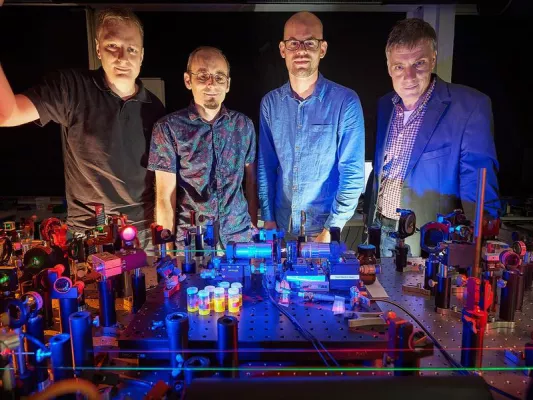
Cosimo Rusconi (l.) and Oriol Romero-Isart (r.) play with a levitron to illustrate their work on nanomagnets. (IQOQI Innsbruck/M.R.Knabl)

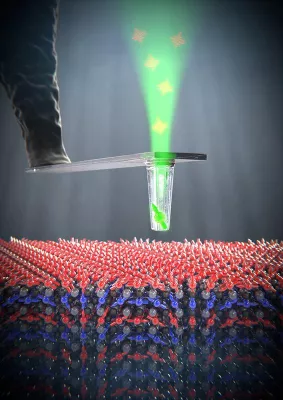
(openPR) Quantum physicists in Oriol Romero-Isart’s research group in Innsbruck show in two current publications that, despite Earnshaw’s theorem, nanomagnets can be stably levitated in an external static magnetic field owing to quantum mechanical principles. The quantum angular momentum of electrons, which also causes magnetism, is accountable for this mechanism.


---
Already in 1842, British mathematician Samuel Earnshaw proved that there is no stable configuration of levitating permanent magnets. If one magnet is levitated above another, the smallest disturbance will cause the system to crash. The magnetic top, a popular toy, circumvents the Earnshaw theorem: When it is disturbed, the gyrating motion of the top causes a system correction and stability is maintained. In collaboration with researchers from the Max Planck Institute for Quantum Optics, Munich, physicists in Oriol Romero-Isart’s research group at the Institute for Theoretical Physics, Innsbruck University, and the Institute for Quantum Optics and Quantum Information, Austrian Academy of Sciences, have now shown that: “In the quantum world, tiny non-gyrating nanoparticles can stably levitate in a magnetic field.” “Quantum mechanical properties that are not noticeable in the macroscopic world but strongly influence nano objects are accountable for this phenomenon,” says Oriol Romero-Isart.

Stability caused by gyromagnetic effect

Albert Einstein and Dutch physicist Wander Johannes de Haas discovered in 1915 that magnetism is the result of quantum mechanical principles: the quantum angular momentum of electrons, or so-called electron spin. Physicists in Oriol Romero-Isart’s research group have now shown that electron spin allows the stable levitation of a single nanomagnet in a static magnetic field, which should be impossible according to the classic Earnshaw theorem. The theoretical physicists carried out comprehensive stability analyses depending on the object’s radius and the strength of the external magnetic field. The results showed that, in the absence of dissipation, a state of equilibrium appears. This mechanism relies on the gyromagnetic effect: Upon a change in direction of the magnetic field, an angular momentum occurs because the magnetic moment couples with the spin of the electrons. “This stabilizes the magnetic levitation of the nanomagnet,” explains first author Cosimo Rusconi. In addition, the researchers showed that the equilibrium state of magnetically levitated nanomagnets exhibits entanglement of its degrees of freedom.

New field of research

Oriol Romero-Isart and his team are optimistic that these levitated nanomagnets can soon be observed experimentally. They have made suggestions on how this could be achieved under realistic conditions. Levitated nanomagnets are a new experimental research field for physicists. Studies of nanomagnets under unstable condition could lead to the discovery of exotic quantum phenomena. In addition, after coupling several nanomagnets, quantum nano magnetism could be simulated and studied experimentally. Levitated nanomagnets are also of high interest for technical applications, for example for developing high precision sensors.

The research was supported by the Austrian Federal Ministry of Science, Research, and Economy (BMWFW) and the European Research Council (ERC).

Pubications:
o) Quantum Spin Stabilized Magnetic Levitation. Cosimo C. Rusconi, Vera Pöchhacker, Katja Kustura, J. Ignacio Cirac, Oriol Romero-Isart. Phys. Rev. Lett. 119, 167202 DOI: 10.1103/PhysRevLett.119.167202
o) Linear Stability Analysis of a Levitated Nanomagnet in a Static Magnetic Field: Quantum Spin Stabilized Magnetic Levitation. Cosimo C. Rusconi, Vera Pöchhacker, J. Ignacio Cirac, Oriol Romero-Isart. Phys. Rev. B 96, 134419 DOI: 10.1103/PhysRevB.96.134419

Contact:
Oriol Romero-Isart
Department of Theoretical Physics
University of Innsbruck
phone: +43 512 507 4730
email: E-Mail

Christian Flatz
Public Relations Office
University of Innsbruck
phone: +43 512 507 32022
email: E-Mail

Weitere Informationen:
- http://dx.doi.org/10.1103/PhysRevLett.119.167202 - Quantum Spin Stabilized Magnetic Levitation. Cosimo C. Rusconi, et.al. Phys. Rev. Lett. 119, 167202
- http://dx.doi.org/10.1103/PhysRevB.96.134419 - Linear Stability Analysis of a Levitated Nanomagnet in a Static Magnetic Field: Quantum Spin Stabilized Magnetic Levitation. Cosimo C. Rusconi, et.al. Phys. Rev. B 96, 134419
- http://iqoqi.at/en/group-page-romero-isart - Quantum Nanophysics, Optics and Information Group

Quelle: idw

Diese Pressemeldung wurde auf openPR veröffentlicht.

Verantwortlich für diese Pressemeldung:

News-ID: 976942
 768

Kostenlose Online PR für alle

Jetzt Ihren Pressetext mit einem Klick auf openPR veröffentlichen

Jetzt gratis starten

Pressebericht „Nanomagnets Levitate Thanks to Quantum Physics“ bearbeiten oder mit dem "Super-PR-Sparpaket" stark hervorheben, zielgerichtet an Journalisten & Top50 Online-Portale verbreiten:

PM löschen PM ändern
Disclaimer: Für den obigen Pressetext inkl. etwaiger Bilder/ Videos ist ausschließlich der im Text angegebene Kontakt verantwortlich. Der Webseitenanbieter distanziert sich ausdrücklich von den Inhalten Dritter und macht sich diese nicht zu eigen. Wenn Sie die obigen Informationen redaktionell nutzen möchten, so wenden Sie sich bitte an den obigen Pressekontakt. Bei einer Veröffentlichung bitten wir um ein Belegexemplar oder Quellenennung der URL.

Pressemitteilungen KOSTENLOS veröffentlichen und verbreiten mit openPR

Stellen Sie Ihre Medienmitteilung jetzt hier ein!

Jetzt gratis starten

Weitere Mitteilungen von Universität Innsbruck

Bild: Peter Zoller erhält Lamb-AwardBild: Peter Zoller erhält Lamb-Award
Peter Zoller erhält Lamb-Award
In dieser Woche wird Quanten-Vordenker Peter Zoller in den USA mit den 2018 Willis Lamb Award for Laser Physics and Quantum Optics ausgezeichnet. Die Verleihung findet am Mittwoch im Rahmen des Winterkolloquiums der Physics-of-Quantum-Electronics-Konferenz in Snowbird, Utah, statt. Neben Zoller werden auch der Chinese Jian-Wei Pan und der Deutsche Ernst Rasel ausgezeichnet. --- Die Auszeichnung ist nach dem amerikanischen Physik-Nobelpreisträger Willis Eugene Lamb, Jr. benannt, der auf zahlreichen Gebieten der Physik und Technologie wesentli…
Bild: Mit nachgebauten Naturstoffen gegen BakterienBild: Mit nachgebauten Naturstoffen gegen Bakterien
Mit nachgebauten Naturstoffen gegen Bakterien
Mit chemisch nachgebauten Naturstoffen will Thomas Magauer von der Universität Innsbruck Mittel gegen die weltweit zunehmenden Antibiotikaresistenzen finden. Biologische Analysen einer Gruppe von erstmals systematisch hergestellten Molekülen zeigen eine vielversprechende Wirkung zum Beispiel gegen die multiresistenten MRSA-Keime. Die synthetisch erzeugten Wirkstoffe lassen sich zudem chemisch weiter optimieren. --- Durch den ungehemmten Einsatz von Antibiotika entwickeln Krankheitskeime immer häufiger Resistenzen. Seit der Entdeckung von Pen…

Das könnte Sie auch interessieren:

Bild: High-speed Quantum Memory for PhotonsBild: High-speed Quantum Memory for Photons
High-speed Quantum Memory for Photons
Physicists from the University of Basel have developed a memory that can store photons. These quantum particles travel at the speed of light and are thus suitable for high-speed data transfer. The researchers were able to store them in an atomic vapor and read them out again later without altering their quantum mechanical properties too much. This memory …
Two physics professors to join IST Austria
… experimental physicists Onur Hosten and Zhanybek Alpichshev who will join in February and August, respectively. Onur Hosten’s research is focused on atomic and optical physics and quantum measurement techniques. He obtained his PhD from the University of Illinois at Urbana-Champaign and is currently based at Stanford University. Zhanybek Alpichshev, who is an …
Bild: Ions in the spotlightBild: Ions in the spotlight
Ions in the spotlight
… temperature to rise by a factor of 10,000. Although this is still barely a thousandth of a degree Celsius above absolute zero, it already leads to heat death for sensitive quantum effects. This is where the method that the group has been developing for its objectives since 2010 comes in: optical trapping of charged atoms. An extremely bright laser is used …
Bild: Peter Zoller erhält Lamb-AwardBild: Peter Zoller erhält Lamb-Award
Peter Zoller erhält Lamb-Award
In dieser Woche wird Quanten-Vordenker Peter Zoller in den USA mit den 2018 Willis Lamb Award for Laser Physics and Quantum Optics ausgezeichnet. Die Verleihung findet am Mittwoch im Rahmen des Winterkolloquiums der Physics-of-Quantum-Electronics-Konferenz in Snowbird, Utah, statt. Neben Zoller werden auch der Chinese Jian-Wei Pan und der Deutsche Ernst …
Bild: Exotic quantum states made from light: Physicists create optical “wells” for a super-photonBild: Exotic quantum states made from light: Physicists create optical “wells” for a super-photon
Exotic quantum states made from light: Physicists create optical “wells” for a super-photon
… light of a Bose-Einstein condensate flows. The creation of such highly low-loss structures for light is a prerequisite for complex light circuits, such as for quantum information processing for a new generation of computers. The researchers are now presenting their results in the journal Nature Photonics. --- Light particles (photons) occur as tiny, …
Bild: Mikhail Lemeshko of IST Austria wins Ludwig Boltzmann PrizeBild: Mikhail Lemeshko of IST Austria wins Ludwig Boltzmann Prize
Mikhail Lemeshko of IST Austria wins Ludwig Boltzmann Prize
… greatly simplifies these calculations is the angulon, a quasiparticle that Mikhail Lemeshko and a collaborator introduced in 2015 (see: “Quantum rotors in a quantum bath”, http://ist.ac.at/en/news-media/news/news-detail/browse/11/article/quantum-rotors-in-a-quantum-bath/6/. In a subsequent paper, which won him the Ludwig Boltzmann Prize and is based …
Bild: Quantum Sensors Decipher Magnetic Ordering in a New Semiconducting MaterialBild: Quantum Sensors Decipher Magnetic Ordering in a New Semiconducting Material
Quantum Sensors Decipher Magnetic Ordering in a New Semiconducting Material
… in a multiferroic material. These materials are considered highly promising candidates for future data storage media. The researchers were able to prove their findings using unique quantum sensors that were developed at Basel University and that can analyze electromagnetic fields on the nanometer scale. The results – obtained by scientists from the University …
Bild: Using Mirrors to Improve the Quality of Light ParticlesBild: Using Mirrors to Improve the Quality of Light Particles
Using Mirrors to Improve the Quality of Light Particles
… the University of Basel’s Department of Physics and the Swiss Nanoscience Institute have succeeded in dramatically improving the quality of individual photons generated by a quantum system. The scientists have successfully put a 10-year-old theoretical prediction into practice. With their paper, published recently in Physical Review X, they have taken …
Bild: Lightwave controlled nanoscale electron acceleration sets the paceBild: Lightwave controlled nanoscale electron acceleration sets the pace
Lightwave controlled nanoscale electron acceleration sets the pace
… table-top free-electron lasers. A german team of physicists from Rostock University, the Max Born Institute in Berlin, the Ludwig-Maxmilians-Universität Munich, and the Max Planck Institute of Quantum Optics in Garching has now shown how electrons can be accelerated in an extreme and well-controlled way with laser light, while crossing a silver particle …
Riddle of matter remains unsolved: Proton and antiproton share fundamental properties
… collaboration plans to develop further innovative methods over the next few year and improve on the current results. Images:http://www.uni-mainz.de/bilder_presse/08_physik_quantum_BASE_antiprotonen-entschleuniger_CERN.jpg BASE experiment at the CERN antiproton decelerator in Geneva: Visible in the image are the control equipment, the superconducting …
Sie lesen gerade: Nanomagnets Levitate Thanks to Quantum Physics