openPR Recherche & Suche
Presseinformation

High-speed Quantum Memory for Photons

08.09.201712:00 UhrWissenschaft, Forschung, Bildung
Bild: High-speed Quantum Memory for Photons
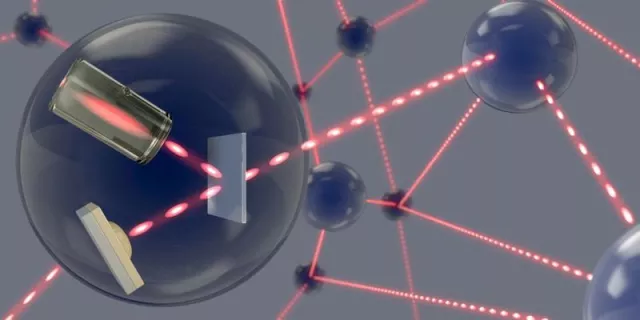
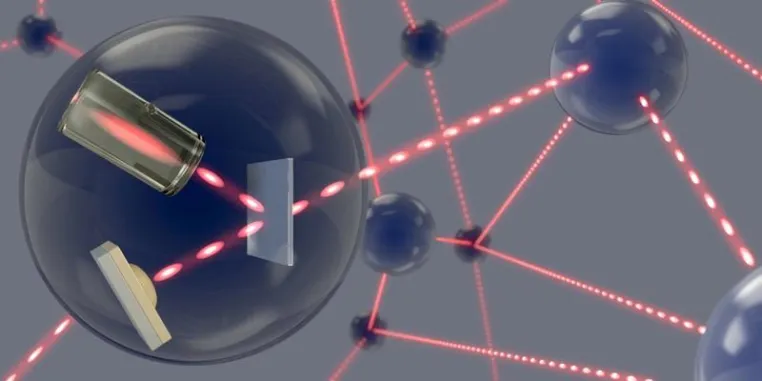
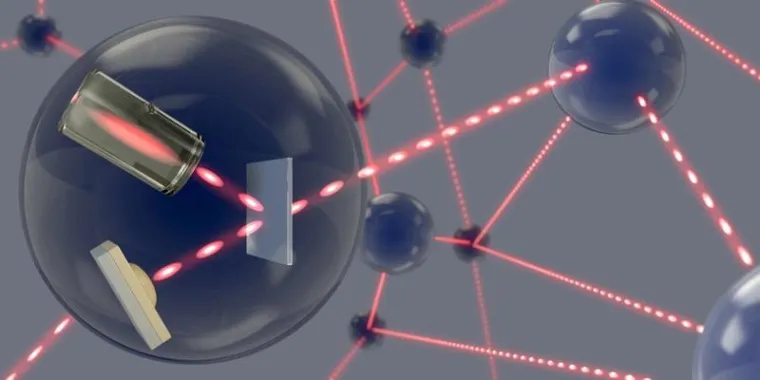
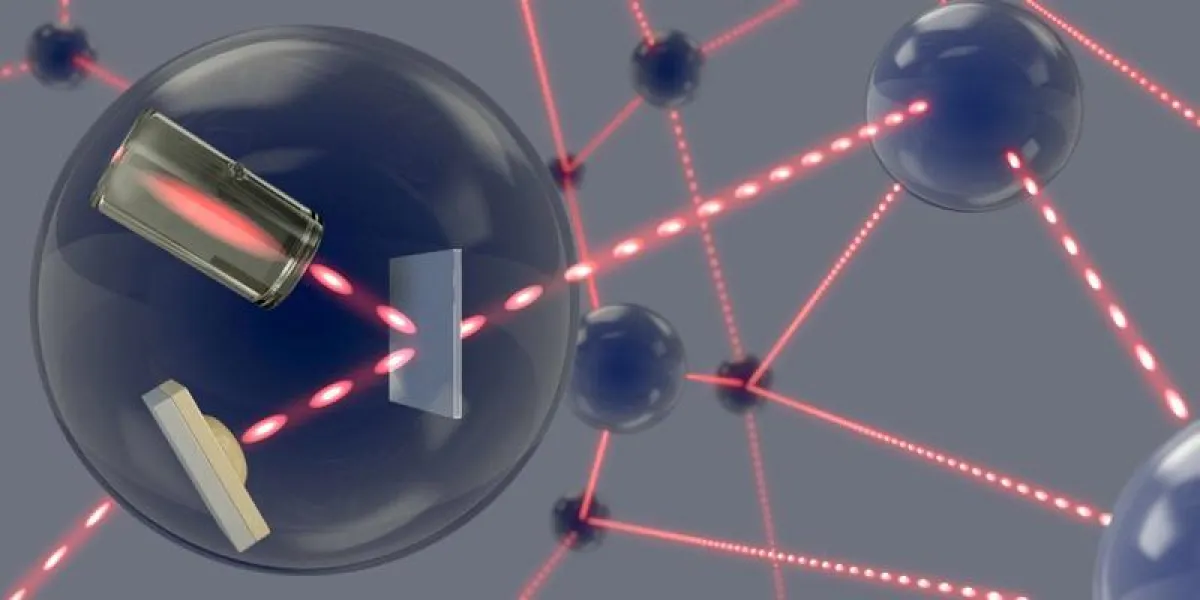
Schematic of a quantum network: single photons transmit quantum information between the network nodes, where they are stored in an atomic gas.  (University of Basel, Department of Physics)
Schematic of a quantum network: single photons transmit quantum information between the network nodes, where they are stored in an atomic gas. (University of Basel, Department of Physics)

(openPR) Physicists from the University of Basel have developed a memory that can store photons. These quantum particles travel at the speed of light and are thus suitable for high-speed data transfer. The researchers were able to store them in an atomic vapor and read them out again later without altering their quantum mechanical properties too much. This memory technology is simple and fast and it could find application in a future quantum Internet. The journal Physical Review Letters has published the results.


---
Even today, fast data transfer in telecommunication networks employs short light pulses. Ultra broadband technology uses optical fiber links through which information can be transferred at the speed of light. At the receiver’s end, the transmitted information has to be stored quickly and without errors so that it can be processed further electronically on computers. To avoid transmission errors, each bit of information is encoded in relatively strong light pulses that each contain at least several hundreds of photons.

For several years, researchers all over the world have been working on operating such networks with single photons. Encoding one bit per photon is not only very efficient, but it also allows for a radically new form of information processing based on the laws of quantum physics. These laws allow a single photon to encode not only the states 0 or 1 of a classic bit, but also to encode a superposition of both states at the same time. Such quantum bits are the basis for quantum information processing that could make unconditionally secure communication and super fast quantum computers possible in the future. The ability to store and retrieve single photons from a quantum memory is a key element for these technologies, which is intensively investigated.

Simple and fast

A team of physicists led by the professors Philipp Treutlein and Richard Warburton from the University of Basel has now developed a particularly simple and fast quantum memory that stores photons in a gas of rubidium atoms. A laser controls the storage and retrieval processes. The technology used does not require cooling devices or complicated vacuum equipment and can be implemented in a highly compact setup. The researchers were also able to verify that the memory has a very low noise level and is suitable for single photons.

One step closer to the quantum internet

"The combination of a simple setup, high bandwidth and low noise level is very promising for future application in quantum networks," says Janik Wolters, first author of the study. The development of such quantum networks is one of the goals of the National Center of Competence in Quantum Science and Technology (NCCR QSIT) and of the EU Framework Programme for Research and Innovation that have funded this study. In the future, quantum networks could lead to unconditionally secure communication, the networking of different quantum computers and the simulation of complex physical, chemical and biological systems.

Original source

Janik Wolters, Gianni Buser, Andrew Horsley, Lucas Béguin, Andreas Jöckel, Jan-Philipp Jahn, Richard J. Warburton, and Philipp Treutlein
Simple Atomic Quantum Memory Suitable for Semiconductor Quantum Dot Single Photons
Phys. Rev. Lett. (2017), doi: 10.1103/PhysRevLett.119.060502

Further information

Prof. Dr. Philipp Treutlein, University of Basel, Department of Physics, phone: +41 61 207 37 66, email: E-Mail

Prof. Dr. Richard Warburton, University of Basel, Department of Physics, phone: +41 61 207 35 60, email: E-Mail

Weitere Informationen:
- https://www.unibas.ch/en/News-Events/News/Uni-Research/High-speed-Quantum-Memory-for-Photons.html

Quelle: idw

Diese Pressemeldung wurde auf openPR veröffentlicht.

Verantwortlich für diese Pressemeldung:

News-ID: 967697
 516

Kostenlose Online PR für alle

Jetzt Ihren Pressetext mit einem Klick auf openPR veröffentlichen

Jetzt gratis starten

Pressebericht „High-speed Quantum Memory for Photons“ bearbeiten oder mit dem "Super-PR-Sparpaket" stark hervorheben, zielgerichtet an Journalisten & Top50 Online-Portale verbreiten:

PM löschen PM ändern
Disclaimer: Für den obigen Pressetext inkl. etwaiger Bilder/ Videos ist ausschließlich der im Text angegebene Kontakt verantwortlich. Der Webseitenanbieter distanziert sich ausdrücklich von den Inhalten Dritter und macht sich diese nicht zu eigen. Wenn Sie die obigen Informationen redaktionell nutzen möchten, so wenden Sie sich bitte an den obigen Pressekontakt. Bei einer Veröffentlichung bitten wir um ein Belegexemplar oder Quellenennung der URL.

Pressemitteilungen KOSTENLOS veröffentlichen und verbreiten mit openPR

Stellen Sie Ihre Medienmitteilung jetzt hier ein!

Jetzt gratis starten

Weitere Mitteilungen von Universität Basel

Bild: Bei Zuckermangel in der Zelle leben Boten-RNAs längerBild: Bei Zuckermangel in der Zelle leben Boten-RNAs länger
Bei Zuckermangel in der Zelle leben Boten-RNAs länger
Leidet eine Zelle unter Zuckermangel, speichert sie bestimmte Boten-RNAs, um so ihr Leben zu verlängern. Wie eine Forschungsgruppe am Biozentrum der Universität Basel nun herausfand, entscheidet das Protein Puf5p bei Zuckermangel in der Zelle darüber, ob eine Boten-RNA aufbewahrt oder abgebaut wird. Wie die in eLife veröffentlichte Studie zeigt, schickt das Protein die Boten-RNAs dazu in eine Zellorganelle, wo ihr Schicksal besiegelt wird. --- Ist eine Zelle Stress ausgesetzt, sei es durch Mangel an Nährstoffen oder einem Zuviel an Spurenele…
Akshay Venkatesh erhält Ostrowski-Preis für höhere Mathematik
Der US-Mathematiker Akshay Venkatesh erhält den mit 100'000 Franken dotierten internationalen Ostrowski-Preis für höhere Mathematik 2017. Die Auszeichnung geht auf den Mathematikprofessor Alexander M. Ostrowski zurück, der an der Universität Basel gelehrt hat. --- Akshay Venkatesh, Professor an der Stanford University, erhält die Auszeichnung für seine bahnbrechenden Leistungen auf den Gebieten der Zahlentheorie, der Theorie der automorphen Formen, der Repräsentationstheorie, der homogenen Dynamik und der arithmetischen Geometrie. Ein wicht…

Das könnte Sie auch interessieren:

Bild: A new knob to control and create higher harmonics in solidsBild: A new knob to control and create higher harmonics in solids
A new knob to control and create higher harmonics in solids
… a new knob to control and optimize the generation of high-order harmonics in bulk materials, one of the most important physical processes for generating high-energy photons and for the ultrafast manipulation of information. --- The generation of high-order harmonics in gases is nowadays routinely used in many different areas of sciences, ranging from …
Bild: Two ERC Starting Grants for IST Austria ProfessorsBild: Two ERC Starting Grants for IST Austria Professors
Two ERC Starting Grants for IST Austria Professors
Johannes Fink and Maximilian Jösch receive prestigious ERC Grants – Projects on quantum networks and neuronal mechanisms of attention funded --- Johannes Fink and Maximilian Jösch, both Assistant Professors at the Institute of Science and Technology Austria (IST Austria), have been awarded Starting Grants by the European Research Council (ERC). With …
Bild: Schneller Quantenspeicher für PhotonenBild: Schneller Quantenspeicher für Photonen
Schneller Quantenspeicher für Photonen
… ermöglichen. Originalbeitrag Janik Wolters, Gianni Buser, Andrew Horsley, Lucas Béguin, Andreas Jöckel, Jan-Philipp Jahn, Richard J. Warburton, and Philipp Treutlein Simple Atomic Quantum Memory Suitable for Semiconductor Quantum Dot Single Photons Phys. Rev. Lett. (2017), doi: 10.1103/PhysRevLett.119.060502 Weitere Auskünfte Prof. Dr. Philipp Treutlein, Universität …
Bild: Introducing Priolite Hot Sync up to 1/8000th Shutter Speed for SonyBild: Introducing Priolite Hot Sync up to 1/8000th Shutter Speed for Sony
Introducing Priolite Hot Sync up to 1/8000th Shutter Speed for Sony
… of a second, combined with the ability to operate any of the Priolite Hot Sync strobes at any power setting and without the need for an outlet, truly represents a quantum leap forward for all owners of Sony cameras,” says Joachim Renschke, the CEO and founder of Priolite GmbH, Germany. The 2.4GHz Priolite Remote Control supports 4 groups with 9 different …
Bild: An international team of physicists a coherent amplification effect in laser excited dielectricsBild: An international team of physicists a coherent amplification effect in laser excited dielectrics
An international team of physicists a coherent amplification effect in laser excited dielectrics
… also the discovery of the LASER in the mid 60s by Theodore Maiman was an unusual discovery that was initially seen as no more than another thrilling aspect of quantum physics. However, today, more than 50 years later, there are no products or technical process in which laser-technology is not involved in a certain way.” The publication was published …
Bild: Using Mirrors to Improve the Quality of Light ParticlesBild: Using Mirrors to Improve the Quality of Light Particles
Using Mirrors to Improve the Quality of Light Particles
… the University of Basel’s Department of Physics and the Swiss Nanoscience Institute have succeeded in dramatically improving the quality of individual photons generated by a quantum system. The scientists have successfully put a 10-year-old theoretical prediction into practice. With their paper, published recently in Physical Review X, they have taken …
Bild: Exotic quantum states made from light: Physicists create optical “wells” for a super-photonBild: Exotic quantum states made from light: Physicists create optical “wells” for a super-photon
Exotic quantum states made from light: Physicists create optical “wells” for a super-photon
… light of a Bose-Einstein condensate flows. The creation of such highly low-loss structures for light is a prerequisite for complex light circuits, such as for quantum information processing for a new generation of computers. The researchers are now presenting their results in the journal Nature Photonics. --- Light particles (photons) occur as tiny, …
Bild: Entangling photons from a quantum dot in the telecom C-bandBild: Entangling photons from a quantum dot in the telecom C-band
Entangling photons from a quantum dot in the telecom C-band
… The generation of entangled photons, i.e. a non-classical phenomenon which “bounds” the states of two different entities, is a cornerstone for the realization of quantum networks. --- Quantum dots are one of the most prominent and promising candidates as non-classical light sources applied in quantum information technology. They have been proven to …
Bild: USB-Adapterbox für PCMCIA-SpeicherkartenBild: USB-Adapterbox für PCMCIA-Speicherkarten
USB-Adapterbox für PCMCIA-Speicherkarten
… ATA PCMCIA oder HDD im PCMCIA Format (Typ I oder II), CompactFlash Card (Typ I oder II) oder Microdrive, SD & SDHC Card (unterstützt den SD/SDHC High-Speed Mode), MMC & MMC plus, Memory Stick PRO/PRO und Duo/PRO-HG/PRO-HG Duo. Jeder einzelne Steckplatz wird unter Windows als ein separates Wechselspeicher-Laufwerk verwaltet; somit ist ein schnelles …
X-ray imaging with a significantly enhanced resolution
… scattering dominates, for example in the form of fluorescence resulting from photon absorption and subsequent emission,’ explains Anton Classen, member of the FAU working group Quantum Optics and Quantum Information. ‘This creates a diffuse background that cannot be used for coherent imaging and reduces the reproduction fidelity of coherent methods.’ Making …
Sie lesen gerade: High-speed Quantum Memory for Photons