openPR Recherche & Suche
Presseinformation

Exotic quantum states made from light: Physicists create optical “wells” for a super-photon

14.08.201718:00 UhrWissenschaft, Forschung, Bildung
Bild: Exotic quantum states made from light: Physicists create optical “wells” for a super-photon
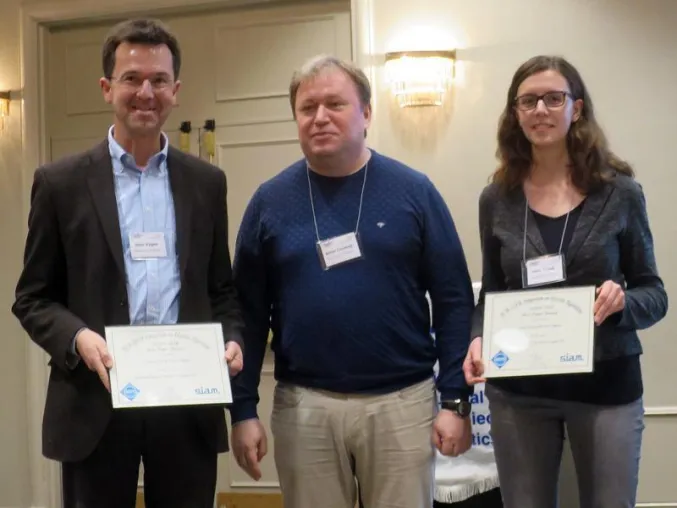
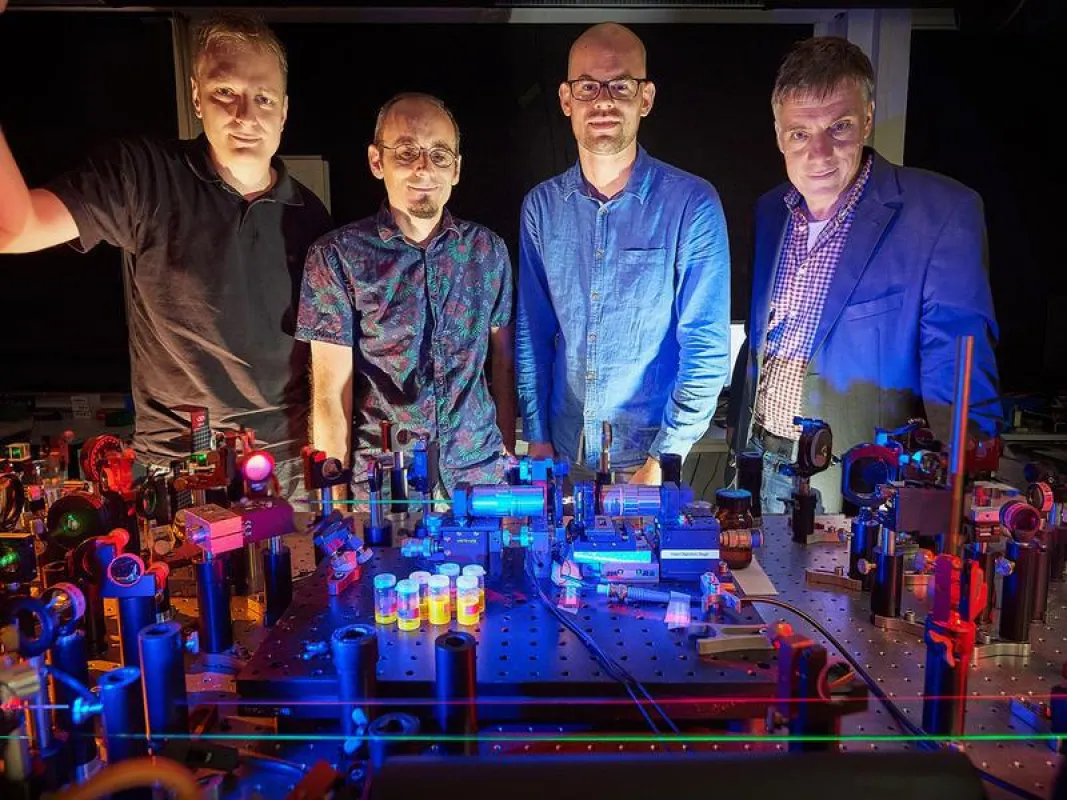
The Bonn researchers (from left) Dr. Tobias Damm, Dr. Frank Vewinger, David Dung und Prof. Dr. Martin Weitz. (Photo: Volker Lannert/Uni Bonn)

(openPR) Physicists at the University of Bonn have managed to create optical hollows and more complex patterns into which the light of a Bose-Einstein condensate flows. The creation of such highly low-loss structures for light is a prerequisite for complex light circuits, such as for quantum information processing for a new generation of computers. The researchers are now presenting their results in the journal Nature Photonics.


---
Light particles (photons) occur as tiny, indivisible portions. Many thousands of these light portions can be merged to form a single super-photon if they are sufficiently concentrated and cooled. The individual particles merge with each other, making them indistinguishable. Researchers call this a photonic Bose-Einstein condensate. It has long been known that normal atoms form such condensates. Prof. Martin Weitz from the Institute of Applied Physics at the University of Bonn attracted attention among experts in 2010 when he produced a Bose-Einstein condensate from photons for the first time.

In his latest study, Prof. Weitz’ team experimented with this kind of super-photon. In the experimental setup, a laser beam was rapidly bounced back and forth between two mirrors. In between was a pigment that cooled the laser light to such an extent that a super-photon was created from the individual light portions. “The special thing is that we have built a kind of optical well in various forms, into which the Bose-Einstein condensate was able to flow,” reports Weitz.

A polymer varies the light path

The team of researchers used a trick here: It mixed a polymer into the pigment between the mirrors, which changed its refractive index depending on the temperature. The route between the mirrors for the light thus changed so that longer light wavelengths passed between the mirrors when heated. The extent of the light path between the mirrors could be varied, in that the polymer could be warmed via a very thin heating layer.

“With the help of various temperature patterns, we were able to create different optical dents,” explains Weitz. The geometry of the mirror only appeared to warp, while the refractive index of the polymer changed at certain points – however, this had the same effect as a hollow shape. Part of the super-photon flowed into this apparent well. In this way, the researchers were able to use their apparatus to create different, very low-loss patterns that captured the photonic Bose-Einstein condensate.

Precursor of quantum circuits

The team of researchers investigated in detail the formation of two neighboring wells, controlled via the temperature pattern of the polymer. When the light in both optical hollows remained at a similar energy level, the super-photon flowed from one well into the neighboring one. “This was a precursor of optical quantum circuits,” highlighted the physicist at the University of Bonn. “Perhaps even complex arrangements, for which quantum entanglement occurs in interaction with a possible photon interaction in suitable materials, can be produced with this experimental setup.”

This would, in turn, be the prerequisite for a new technique for quantum communication and quantum computers. “But that’s still a long way off,” says Weitz. The findings by the research team could also conceivably be used to further develop lasers – for instance for highly precise welding work.

Publication: David Dung, Christian Kurtscheid, Tobias Damm, Julian Schmitt, Frank Vewinger, Martin Weitz & Jan Klärs: Variable Potentials for Thermalized Light and Coupled Condensates, Nature Photonics, DOI: 10.1038/nphoton.2017.139

Media contact:

David Dung M.Sc.
Institute of Applied Physics
University of Bonn
Tel. +49 (0)228/733453 or 733455
E-mail: E-Mail

Prof. Martin Weitz (available from 21 Aug 2017)
Institute of Applied Physics
University of Bonn
Tel. +49 (0)228/734837 or 734836
E-mail: E-Mail

Quelle: idw

Diese Pressemeldung wurde auf openPR veröffentlicht.

Verantwortlich für diese Pressemeldung:

News-ID: 963468
 591

Kostenlose Online PR für alle

Jetzt Ihren Pressetext mit einem Klick auf openPR veröffentlichen

Jetzt gratis starten

Pressebericht „Exotic quantum states made from light: Physicists create optical “wells” for a super-photon“ bearbeiten oder mit dem "Super-PR-Sparpaket" stark hervorheben, zielgerichtet an Journalisten & Top50 Online-Portale verbreiten:

PM löschen PM ändern
Disclaimer: Für den obigen Pressetext inkl. etwaiger Bilder/ Videos ist ausschließlich der im Text angegebene Kontakt verantwortlich. Der Webseitenanbieter distanziert sich ausdrücklich von den Inhalten Dritter und macht sich diese nicht zu eigen. Wenn Sie die obigen Informationen redaktionell nutzen möchten, so wenden Sie sich bitte an den obigen Pressekontakt. Bei einer Veröffentlichung bitten wir um ein Belegexemplar oder Quellenennung der URL.

Pressemitteilungen KOSTENLOS veröffentlichen und verbreiten mit openPR

Stellen Sie Ihre Medienmitteilung jetzt hier ein!

Jetzt gratis starten

Weitere Mitteilungen von Rheinische Friedrich-Wilhelms-Universität Bonn

Bild: Näher an der optimalen TourBild: Näher an der optimalen Tour
Näher an der optimalen Tour
Die Doktorandin Vera Traub und ihr Betreuer, Jens Vygen, Professor am Bonner Forschungsinstitut für Diskrete Mathematik, erhielten auf der weltweit führenden Konferenz für diskrete Algorithmen (SODA) in New Orleans einen Preis für die beste Veröffentlichung („Best Paper Award“). Mit ihrem neu entwickelten Algorithmus kann man Touren durch beliebig viele Städte ermitteln, die der kürzesten Tour „möglichst nah“ kommen. --- Das „Problem des Handlungsreisenden“ ist weltberühmt und wurde erstmals im Jahr 1930 formuliert: Gegeben sind ein Anfangs-…
Bild: Entzündungsmechanismen treiben Alzheimer-Erkrankung voranBild: Entzündungsmechanismen treiben Alzheimer-Erkrankung voran
Entzündungsmechanismen treiben Alzheimer-Erkrankung voran
Laut einer jetzt im Fachmagazin „Nature“ veröffentlichten Studie treiben Entzündungsmechanismen grundlegende Prozesse der Alzheimer-Erkrankung voran. Auslöser ist das Immunsystem des Gehirns. Wissenschaftler des Deutschen Zentrums für Neurodegenerative Erkrankungen (DZNE) und der Universität Bonn stützen sich dabei auf aktuelle Laboruntersuchungen. Diese Ergebnisse, an denen weitere Forscher aus Europa und den USA beteiligt waren, könnten auf lange Sicht den Weg für eine frühzeitige Behandlung der Alzheimer-Erkrankung bereiten: zu einem Zeitp…

Das könnte Sie auch interessieren:

Bild: VITA Exotic: Mandarinen-Mango-Limo lockt treue und neue FansBild: VITA Exotic: Mandarinen-Mango-Limo lockt treue und neue Fans
VITA Exotic: Mandarinen-Mango-Limo lockt treue und neue Fans
VITA COLA verstärkt ihre Limonaden um VITA Exotic und optimiert darüber hinaus die bisherigen Produkte der Range Schmalkalden/Lichtenau, Januar 2012. Im Februar 2012 bekommen die VITA Limonaden Verstärkung. Zu den Sorten Orange und Zitrone gesellt sich VITA Exotic mit der Geschmacksrichtung Mandarine-Mango. Wie alle Limonaden der ostdeutschen Kult-Marke …
Bild: Teasen will gelernt sein - Die Kunst des VerführensBild: Teasen will gelernt sein - Die Kunst des Verführens
Teasen will gelernt sein - Die Kunst des Verführens
Das erste Berliner Tanzstudio für Burlesque, Exotic und Pole Dance ist die Adresse für Frauen in Berlin. Das Studio Schönheitstanz Berlin bietet eine neue exotische Freizeitvariante für alle Frauen an, die ein Interesse haben, die Kunst des Verführens zu erlernen. In angenehmer Atmosphäre und je nach individueller körperlicher Fitness erlernen die Teilnehmerinnen …
Bild: Deutsche Physik-Meisterschaft – Countdown zur Anmeldung zu den Regionalwettbewerben läuftBild: Deutsche Physik-Meisterschaft – Countdown zur Anmeldung zu den Regionalwettbewerben läuft
Deutsche Physik-Meisterschaft – Countdown zur Anmeldung zu den Regionalwettbewerben läuft
Noch bis zum 3. Dezember können sich Teams aus Schülerinnen oder Schüler zu den Regionalwettbewerben zum German Young Physicists´ Tournament (GYPT) anmelden. Mentorinnen und Mentoren sowie GYPT-Zentren in Bayreuth, Berlin, Bochum, Dachau, Erlangen, Hamburg, Hameln, Kassel, Leipzig, Meißen, Neustrelitz, Papenburg, Ulm und Wuppertal helfen bei der Vorbereitung. --- Bad …
Bild: Quantum magnets doped with holesBild: Quantum magnets doped with holes
Quantum magnets doped with holes
… Because of the interplay between the motion of the defect and the magnetic correlations of the electron spins, the magnetic order seems to be suppressed. In general, solid state physicists are not able to separate the two processes, so they cannot answer the question, whether the magnetic order is indeed reduced, or whether it is just hidden. Now a team …
Bild: ‘Find the Lady’ in the quantum worldBild: ‘Find the Lady’ in the quantum world
‘Find the Lady’ in the quantum world
… proposed a new way to make atoms or ions indistinguishable by swapping their positions. These particles are then expected to exhibit exotic properties. The study involved physicists from the University of Bonn, the Austrian Academy of Sciences, and the University of California. The work has now been published in Physical Review Letters. --- Imagine that …
Bild: Nanomagnets Levitate Thanks to Quantum PhysicsBild: Nanomagnets Levitate Thanks to Quantum Physics
Nanomagnets Levitate Thanks to Quantum Physics
Quantum physicists in Oriol Romero-Isart’s research group in Innsbruck show in two current publications that, despite Earnshaw’s theorem, nanomagnets can be stably levitated in an external static magnetic field owing to quantum mechanical principles. The quantum angular momentum of electrons, which also causes magnetism, is accountable for this mechanism. --- Already …
Bild: Physicists find strange state of matter in superconducting crystalBild: Physicists find strange state of matter in superconducting crystal
Physicists find strange state of matter in superconducting crystal
… Institute for Chemical Physics of Solids (MPI CPfS) in Dresden aims to discover and understand new materials with unusual properties. In close cooperation, chemists and physicists (including chemists working on synthesis, experimentalists and theoreticians) use the most modern tools and methods to examine how the chemical composition and arrangement of …
Exotic Poland. Paper cutouts from Mazovia.
DAS EXOTISCHE IST IN DER NAEHE Ist das Exotische nicht in den Augen des Beobachters zu finden? Die Ausstellung Exotic Poland. Paper cutouts from Mazovia bringt die exotische Kunst des polnischen Scherenschnitts erstmalig nach Berlin. Die Ausstellung öffnet am 17. Juni um 19 Uhr im Rahmen des Kunst- und Kulturfestivals 48 Stunden Neukölln (Firma BORODESIGN, …
Bild: High resolution without particle acceleratorBild: High resolution without particle accelerator
High resolution without particle accelerator
A first for physics – University of Jena physicists are first to achieve optical coherence tomography with XUV radiation at laboratory scale. --- A visit to the optometrist often involves optical coherence tomography. This imaging process uses infrared radiation to penetrate the layers of the retina and examine it more closely in three dimensions, without …
Bild: Physicists Design Ultrafocused PulsesBild: Physicists Design Ultrafocused Pulses
Physicists Design Ultrafocused Pulses
Physicists working with researcher Oriol Romero-Isart devised a new simple scheme to theoretically generate arbitrarily short and focused electromagnetic fields. This new tool could be used for precise sensing and in microscopy. --- Microwaves, heat radiation, light and X-radiation are examples for electromagnetic waves. Many applications require to …
Sie lesen gerade: Exotic quantum states made from light: Physicists create optical “wells” for a super-photon