openPR Recherche & Suche
Presseinformation

Physicists find strange state of matter in superconducting crystal

22.08.201713:00 UhrWissenschaft, Forschung, Bildung
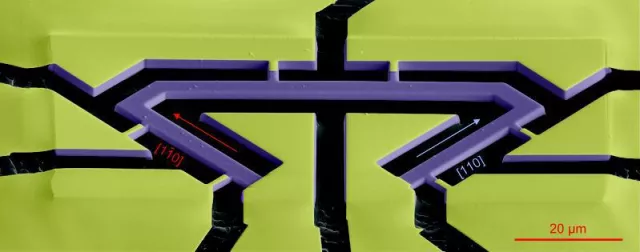
Bild: Physicists find strange state of matter in superconducting crystal
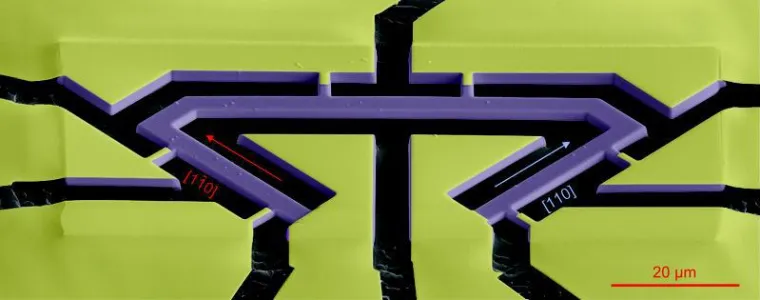
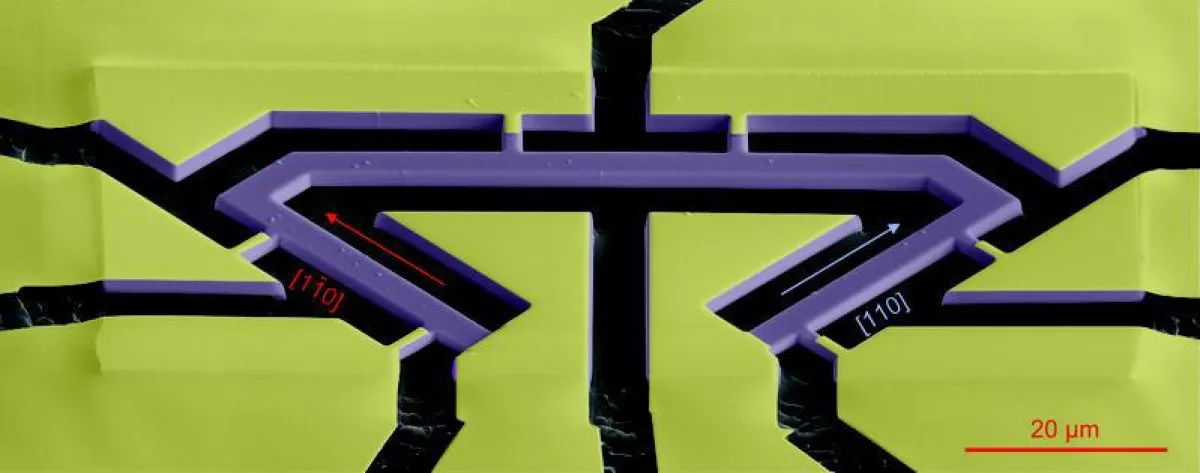
Crystalline samples of CeRhIn5 from Los Alamos were cut into microscopic, crystalline conducting paths with a focused ion beam at MPI-CPfS (MPI CPfS)

(openPR) New research published this week shows a rare state of matter in which electrons in a superconducting crystal organize collectively. The findings lay the groundwork for answering one of the most compelling questions in physics: How do correlated electron systems work, and are they related to one another?


---
The paper, Electronic in-plane symmetry breaking at field-tuned quantum criticality in CeRhIn5, was published in the journal Nature.

Electrons in most metals act individually, free to move through a metal to conduct electric currents and heat. But in a special sample of layered cerium, rhodium and indium (CeRhIn5), scientists discovered that electrons unite to flow in the same direction (a behavior called “breaking symmetry”) when in high magnetic fields of 30 tesla. Known as “electronic nematic,” this is a rare state of matter between liquid and crystal.

“It’s sort of like in ancient times,” clarifies Phillip Moll, principal investigator of this work and leader of the Physics of Microstructured Quantum Matter Group at the Max-Planck Institute for Chemical Physics of Solids in Germany. “People would draw maps in whatever direction best served them. But this state is like the moment when the world’s mapmakers unified to arbitrarily pick north as the orientation for all maps.”

Scientists believe that the electronic nematicity state may be closely related to superconductivity, another strongly correlated electron state in which electrons flow with no resistance. This cerium crystal becomes a superconductor under high pressure. However, when placed in a high magnetic field, it demonstrates this electronic nematic state. Because it exhibits both behaviors, CeRhIn5 appears uniquely positioned to one-way reveal possible interactions between these two correlated electron phases.

“This fundamental question in materials in which the electrons interact was the starting point for my PhD thesis,” adds Maja Bachmann, a doctoral student on the research team. “Do the electrons have to decide either to pair or to all go in one direction? In other words, are superconductivity and nematicity competitive phenomena, or could the same interaction that leads to pairing also create nematicity?”

This research featured a specialized sample fabricated from a single crystal of CeRhIn5 using focused ion beam (FIB) machining, and required experiments in both pulsed and resistive magnets. Work in the DC Field Facility’s 45-tesla hybrid showed that the nematic phase appears in very high fields, beginning at 30 tesla and remaining through the hybrid’s full field. Researchers wanted to understand how far this phase extended and, through experiments at the Pulsed Field Facility, found that at around 50 tesla, the nematicity vanishes, possibly even undergoing another exotic phase transition. .

But something else happened during the pulsed experiments: Researchers noticed that they could control the direction of the electrons when they tilted the field slightly. Returning back to the DC Field Facility, the scientists were able to continuously change this tilt angle while keeping the field steady at 45 tesla, a unique experimental parameter at the MagLab.

“One big advantage of the MagLab is that it offers all the state-of-the-art magnet technologies, and throughout a project, the magnet type can be changed easily if it becomes clear that a different technology was required,” Moll said. “Really, the close technological, scientific and administrative integration of these very different but complementary high-field technologies was the key to this success, and is a major strength of the MagLab.”

Moll’s team performed additional work in the lab’s 100-tesla pulsed magnet that will be featured in a future paper. The researchers are continuing to explore how the nematic phase merges into the superconducting phase, part of an ongoing project that will involve additional MagLab experiments.

In addition to Bachman, Moll’s co-authors on the paper included F. Ronning and E.D. Bauer of Los Alamos National Laboratory; T. Helm and K. R. Shirer of the Max-Planck-Institute for Chemical Physics of Solids; and L. Balicas, M. K. Chan, B. J. Ramshaw, R. D. McDonald, F. F. Balakirev and M. Jaime of the National MagLab.

The research at the Max Planck Institute for Chemical Physics of Solids (MPI CPfS) in Dresden aims to discover and understand new materials with unusual properties.
In close cooperation, chemists and physicists (including chemists working on synthesis, experimentalists and theoreticians) use the most modern tools and methods to examine how the chemical composition and arrangement of atoms, as well as external forces, affect the magnetic, electronic and chemical properties of the compounds.
New quantum materials, physical phenomena and materials for energy conversion are the result of this interdisciplinary collaboration.
The MPI CPfS is part of the Max Planck Society and was founded in 1995 in Dresden. It consists of around 280 employees, of which about 180 are scientists, including 70 doctoral students.

Weitere Informationen:
- http://www.nature.com/nature/journal/v548/n7667/full/nature23315.html
- http://www.cpfs.mpg.de
- http://www.miquamat.de

Quelle: idw
Diese Pressemeldung wurde auf openPR veröffentlicht.

Verantwortlich für diese Pressemeldung:

News-ID: 964593
 142

Kostenlose Online PR für alle

Jetzt Ihren Pressetext mit einem Klick auf openPR veröffentlichen

Jetzt gratis starten

Pressebericht „Physicists find strange state of matter in superconducting crystal“ bearbeiten oder mit dem "Super-PR-Sparpaket" stark hervorheben, zielgerichtet an Journalisten & Top50 Online-Portale verbreiten:

PM löschen PM ändern
Disclaimer: Für den obigen Pressetext inkl. etwaiger Bilder/ Videos ist ausschließlich der im Text angegebene Kontakt verantwortlich. Der Webseitenanbieter distanziert sich ausdrücklich von den Inhalten Dritter und macht sich diese nicht zu eigen. Wenn Sie die obigen Informationen redaktionell nutzen möchten, so wenden Sie sich bitte an den obigen Pressekontakt. Bei einer Veröffentlichung bitten wir um ein Belegexemplar oder Quellenennung der URL.

Pressemitteilungen KOSTENLOS veröffentlichen und verbreiten mit openPR

Stellen Sie Ihre Medienmitteilung jetzt hier ein!

Jetzt gratis starten

Weitere Mitteilungen von Max-Planck-Institut für Chemische Physik fester Stoffe

Bild: Bit data goes anti-skyrmionsBild: Bit data goes anti-skyrmions
Bit data goes anti-skyrmions
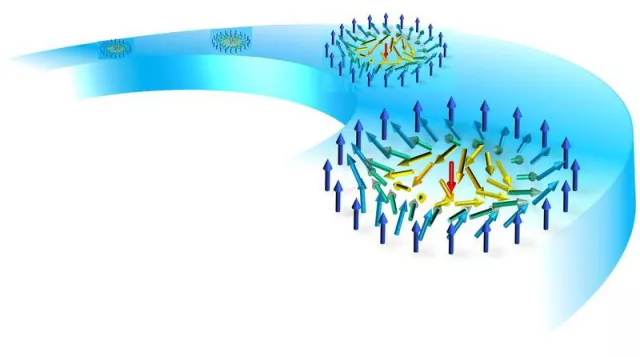
Today’s world, rapidly changing because of “big data”, is encapsulated in trillions of tiny magnetic objects – magnetic bits – each of which stores one bit of data in magnetic disk drives. A group of scientists from the Max Planck Institutes in Halle and Dresden have discovered a new kind of magnetic nano-object in a novel material that could serve as a magnetic bit with cloaking properties to make a magnetic disk drive with no moving parts – a Racetrack Memory – a reality in the near future. --- Most digital data is stored in the cloud as m…
Bild: Wissenschaftler entdecken seltene Ordnung von Elektronen in einem supraleitenden KristallBild: Wissenschaftler entdecken seltene Ordnung von Elektronen in einem supraleitenden Kristall
Wissenschaftler entdecken seltene Ordnung von Elektronen in einem supraleitenden Kristall
In einem Artikel der aktuellen Ausgabe des Forschungsmagazins „Nature“ berichten Wissenschaftler vom Max-Planck-Institut für Chemische Physik fester Stoffe in Dresden von der Entdeckung eines seltenen Materiezustandes, bei dem sich die Elektronen in einem Kristall gemeinsam in einer Richtung bewegen. Diese Entdeckung berührt eine der offenen Fragestellungen im Bereich der Festkörperphysik: Was passiert, wenn sich Elektronen gemeinsam im Kollektiv verhalten, in sogenannten „stark korrelierten Elektronensystemen“, und wie „einigen sich“ die Ele…

Das könnte Sie auch interessieren:

Bild: High resolution without particle acceleratorBild: High resolution without particle accelerator
High resolution without particle accelerator
A first for physics – University of Jena physicists are first to achieve optical coherence tomography with XUV radiation at laboratory scale. --- A visit to the optometrist often involves optical coherence tomography. This imaging process uses infrared radiation to penetrate the layers of the retina and examine it more closely in three dimensions, without …
Bild: Physicists Design Ultrafocused PulsesBild: Physicists Design Ultrafocused Pulses
Physicists Design Ultrafocused Pulses
Physicists working with researcher Oriol Romero-Isart devised a new simple scheme to theoretically generate arbitrarily short and focused electromagnetic fields. This new tool could be used for precise sensing and in microscopy. --- Microwaves, heat radiation, light and X-radiation are examples for electromagnetic waves. Many applications require to …
Bild: Ions in the spotlightBild: Ions in the spotlight
Ions in the spotlight
Experiment by Freiburg physicists published in science journal --- The results of a research group from the Institute of Physics at the University of Freiburg has been given a special place in the “Nature Photonics” journal: an accompanying “News & Views” article in the print version of the science journal highlights the work of the team led by Alexander …
Bild: ‘Find the Lady’ in the quantum worldBild: ‘Find the Lady’ in the quantum world
‘Find the Lady’ in the quantum world
… proposed a new way to make atoms or ions indistinguishable by swapping their positions. These particles are then expected to exhibit exotic properties. The study involved physicists from the University of Bonn, the Austrian Academy of Sciences, and the University of California. The work has now been published in Physical Review Letters. --- Imagine that …
Bild: High-speed Quantum Memory for PhotonsBild: High-speed Quantum Memory for Photons
High-speed Quantum Memory for Photons
Physicists from the University of Basel have developed a memory that can store photons. These quantum particles travel at the speed of light and are thus suitable for high-speed data transfer. The researchers were able to store them in an atomic vapor and read them out again later without altering their quantum mechanical properties too much. This memory …
Bild: Deutsches Nationalteam gewinnt europäischen PhysikwettbewerbBild: Deutsches Nationalteam gewinnt europäischen Physikwettbewerb
Deutsches Nationalteam gewinnt europäischen Physikwettbewerb
… Stiller (16) und Simon Hermes (17) vom Herder-Gymnasium Berlin gemeinsam mit Nikita Petrov (16) vom Gymnasium Neubiberg bei München beim Physikwettbewerb Austrian Young Physicists’ Tournament (AYPT) den ersten Platz. Während der zweitägigen Vorrunde in Leoben, Österreich, erkämpfte sich das deutsche Nationalteam erfolgreich einen Platz im Finale. Dort …
Bild: An international team of physicists a coherent amplification effect in laser excited dielectricsBild: An international team of physicists a coherent amplification effect in laser excited dielectrics
An international team of physicists a coherent amplification effect in laser excited dielectrics
An international team of physicists from the University of Kassel, led by Prof. Thomas Baumert, and the University of Aarhus, led by Prof. Peter Balling, discovered that ultra-short laser pulses are amplified in a laser excited piece of glass. This amplification, similar to a classical laser, is directed and of coherent nature. By utilizing theoretical …
Bild: Abrupt motion sharpens x-ray pulsesBild: Abrupt motion sharpens x-ray pulses
Abrupt motion sharpens x-ray pulses
Spectrally narrow x-ray pulses may be “sharpened” by purely mechanical means. This sounds surprisingly, but a team of theoretical and experimental physicists developed and realized such a method. It is based on fast motions, precisely synchronized with the pulses, of a target interacting with the x-ray light. Thereby, photons are redistributed within …
Bild: Deutsche Physik-Meisterschaft – Countdown zur Anmeldung zu den Regionalwettbewerben läuftBild: Deutsche Physik-Meisterschaft – Countdown zur Anmeldung zu den Regionalwettbewerben läuft
Deutsche Physik-Meisterschaft – Countdown zur Anmeldung zu den Regionalwettbewerben läuft
Noch bis zum 3. Dezember können sich Teams aus Schülerinnen oder Schüler zu den Regionalwettbewerben zum German Young Physicists´ Tournament (GYPT) anmelden. Mentorinnen und Mentoren sowie GYPT-Zentren in Bayreuth, Berlin, Bochum, Dachau, Erlangen, Hamburg, Hameln, Kassel, Leipzig, Meißen, Neustrelitz, Papenburg, Ulm und Wuppertal helfen bei der Vorbereitung. --- Bad …
Bild: Nanomagnets Levitate Thanks to Quantum PhysicsBild: Nanomagnets Levitate Thanks to Quantum Physics
Nanomagnets Levitate Thanks to Quantum Physics
Quantum physicists in Oriol Romero-Isart’s research group in Innsbruck show in two current publications that, despite Earnshaw’s theorem, nanomagnets can be stably levitated in an external static magnetic field owing to quantum mechanical principles. The quantum angular momentum of electrons, which also causes magnetism, is accountable for this mechanism. --- Already …
Sie lesen gerade: Physicists find strange state of matter in superconducting crystal