openPR Recherche & Suche
Presseinformation

Bit data goes anti-skyrmions

01.09.201717:00 UhrWissenschaft, Forschung, Bildung
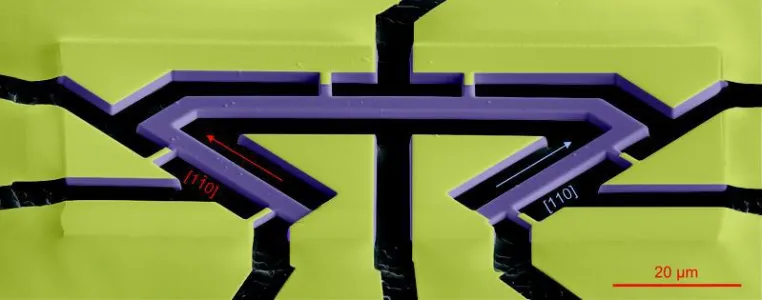
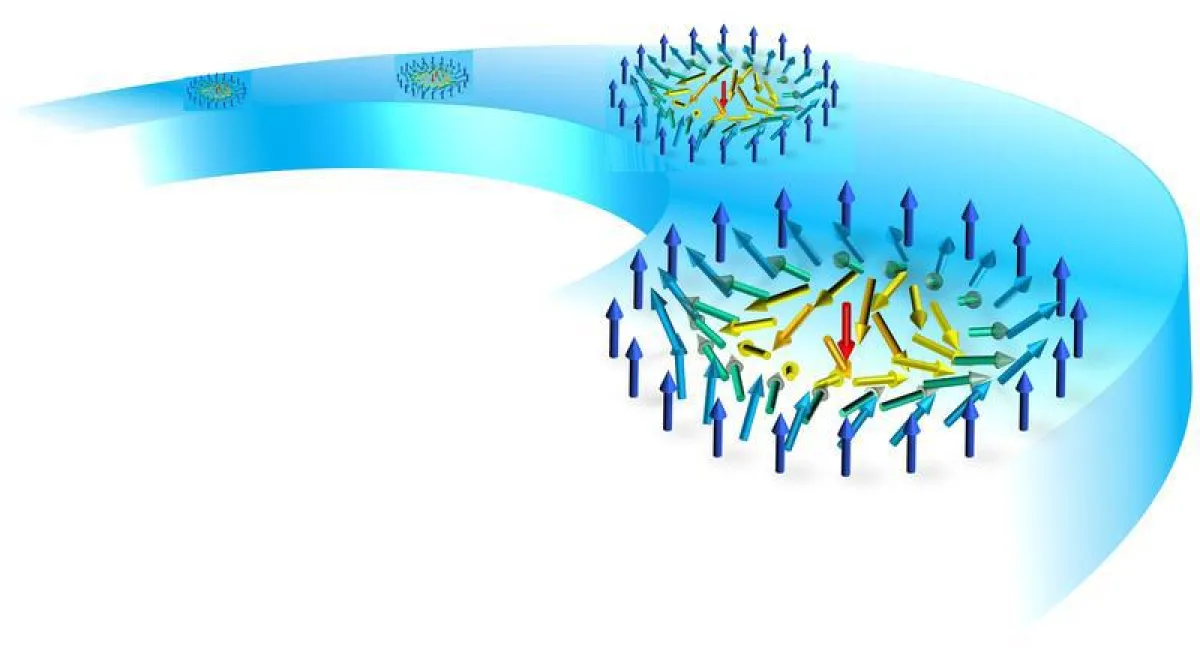
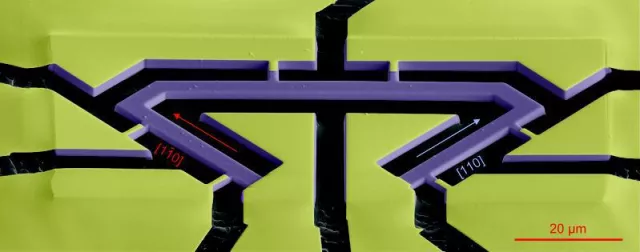
Bild: Bit data goes anti-skyrmions
Anti-skyrmions on a racetrack (MPI of Microstructure Physics)

(openPR) Today’s world, rapidly changing because of “big data”, is encapsulated in trillions of tiny magnetic objects – magnetic bits – each of which stores one bit of data in magnetic disk drives. A group of scientists from the Max Planck Institutes in Halle and Dresden have discovered a new kind of magnetic nano-object in a novel material that could serve as a magnetic bit with cloaking properties to make a magnetic disk drive with no moving parts – a Racetrack Memory – a reality in the near future.


---
Most digital data is stored in the cloud as magnetic bits within massive numbers of magnetic disk drives. Over the past several decades these magnetic bits have shrunk by many orders of magnitude, reaching limits where the boundaries of these magnetic regions can have special properties. In some special materials these boundaries - “magnetic domain walls” – can be described as being topological. What this means is that these walls can be thought of as having a special magical cloak – what is referred to by scientists as “topological protection”. An important consequence is that such magnetic walls are more stable to perturbations than similar magnetic bits without topological protection that are formed in conventional magnetic materials. Thus, these “topological” magnetic objects could be especially useful for storing “1”s and “0”s, the basic elements of digital data.

One such object is a “magnetic skyrmion” which is a tiny magnetic region, perhaps tens to hundreds of atoms wide, separated from a surrounding magnetic region by a chiral domain wall. Until recently only one type of skyrmion has been found in which it is surrounded by a chiral domain wall that takes the same form in all directions. But there have been predictions of several other types of skyrmions that were not yet observed. Now in a paper published in Nature*, scientists from Prof. Stuart Parkin’s NISE department at the Max Planck Institute for Microstructure Physics in Halle, Germany, have found a second class of skyrmions, what are called “anti-skyrmions”, in materials synthesized in Prof. Claudia Felser’s Solid State Chemistry Department at the Max Planck Institute for CPFS, Dresden, Germany. The scientists from Halle and Dresden have found these tiny magnetic objects in a special class of versatile magnetic compounds called Heusler compounds that Claudia Felser and her colleagues have explored extensively over the past 20 years. Of these Heusler compounds, a tiny subset have just the right crystal symmetry to allow for the possibility of forming anti-skyrmions but not skyrmions. Using a highly sensitive transmission electron microscope at the Max Planck Institute for Microstructure Physics, Halle, that was specially modified to allow for the detection of tiny magnetic moments, anti-skyrmions were created and detected over a wide range of temperatures and magnetic fields. Most importantly, anti-skyrmions, both in ordered arrays and as isolated objects, could be seen even at room temperature and in zero magnetic fields.
The special cloaking properties of skyrmions makes them of great interest for a radically new form of solid-state memory – the Racetrack Memory - that was proposed by Stuart Parkin a decade ago. In Racetrack Memory digital data is encoded within magnetic domain walls that are packed closely within nanoscopic magnetic wires. One of the unique features of Racetrack Memory, which is distinct from all other memories, is that the walls are moved around the nanowires themselves using recent discoveries in spin-orbitronics. Very short pulses of current move all the domain walls backwards and forwards along the nano-wires. The walls – the magnetic bits – can be read and written by devices incorporated directly into the nanowires themselves, thereby eliminating any mechanical parts. Topologically protected magnetic walls are very promising for Racetrack Memory.

Thus, anti-skyrmions could be coming to Racetrack Memory soon! Going even beyond anti-skyrmions the next goal is the realization of a third class of skyrmions - antiferromagnetic skyrmions – which are tiny magnetic objects that actually have no net magnetic moment. They are magnetically almost invisible but have unique properties that make them of great interest.

Weitere Informationen:
- http://www.cpfs.mpg.de/2822637/20170901_2
- http://www.mpi-halle.mpg.de/home
- http://www.cpfs.mpg.de/en

Quelle: idw
Diese Pressemeldung wurde auf openPR veröffentlicht.

Verantwortlich für diese Pressemeldung:

News-ID: 966533
 185

Kostenlose Online PR für alle

Jetzt Ihren Pressetext mit einem Klick auf openPR veröffentlichen

Jetzt gratis starten

Pressebericht „Bit data goes anti-skyrmions“ bearbeiten oder mit dem "Super-PR-Sparpaket" stark hervorheben, zielgerichtet an Journalisten & Top50 Online-Portale verbreiten:

PM löschen PM ändern
Disclaimer: Für den obigen Pressetext inkl. etwaiger Bilder/ Videos ist ausschließlich der im Text angegebene Kontakt verantwortlich. Der Webseitenanbieter distanziert sich ausdrücklich von den Inhalten Dritter und macht sich diese nicht zu eigen. Wenn Sie die obigen Informationen redaktionell nutzen möchten, so wenden Sie sich bitte an den obigen Pressekontakt. Bei einer Veröffentlichung bitten wir um ein Belegexemplar oder Quellenennung der URL.

Pressemitteilungen KOSTENLOS veröffentlichen und verbreiten mit openPR

Stellen Sie Ihre Medienmitteilung jetzt hier ein!

Jetzt gratis starten

Weitere Mitteilungen von Max-Planck-Institut für Chemische Physik fester Stoffe

Bild: Wissenschaftler entdecken seltene Ordnung von Elektronen in einem supraleitenden KristallBild: Wissenschaftler entdecken seltene Ordnung von Elektronen in einem supraleitenden Kristall
Wissenschaftler entdecken seltene Ordnung von Elektronen in einem supraleitenden Kristall
In einem Artikel der aktuellen Ausgabe des Forschungsmagazins „Nature“ berichten Wissenschaftler vom Max-Planck-Institut für Chemische Physik fester Stoffe in Dresden von der Entdeckung eines seltenen Materiezustandes, bei dem sich die Elektronen in einem Kristall gemeinsam in einer Richtung bewegen. Diese Entdeckung berührt eine der offenen Fragestellungen im Bereich der Festkörperphysik: Was passiert, wenn sich Elektronen gemeinsam im Kollektiv verhalten, in sogenannten „stark korrelierten Elektronensystemen“, und wie „einigen sich“ die Ele…
Bild: Physicists find strange state of matter in superconducting crystalBild: Physicists find strange state of matter in superconducting crystal
Physicists find strange state of matter in superconducting crystal
New research published this week shows a rare state of matter in which electrons in a superconducting crystal organize collectively. The findings lay the groundwork for answering one of the most compelling questions in physics: How do correlated electron systems work, and are they related to one another? --- The paper, Electronic in-plane symmetry breaking at field-tuned quantum criticality in CeRhIn5, was published in the journal Nature. Electrons in most metals act individually, free to move through a metal to conduct electric currents an…

Das könnte Sie auch interessieren:

Bild: Echtzeit für Windows 7 64-Bit kommtBild: Echtzeit für Windows 7 64-Bit kommt
Echtzeit für Windows 7 64-Bit kommt
Im September ist es endlich soweit - die neue 64-Bit Realtime-Engine von Sybera kommt. Sybera hat in den vergangenen 12 Monaten die bisherige Konzeption der X-Realtime-Engine grundlegend überarbeitet und für den Einsatz für 64-Bit Windows vorbereitet. Hierbei wird nun erstmals auch das Source-Line Debugging der Echtzeit-Tasks auf dem selben System möglich …
Bild: Virenschutz-Lösungen: Norman stellt neue Version von Norman Endpoint Protection vorBild: Virenschutz-Lösungen: Norman stellt neue Version von Norman Endpoint Protection vor
Virenschutz-Lösungen: Norman stellt neue Version von Norman Endpoint Protection vor
… Zugriffsversuche beispielsweise durch Rootkits und Spyware. Intrusion Guard wird zentral über die Konsole verwaltet. Systemvoraussetzungen Clientseitige Systemvoraussetzungen sind Windows 2000 SP4 mit Rollup 1, Windows XP (32 Bit) SP3, Windows XP (64 Bit), Windows Vista (32 Bit) SP1, Windows Vista (64 Bit), Windows 7 (32 Bit) oder Windows 7 (64 Bit). Für …
Bild: PCI-822/826LU Universal PCI BoardsBild: PCI-822/826LU Universal PCI Boards
PCI-822/826LU Universal PCI Boards
PCI-822/826LU Universal PCI Boards! IPC2U präsentiert die neuen PCI-822/826LU Universal PCI, 32-Channel, 250 kS/s,12-bit (16-bit) analog input, 16-bit analog output, Low Gain Multi-function DAQ Boards. PCI-822/826LU wurden entwickelt für die Hochgeschwindigkeits-Datenübertragung von analogen und digitalen Signalen über Universal PCI. Dabei wird sowohl …
Bild: Sascha Sommer zukünftig Alleinaktionär der BIT Treuhand AGBild: Sascha Sommer zukünftig Alleinaktionär der BIT Treuhand AG
Sascha Sommer zukünftig Alleinaktionär der BIT Treuhand AG
Hamburg/Neuwied, 08. Juli 2014 Sascha Sommer, langjähriger Alleinvorstand und Aktionär der BIT – Beteiligungs- & Investitions- Treuhand AG, erwirbt mit sofortiger Wirkung sämtliche Geschäftsanteile des Unternehmens im Wege eines Management-Buy-out von der Aragon AG. Im Rahmen der Transaktion wird Herr Sommer seine unternehmerischen Aktivitäten voll …
ThinPrint löst das x64-Bit-Druckertreiberproblem unter Windows 2003
Neue Version der .print Engine ermöglicht das Drucken unter x64 Windows auf jeden 32-Bit-Druckertreiber (Berlin, Juli 2005) Der auf Druckmanagement spezialisierte Softwarehersteller ThinPrint kündigt eine 64-Bit-Version seiner Softwarelösung an, mit der Unternehmen auch weiterhin 32-Bit-Druckertreiber und damit 64-Bit-inkompatible Druckermodelle nutzen …
Bild: Echtzeit unter Windows in 64 BitBild: Echtzeit unter Windows in 64 Bit
Echtzeit unter Windows in 64 Bit
»RealTime Suite« jetzt auch für 64-Bit-Systeme Echtzeiterweiterung von Kithara ermöglicht Ausführung von Echtzeitanwendungen auch unter Windows 7 mit 64 Bit. Das Unternehmen Kithara Software aus Berlin bietet die seit Jahren bekannte Windows-Echtzeiterweiterung »RealTime Suite« nun auch in einer speziellen 64-Bit-Version an, um damit diesem deutlichen …
Bild: Kithara Software jetzt mit 64-Bit-UnterstützungBild: Kithara Software jetzt mit 64-Bit-Unterstützung
Kithara Software jetzt mit 64-Bit-Unterstützung
Kithara Software jetzt mit 64-Bit-Unterstützung Die Anzahl der neuen PCs, die mit einer 64-Bit-Version von Windows ausgestattet sind, ist in letzter Zeit enorm gestiegen. Einige Computerhersteller liefern sogar jetzt alle neuen Computer generell mit einer 64-Bit-Version von Windows 7 aus. Um den Anwendern Kopfzerbrechen zu ersparen und von möglichen …
Bild: serVonic IXI-UMS Release 5.75 - IXI-UMS ready for MS Windows Server 2003 64-Bit / internationale ZeichensätzeBild: serVonic IXI-UMS Release 5.75 - IXI-UMS ready for MS Windows Server 2003 64-Bit / internationale Zeichensätze
serVonic IXI-UMS Release 5.75 - IXI-UMS ready for MS Windows Server 2003 64-Bit / internationale Zeichensätze
… der Unified Messaging-Lösung IXI-UMS von serVonic erhältlich. Damit bietet der Softwarehersteller seine Lösung nun mit Microsoft Windows Server 2003 64-Bit-Unterstützung und gesteigerter Performance an. Die Kommunikationssoftware kann damit auch problemlos im modernen Rechenzentrumsbetrieb eingesetzt werden. Zusätzlich ermöglicht die Unterstützung internationaler …
Bessere Leistung bei CPU und Speicher - Windows Server 2003 unterstützt 64-Bit-Prozessoren von AMD u
Bessere Leistung bei CPU und Speicher Beta: Windows Server 2003 unterstützt 64-Bit-Prozessoren von AMD und Intel 17. Oktober 2003 - Ab sofort bietet Microsoft «Windows Server 2003 for 64-Bit Extended Systems» als Beta-Version für 64-Bit-Prozessoren aus dem Hause AMD an. AMDs Server-Prozessor «Opteron» läuft sowohl unter der Standard- als auch der Enterprise …
Bild: Einsatzbereit für 64-BitBild: Einsatzbereit für 64-Bit
Einsatzbereit für 64-Bit
Berlin/Teltow; Juni 2008. Ferrari electronic ermöglicht mit OfficeMaster 3.1 den Einsatz seiner umfassenden Unified Communications-Lösung jetzt auch unter 64-Bit Betriebssystemen. Die komplett überarbeitete Software kann gemeinsam mit Microsoft Exchange 2007 bzw. dem Small Business Server auf 64-Bit Betriebssystemen aufgesetzt werden. OfficeMaster bietet …
Sie lesen gerade: Bit data goes anti-skyrmions