openPR Recherche & Suche
Presseinformation

Quantum Sensors Decipher Magnetic Ordering in a New Semiconducting Material

13.09.201720:00 UhrWissenschaft, Forschung, Bildung
Bild: Quantum Sensors Decipher Magnetic Ordering in a New Semiconducting Material
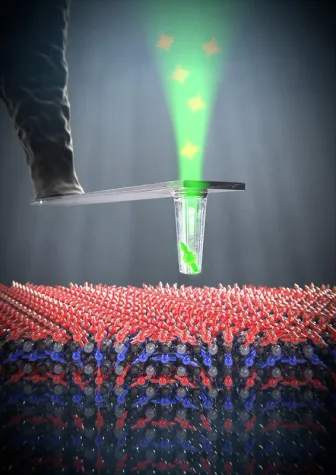
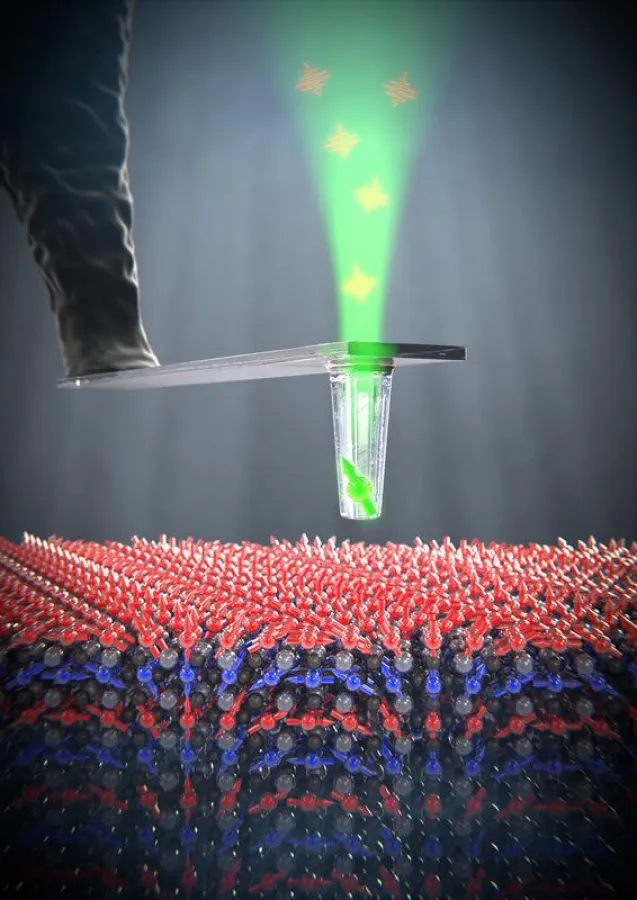
An individual electron spin in a quantum sensor reacts to the magnetic field of a thin film of bismuth ferrite.  ((Bild: Universität Basel, Departement Physik))
An individual electron spin in a quantum sensor reacts to the magnetic field of a thin film of bismuth ferrite. ((Bild: Universität Basel, Departement Physik))

(openPR) For the first time, physicists have successfully imaged spiral magnetic ordering in a multiferroic material. These materials are considered highly promising candidates for future data storage media. The researchers were able to prove their findings using unique quantum sensors that were developed at Basel University and that can analyze electromagnetic fields on the nanometer scale. The results – obtained by scientists from the University of Basel’s Department of Physics, the Swiss Nanoscience Institute, the University of Montpellier and several laboratories from University Paris-Saclay – were recently published in the journal Nature.


---
Multiferroics are materials that simultaneously react to electric and magnetic fields. These two properties are rarely found together, and their combined effect makes it possible to change the magnetic ordering of materials using electric fields.

This offers particular potential for novel data storage devices: multiferroic materials can be used to create nanoscale magnetic storage media that can be deciphered and modified using electric fields.

Magnetic media of this kind would consume very little power and operate at very high speeds. They could also be used in spintronics – a new form of electronics that uses electrons’ spin as well as electrical charge.

Spiral magnetic ordering

Bismuth ferrite is a multiferroic material that exhibits electric and magnetic properties even at room temperature. While its electrical properties have been studied in depth, there was no suitable method for representing magnetic ordering on the nanometer scale until now.

The group led by Georg-H.-Endress Professor Patrick Maletinsky, from the Swiss Nanoscience Institute and the University of Basel’s Department of Physics, has developed quantum sensors based on diamonds with nitrogen vacancy centers. This allowed them, in collaboration with colleagues at the University of Montpellier and the University Paris-Saclay in France, to depict and study the magnetic ordering of a thin bismuth ferrite film for the first time, as they report in Nature.

Knowing how the electron spins behave and how the magnetic field is ordered is of crucial importance for the future application of multiferroic materials as data storage.

The scientists were able to show that bismuth ferrite exhibits spiral magnetic ordering, with two superimposed electron spins (shown in red and blue in the image) adopting opposing orientations and rotating in space, whereas it was previously assumed that this rotation took place within a plane. According to the researchers, the quantum sensors now show that a slight tilt in these opposing spins leads to spatial rotation with a slight twist.

“Our diamond quantum sensors allow not only qualitative but also quantitative analysis. This meant we were able to obtain a detailed picture of the spin configuration in multiferroics for the first time,” explains Patrick Maletinsky. “We are confident that this will pave the way for advances in research into these promising materials.”

Vacancies with special properties

The quantum sensors they used consist of two tiny monocrystalline diamonds, whose crystal lattices have a vacancy and a nitrogen atom in two neighboring positions. These nitrogen vacancy centers contain orbiting electrons whose spins respond very sensitively to external electric and magnetic fields, allowing the fields to be imaged at a resolution of just a few nanometers.

Scientists at the University of Montpellier took the magnetic measurements using the quantum sensors produced in Basel. The samples were supplied by experts from the CNRS/Thales laboratory at University Paris-Saclay, who are leading lights in the field of bismuth ferrite research.

Quantum sensors for the market

The quantum sensors used in the research are suitable for studying a wide range of materials, as they provide precisely detailed qualitative and quantitative data both at room temperature and at temperatures close to absolute zero.

In order to make them available to other research groups, Patrick Maletinsky founded the start-up Qnami in 2016 in collaboration with Dr. Mathieu Munsch. Qnami produces the diamond sensors and provides application advice to its customers from research and industry.

Original article

I. Gross, W. Akhtar, V. Garcia, L. J. Martínez, S. Chouaieb, K. Garcia, C. Carrétéro, A. Barthélémy, P. Appel, P. Maletinsky, J.-V. Kim, J. Y. Chauleau, N. Jaouen, M. Viret, M. Bibes, S. Fusil and V. Jacques
Real-space imaging of non-collinear antiferromagnetic order with a single spin magnetometer
Nature (2017), doi: 10.1038/nature23656

Further information

Prof. Patrick Maletinsky, University of Basel, Department of Physics, tel. +41 61 207 37 63, email: E-Mail

Quelle: idw

Diese Pressemeldung wurde auf openPR veröffentlicht.

Verantwortlich für diese Pressemeldung:

News-ID: 968619
 555

Kostenlose Online PR für alle

Jetzt Ihren Pressetext mit einem Klick auf openPR veröffentlichen

Jetzt gratis starten

Pressebericht „Quantum Sensors Decipher Magnetic Ordering in a New Semiconducting Material“ bearbeiten oder mit dem "Super-PR-Sparpaket" stark hervorheben, zielgerichtet an Journalisten & Top50 Online-Portale verbreiten:

PM löschen PM ändern
Disclaimer: Für den obigen Pressetext inkl. etwaiger Bilder/ Videos ist ausschließlich der im Text angegebene Kontakt verantwortlich. Der Webseitenanbieter distanziert sich ausdrücklich von den Inhalten Dritter und macht sich diese nicht zu eigen. Wenn Sie die obigen Informationen redaktionell nutzen möchten, so wenden Sie sich bitte an den obigen Pressekontakt. Bei einer Veröffentlichung bitten wir um ein Belegexemplar oder Quellenennung der URL.

Pressemitteilungen KOSTENLOS veröffentlichen und verbreiten mit openPR

Stellen Sie Ihre Medienmitteilung jetzt hier ein!

Jetzt gratis starten

Weitere Mitteilungen von Universität Basel

Bild: Bei Zuckermangel in der Zelle leben Boten-RNAs längerBild: Bei Zuckermangel in der Zelle leben Boten-RNAs länger
Bei Zuckermangel in der Zelle leben Boten-RNAs länger
Leidet eine Zelle unter Zuckermangel, speichert sie bestimmte Boten-RNAs, um so ihr Leben zu verlängern. Wie eine Forschungsgruppe am Biozentrum der Universität Basel nun herausfand, entscheidet das Protein Puf5p bei Zuckermangel in der Zelle darüber, ob eine Boten-RNA aufbewahrt oder abgebaut wird. Wie die in eLife veröffentlichte Studie zeigt, schickt das Protein die Boten-RNAs dazu in eine Zellorganelle, wo ihr Schicksal besiegelt wird. --- Ist eine Zelle Stress ausgesetzt, sei es durch Mangel an Nährstoffen oder einem Zuviel an Spurenele…
Akshay Venkatesh erhält Ostrowski-Preis für höhere Mathematik
Der US-Mathematiker Akshay Venkatesh erhält den mit 100'000 Franken dotierten internationalen Ostrowski-Preis für höhere Mathematik 2017. Die Auszeichnung geht auf den Mathematikprofessor Alexander M. Ostrowski zurück, der an der Universität Basel gelehrt hat. --- Akshay Venkatesh, Professor an der Stanford University, erhält die Auszeichnung für seine bahnbrechenden Leistungen auf den Gebieten der Zahlentheorie, der Theorie der automorphen Formen, der Repräsentationstheorie, der homogenen Dynamik und der arithmetischen Geometrie. Ein wicht…

Das könnte Sie auch interessieren:

Bild: Quantum magnets doped with holesBild: Quantum magnets doped with holes
Quantum magnets doped with holes
MPQ-scientists reveal hidden magnetic order in one-dimensional quantum crystals doped with holes. --- Magnetism is a phenomenon that we experience in everyday-life quite often. The property, which is observed in materials such as such as iron, is caused by the alignment of electron spins. Even more interesting effects are expected in case that the magnetic …
Bild: Organic photodiodes – more economical detectors for the NIR regionBild: Organic photodiodes – more economical detectors for the NIR region
Organic photodiodes – more economical detectors for the NIR region
… wafer level and are therefore economical. Simultaneously, they also may have high sensitivity outside the visible wavelength region, depending on the system of materials selected. The Fraunhofer FEP has extensive experience in integrating organic layers on CMOS wafers. Diverse OLED microdisplays (high-resolution, low power, embedded image sensors, ...) …
Bild: Quantenphysik lässt Nanomagnete stabil schwebenBild: Quantenphysik lässt Nanomagnete stabil schweben
Quantenphysik lässt Nanomagnete stabil schweben
… unterstützt wurden die Forschung vom österreichischen Bundesministerium für Wissenschaft, Forschung und Wirtschaft und dem Europäischen Forschungsrat ERC. Publikationen: o) Quantum Spin Stabilized Magnetic Levitation. Cosimo C. Rusconi, Vera Pöchhacker, Katja Kustura, J. Ignacio Cirac, Oriol Romero-Isart. Phys. Rev. Lett. 119, 167202 DOI: 10.1103/PhysRevLett.119.167202 o) …
Imaging how magnetism goes surfing
Using advanced dynamic imaging, researchers have been able to visualise deformation (sound) waves in crystals and measured the effect on nanomagnetic elements. This offers new low power magnetization manipulation for memory or logic applications and the methodology offers a new approach for analysing dynamic strains in other research fields: nanoparticles, …
Riddle of matter remains unsolved: Proton and antiproton share fundamental properties
Magnetic forces in antiprotons now measured to nine significant digits—350 times more precise than before --- The search goes on. No difference in protons and antiprotons have yet been found which would help to potentially explain the existence of matter in our universe. However, physicists in the BASE collaboration at the CERN research center have been …
Bild: Nanomagnets Levitate Thanks to Quantum PhysicsBild: Nanomagnets Levitate Thanks to Quantum Physics
Nanomagnets Levitate Thanks to Quantum Physics
… Oriol Romero-Isart’s research group in Innsbruck show in two current publications that, despite Earnshaw’s theorem, nanomagnets can be stably levitated in an external static magnetic field owing to quantum mechanical principles. The quantum angular momentum of electrons, which also causes magnetism, is accountable for this mechanism. --- Already in 1842, …
Bild: Bit data goes anti-skyrmionsBild: Bit data goes anti-skyrmions
Bit data goes anti-skyrmions
Today’s world, rapidly changing because of “big data”, is encapsulated in trillions of tiny magnetic objects – magnetic bits – each of which stores one bit of data in magnetic disk drives. A group of scientists from the Max Planck Institutes in Halle and Dresden have discovered a new kind of magnetic nano-object in a novel material that could serve …
Bild: Magnetic Quantum Objects in a "Nano Egg-Box"Bild: Magnetic Quantum Objects in a "Nano Egg-Box"
Magnetic Quantum Objects in a "Nano Egg-Box"
Magnetic quantum objects in superconductors, so-called "fluxons", are particularly suitable for the storage and processing of data bits. Computer circuits based on fluxons could be operated with significantly higher speed and, at the same time, produce much less heat dissipation. Physicists around Wolfgang Lang at the University of Vienna and their colleagues …
Bild: Carbon Nanotubes Turn Electrical Current into Light-emitting Quasi-particlesBild: Carbon Nanotubes Turn Electrical Current into Light-emitting Quasi-particles
Carbon Nanotubes Turn Electrical Current into Light-emitting Quasi-particles
Light-matter quasi-particles can be generated electrically in semiconducting carbon nanotubes. Material scientists and physicists from Heidelberg University (Germany) and the University of St Andrews (Scotland) used light-emitting and extremely stable transistors to reach strong light-matter coupling and create exciton-polaritons. These particles may …
Bild: Physicists find strange state of matter in superconducting crystalBild: Physicists find strange state of matter in superconducting crystal
Physicists find strange state of matter in superconducting crystal
… sample of layered cerium, rhodium and indium (CeRhIn5), scientists discovered that electrons unite to flow in the same direction (a behavior called “breaking symmetry”) when in high magnetic fields of 30 tesla. Known as “electronic nematic,” this is a rare state of matter between liquid and crystal. “It’s sort of like in ancient times,” clarifies Phillip …
Sie lesen gerade: Quantum Sensors Decipher Magnetic Ordering in a New Semiconducting Material