openPR Recherche & Suche
Presseinformation

Carbon Nanotubes Turn Electrical Current into Light-emitting Quasi-particles

26.07.201711:07 UhrWissenschaft, Forschung, Bildung
Bild: Carbon Nanotubes Turn Electrical Current into Light-emitting Quasi-particles
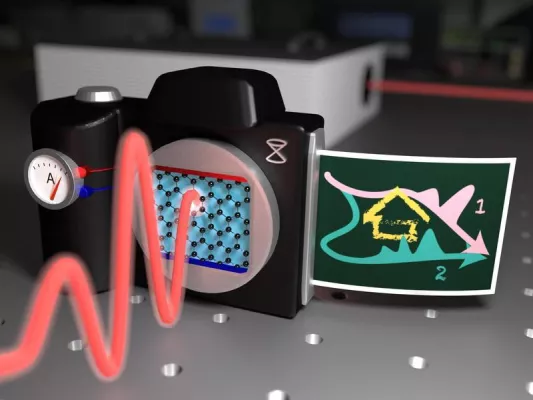
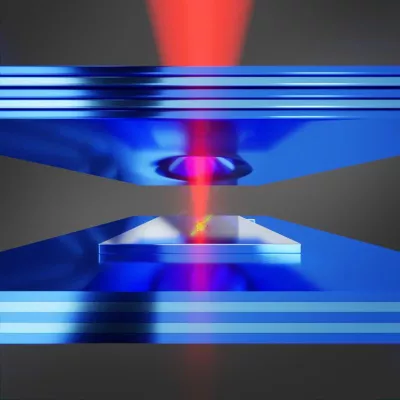
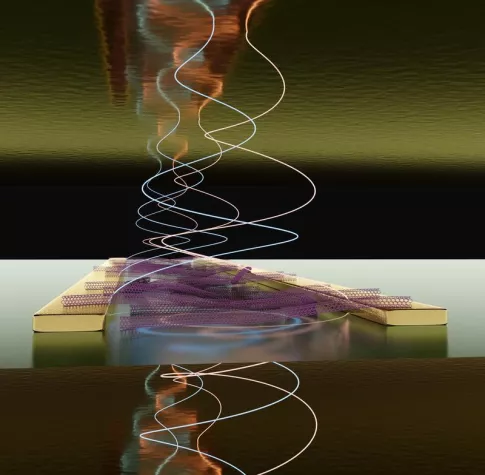
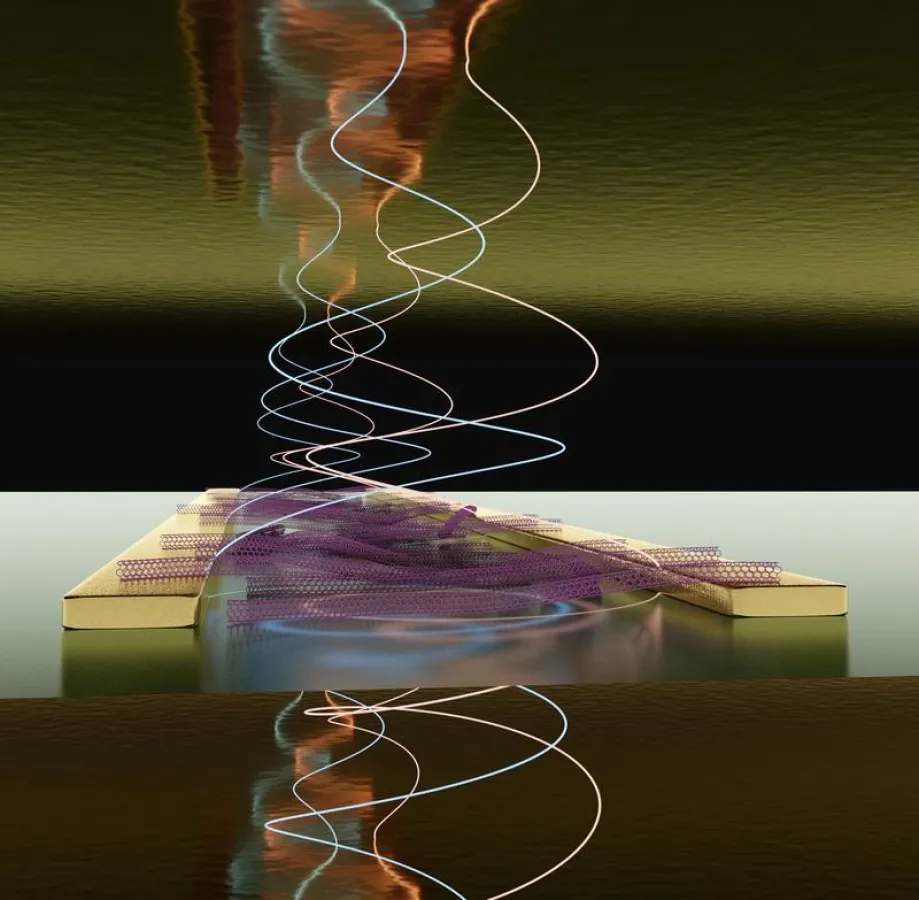
Artistic rendering of a light-emitting transistor with carbon nanotubes between two mirrors for electrical generation of polaritons.  (Image credit: Dr Yuriy Zakharko, co-author)
Artistic rendering of a light-emitting transistor with carbon nanotubes between two mirrors for electrical generation of polaritons. (Image credit: Dr Yuriy Zakharko, co-author)

(openPR) Light-matter quasi-particles can be generated electrically in semiconducting carbon nanotubes. Material scientists and physicists from Heidelberg University (Germany) and the University of St Andrews (Scotland) used light-emitting and extremely stable transistors to reach strong light-matter coupling and create exciton-polaritons. These particles may pave the way for new light sources, so-called electrically pumped polariton lasers, that could be manufactured with carbon nanotubes.


---
Press Release
Heidelberg, 24 July 2017

Carbon Nanotubes Turn Electrical Current into Light-emitting Quasi-particles
Strong light-matter coupling in these semiconducting tubes may hold the key to electrically pumped lasers

Light-matter quasi-particles can be generated electrically in semiconducting carbon nanotubes. Material scientists and physicists from Heidelberg University (Germany) and the University of St Andrews (Scotland) used light-emitting and extremely stable transistors to reach strong light-matter coupling and create exciton-polaritons. These particles may pave the way for new light sources, so-called electrically pumped polariton lasers, that could be manufactured with carbon nanotubes. These findings, published in "Nature Materials", are the result of a cooperation between Prof. Dr Jana Zaumseil (Heidelberg) and Prof. Dr Malte C. Gather (St Andrews).

In recent years, research on organic, carbon-based semiconductors for optoelectronic components has led to a variety of applications. Among them are light-emitting diodes for energy-efficient, high-resolution smartphone and TV screens. Despite the rapid progress in this area, realising an electrically pumped laser from organic materials remains elusive. To get closer to this goal, researchers in Heidelberg and St Andrews are working on coupling light and matter in semiconducting carbon nanotubes – microscopically small, tube-shaped structures of carbon.

When photons (light) and excitons (matter) are made to exchange energy fast enough they form new quasi-particles, known as exciton-polaritons, that also emit light. Under certain conditions these emissions can take on the properties of laser light. Prof. Zaumseil explains that exciton-polaritons are currently investigated as a new way to generate laser-like light from organic materials and research in this area has increased significantly.

The team of researchers around Prof. Zaumseil and Prof. Gather previously showed that it is possible to form exciton-polaritons in semiconducting carbon nanotubes. But they used an external laser to stimulate the formation of the light-emitting quasi-particles. In their current experiments, the researchers showed that it is possible to use electricity to generate these particles. To achieve this, they developed a light-emitting transistor with a dense layer to semiconducting carbon nanotubes that was embedded between two metallic mirrors.

Because of the extreme stability and high conductivity provided by the carbon nanotubes in this device, current densities and thus polariton densities were orders of magnitude above any previously reported values. Calculations by PhD student Arko Graf – one of the two lead authors of the study, show that the demonstration of an electrically pumped polariton laser is within realistic reach. As the emission of these light sources can be tuned across a wide range of the near-infrared spectrum, this work holds particular promise for applications in telecommunications.

Original publication:
A. Graf, M. Held, Y. Zakharko, L. Tropf, M.C. Gather and J. Zaumseil: Electrical pumping and tuning of exciton-polaritons in carbon nanotube microcavities. Nature Materials (published online 17 July 2017), doi: 10.1038/nmat4940

Contact:
Prof. Dr Jana Zaumseil
Institute of Physical Chemistry
Phone +49 6221 54-5065

E-Mail

Communications and Marketing
Press Office, phone +49 6221 54-2311

E-Mail

Weitere Informationen:
- http://www.pci.uni-heidelberg.de/apc/zaumseil/index.html
- http://gatherlab.wp.st-andrews.ac.uk

Quelle: idw

Diese Pressemeldung wurde auf openPR veröffentlicht.

Verantwortlich für diese Pressemeldung:

News-ID: 960223
 353

Kostenlose Online PR für alle

Jetzt Ihren Pressetext mit einem Klick auf openPR veröffentlichen

Jetzt gratis starten

Pressebericht „Carbon Nanotubes Turn Electrical Current into Light-emitting Quasi-particles“ bearbeiten oder mit dem "Super-PR-Sparpaket" stark hervorheben, zielgerichtet an Journalisten & Top50 Online-Portale verbreiten:

PM löschen PM ändern
Disclaimer: Für den obigen Pressetext inkl. etwaiger Bilder/ Videos ist ausschließlich der im Text angegebene Kontakt verantwortlich. Der Webseitenanbieter distanziert sich ausdrücklich von den Inhalten Dritter und macht sich diese nicht zu eigen. Wenn Sie die obigen Informationen redaktionell nutzen möchten, so wenden Sie sich bitte an den obigen Pressekontakt. Bei einer Veröffentlichung bitten wir um ein Belegexemplar oder Quellenennung der URL.

Pressemitteilungen KOSTENLOS veröffentlichen und verbreiten mit openPR

Stellen Sie Ihre Medienmitteilung jetzt hier ein!

Jetzt gratis starten

Weitere Mitteilungen von Universität Heidelberg

Dem Phänomen der Supraleitung auf der Spur
Mithilfe ultrakalter Atome haben Wissenschaftler der Universität Heidelberg einen exotischen Materiezustand nachgewiesen. Dabei bilden die zugrundeliegenden Teilchen Paare, wenn ihre Bewegung auf zwei Dimensionen beschränkt wird. Diese Erkenntnisse aus der Quantenphysik könnten wichtige Hinweise liefern, um Phänomene der Supraleitung besser zu verstehen. Die Forschungsergebnisse wurden in der Fachzeitschrift „Science“ veröffentlicht. --- Heidelberg, 21. Dezember 2017 Pressemitteilung Dem Phänomen der Supraleitung auf der Spur Fermionische P…
SCHEIN & SEIN: Von Tatsachen, Irrtümern und Lügen
Eine fundamentale Aufgabe der Wissenschaft ist es, aus einer Fülle von scheinbaren Optionen heraus Fakten und Erkenntnisse von Unrichtigem und Falschem zu trennen. Auch in anderen Bereichen des Lebens stellt sich immer wieder die Herausforderung, zwischen Tatsache, Irrtum und Lüge unterscheiden zu müssen. Dieser Thematik des SCHEIN & SEIN ist die elfte Ausgabe des Forschungsmagazins „Ruperto Carola“ gewidmet. 21 Wissenschaftlerinnen und Wissenschaftler der Universität Heidelberg beschäftigen sich mit unterschiedlichen Aspekten dieses Schwerpu…

Das könnte Sie auch interessieren:

Bild: Exotic quantum states made from light: Physicists create optical “wells” for a super-photonBild: Exotic quantum states made from light: Physicists create optical “wells” for a super-photon
Exotic quantum states made from light: Physicists create optical “wells” for a super-photon
… complex arrangements, for which quantum entanglement occurs in interaction with a possible photon interaction in suitable materials, can be produced with this experimental setup.” This would, in turn, be the prerequisite for a new technique for quantum communication and quantum computers. “But that’s still a long way off,” says Weitz. The findings by …
Bild: OLEDs applied to paper-thin stainless steelBild: OLEDs applied to paper-thin stainless steel
OLEDs applied to paper-thin stainless steel
… the conventional substrate materials like glass or plastic web the material possesses special properties for this purpose and is well-suited as a substrate for organic light-emitting diodes (OLEDs), for example. Thanks to the planarization layer developed by NSSMC as well as the comparatively good thermal conductivity of stainless steel, homogenous large-area …
Bild: FutureCarbon erstmals auf der JEC Composites in ParisBild: FutureCarbon erstmals auf der JEC Composites in Paris
FutureCarbon erstmals auf der JEC Composites in Paris
Eine Heizbeschichtung, die sich so leicht auf beliebige Oberflächen und Geometrien auftragen lässt, wie Standard-Acrylfarben und ein Granulat aus Carbon Nanotubes, das sich so einfach in Flüssigkeiten dispergieren lässt, wie lösliches Kaffee-Pulver in heißem Wasser. Mit diesen und weiteren innovativen Produkten wird FutureCarbon auf der JEC Composites …
Controlled manipulation
… the properties of hybrid systems consisting of carbon nanostructures and a dye. --- Carbon nanostructures offer a lot of potential. Both two-dimensional graphene and one-dimensional carbon nanotubes have unique properties that make them interesting when it comes to possible industrial applications. Carbon nanostructures could be used in new kinds of …
Bild: The fastest light-driven current sourceBild: The fastest light-driven current source
The fastest light-driven current source
Controlling electronic current is essential to modern electronics, as data and signals are transferred by streams of electrons which are controlled at high speed. Demands on transmission speeds are also increasing as technology develops. Scientists from the Chair of Laser Physics and the Chair of Applied Physics at Friedrich-Alexander-Universität Erlangen-Nürnberg …
Bild: Using Mirrors to Improve the Quality of Light ParticlesBild: Using Mirrors to Improve the Quality of Light Particles
Using Mirrors to Improve the Quality of Light Particles
… be used to produce entanglement. Successful optimization Doctoral student Daniel Riedel has now succeeded in boosting the yield of useful photons from these NV centers from 3% to a current value of 50%. In addition, he has been able to almost double the rate at which the photons are emitted. Riedel achieved these significant improvements by placing a …
Bild: Flexible proximity sensor creates smart surfacesBild: Flexible proximity sensor creates smart surfaces
Flexible proximity sensor creates smart surfaces
Fraunhofer IPA has developed a proximity sensor made from silicone and carbon nanotubes (CNT) which detects objects and determines their position. The materials and printing process used mean that the sensor is extremely flexible, economical and can be used for large surfaces. Industry and research partners can use and further develop this innovation …
Bild: Starke Rolle von FutureCarbon bei großangelegter InnovationsallianzBild: Starke Rolle von FutureCarbon bei großangelegter Innovationsallianz
Starke Rolle von FutureCarbon bei großangelegter Innovationsallianz
Das Bundesministerium für Bildung und Forschung (BMBF) fördert seit April 2008 eine Initiative zur Erforschung von Carbon Nanotubes (CNT) und deren Anwendungen. Die in Bayreuth ansässige Firma FutureCarbon GmbH nimmt als einer der größten Partner an diesen Förderprojekten teil. FutureCarbon entwickelt dabei Verfahren weiter, die eine sichere industrielle …
Lithium-Ionen-Batterien mit mehr Ausdauer und Leistung
… der Elektromobilität eine höhere Reichweite zu erzielen und damit einen Beitrag zum Umweltschutz zu leisten. Innovative Elektroden auf CNT-Basis (Kohlenstoffnanoröhrchen = Carbon Nanotubes, CNT) stehen darum im Fokus von CarboPower – einem Projekt, das im Rahmen der Innovationsallianz Carbon Nanotubes (Inno.CNT), einer Forschungsinitiative im Bereich …
Bild: Die Zukunft der Displays ist dioVisionBild: Die Zukunft der Displays ist dioVision
Die Zukunft der Displays ist dioVision
… Technik erlaubt es, Raum-Effekte für Handys, Computer, Displays und Fernseher in nie da gewesener Qualität darzustellen. Besonders mit der Entwicklung der neuen OLED-Displays (organic light-emitting diode), lässt sich mit geringstem Kostenaufwand ein hochqualitativer, räumlicher Eindruck realisieren. 3D war gestern, heute gibt es diovision. Wer …
Sie lesen gerade: Carbon Nanotubes Turn Electrical Current into Light-emitting Quasi-particles