openPR Recherche & Suche
Presseinformation

UZH Anthropologists Describe Third Orangutan Species

02.11.201718:00 UhrWissenschaft, Forschung, Bildung
Bild: UZH Anthropologists Describe Third Orangutan Species
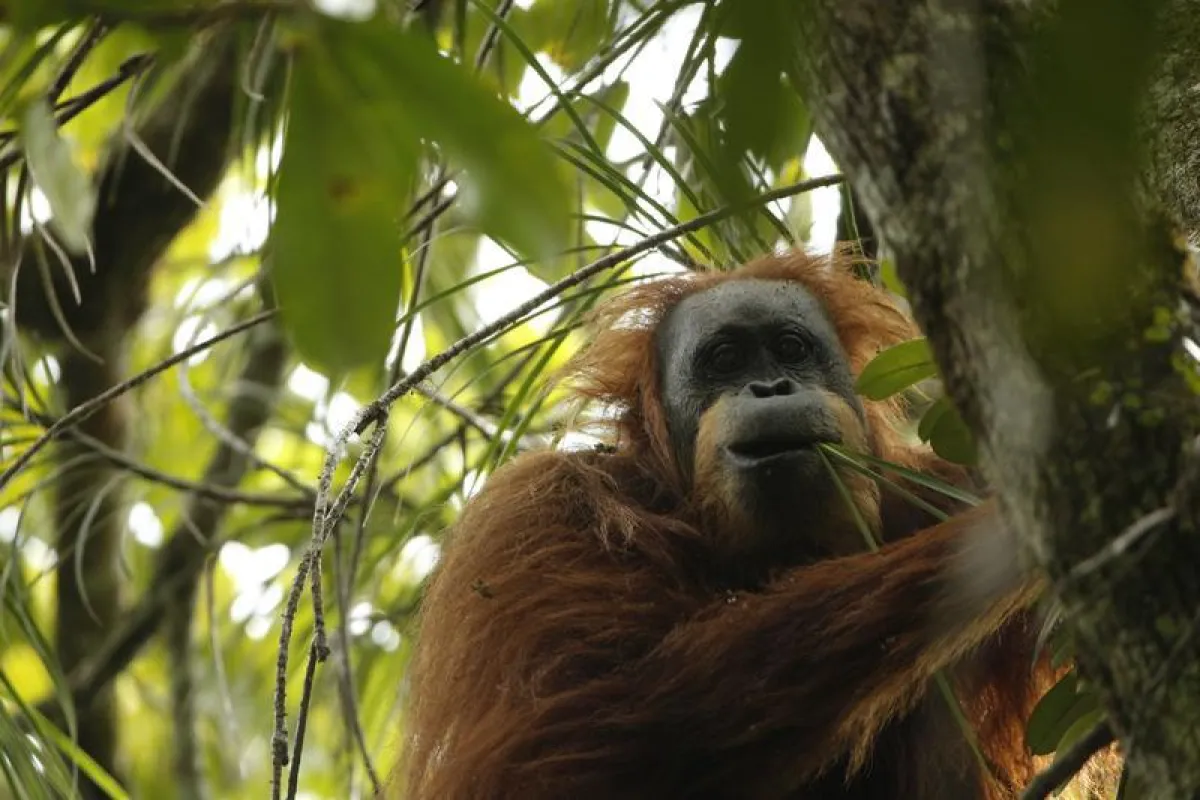
Tapanuli orangutan (Tim Laman)

(openPR) Previously only two species of orangutans were recognized – the Bornean and the Sumatran orangutan. Now, UZH researchers working with an international team have described a new great ape species, the Tapanuli orangutan. It is the great ape species at greatest risk of extinction, with only around 800 remaining individuals occuring in upland forest regions of North Sumatra.


---
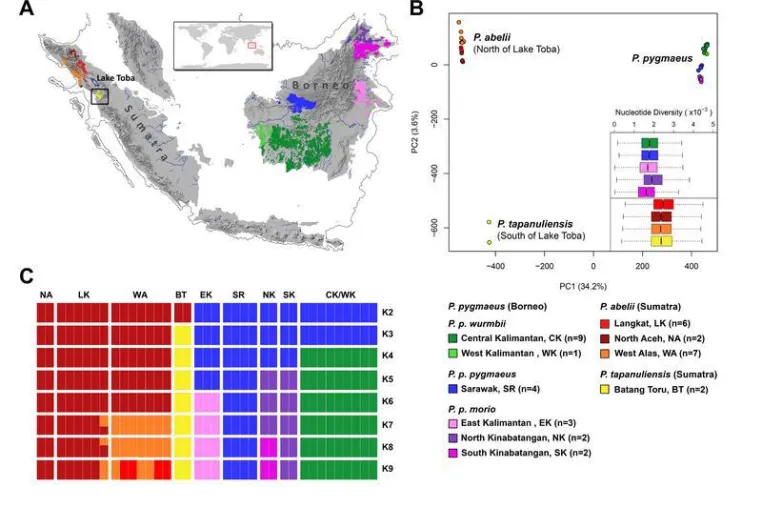
Two species of Indonesian orangutans had previously been officially described and recognized – the Pongo abelii, living on the island of Sumatra, and the Pongo pygmeaeus, endemic to Borneo. In 1997, researchers at the Australian National University discovered an isolated population of orangutans in Batang Toru, a region within the three Tapanuli districts in North Sumatra. UZH anthropologists working together with an international research team have now established that these orangutans are actually a distinct third species, Pongo tapanuliensis. The study carried out by the UZH researchers is the largest genomic study of wild orangutans to date.

Unique teeth and skulls

The first indications of the uniqueness of the Tapanuli population came from the skeletal material of an adult male orangutan killed in 2013 – when compared to other skulls it turned out that certain characteristics of the teeth and skull of the Tapanuli orangutan were unique. “We were quite surprised that the skull was quite different in some characteristics from anything we had seen before,” explains Matt Nowak, who researched the morphological characteristics as part of his PhD thesis and now works for the Sumatran Orangutan Conservation Programme (SOCP).

Three evolutionary lineages identified

“When we realized that the Tapanuli orangutans were morphologically different from all other orangutans, the pieces of the puzzle fell into place,” adds Michael Krützen, Professor of Evolutionary Anthropology and Genomics at UZH. Krützen and his team have been researching the genetic lineage of all living orangutan populations for some time. Previous study results combined with the new genome sequencing of 37 orangutans showed a picture that was consistent with the morphological findings: “We identified three very old evolutionary lineages among all orangutans, despite only having two species currently described,” says Maja Mattle-Greminger, a postdoctoral researcher at UZH.

Direct descendants of the first orangutan population

Extensive computer modelling aimed at reconstructing the history of the population enabled the UZH researchers to verify their new findings. Their calculations show that the Tapanuli population appears to have been isolated from all other Sumatran populations of orangutans for at least 10,000 to 20,000 years. Alexander Nater, who completed his PhD at UZH, explains: “The oldest evolutionary line in the genus Pongo is actually found in Tapanuli orangutans, which appear to be direct descendants of the first Sumatran population in the Sunda archipelago.” In addition, behavioral observations and ecological surveys support the genetic and morphological analyses.

Species conservation the top priority

“It is very exciting to discover a new great ape species in the 21st century,” says the principal author of the study Michael Krützen, although he cautions that the highest priority must now be to protect the Tapanuli orangutan. “All conservation efforts must focus on protecting the species’ environment,” stresses Krützen. More and more rainforest is being lost to agricultural use – virgin forests in the Batang Toru ecosystem are giving way to palm oil plantations, and there are also plans for the construction of a hydroelectric dam which would further intrude on the Tapanuli orangutans’ environment.

A recent survey carried out independently by Indonesian and international scientists indicated that no more than 800 individuals of the Tapanuli population remain, making the Tapanuli orangutan the great ape species at greatest risk of extinction. “If steps are not taken quickly to reduce current and future threats and to conserve every last remaining bit of forest, a great ape species may become extinct within a few decades,” warns Matt Nowak, who supervises research into the Tapanuli orangutans at the Sumatran Orangutan Conservation Programme.

Literature:

Alexander Nater et al. Morphometric, behavioral, and genomic evidence for a new orangutan species. Current Biology. November 2, 2017. DOI:10.1016/j.cub.2017.09.047

Sumatran Orangutan Conservation Programme (SOCP)

In 2005, the Sumatran Orangutan Conservation Programme (SOCP) and other non-governmental organisations, together with several universities and the Indonesian authorities, stepped up their research efforts into the orangutans in the Batang Toru ecosystem. As part of these efforts, in 2006 a monitoring station was established by the SOCP to enable the behavioral ecology and genetics of the Tapanuli orangutan to be examined in more detail.

https://sumatranorangutan.org/

http://www.batangtoru.org/

Main contact

Prof. Dr. Michael Krützen

Anthropological Institute and Museum

University of Zurich

Phone +41 44 635 54 12 / +41 44 308 76 09

E-mail: E-Mail

Questions regarding genetics/genomics

Dr. Maja Mattle-Greminger

Anthropological Institute and Museum

University of Zurich

Phone +41 76 365 19 27

E-mail: E-Mail

Dr. Alexander Nater

Department of Biology

University of Konstanz

Phone +49 7531 88 4066

E-mail: E-Mail

Questions regarding taxonomy/morphology/conservation of species

Dr. Matt Nowak

Sumatran Orangutan Conservation Programme

Department of Anthropology

Southern Illinois University

E-mail: E-Mail

Media Relations

University of Zurich

Phone +41 44 634 44 67

E-mail: E-Mail

Weitere Informationen:
- http://www.media.uzh.ch/en/Press-Releases.html
- http://(Video from October 31, on demand)

Quelle: idw

Diese Pressemeldung wurde auf openPR veröffentlicht.

Verantwortlich für diese Pressemeldung:

News-ID: 977866
 493

Kostenlose Online PR für alle

Jetzt Ihren Pressetext mit einem Klick auf openPR veröffentlichen

Jetzt gratis starten

Pressebericht „UZH Anthropologists Describe Third Orangutan Species“ bearbeiten oder mit dem "Super-PR-Sparpaket" stark hervorheben, zielgerichtet an Journalisten & Top50 Online-Portale verbreiten:

PM löschen PM ändern
Disclaimer: Für den obigen Pressetext inkl. etwaiger Bilder/ Videos ist ausschließlich der im Text angegebene Kontakt verantwortlich. Der Webseitenanbieter distanziert sich ausdrücklich von den Inhalten Dritter und macht sich diese nicht zu eigen. Wenn Sie die obigen Informationen redaktionell nutzen möchten, so wenden Sie sich bitte an den obigen Pressekontakt. Bei einer Veröffentlichung bitten wir um ein Belegexemplar oder Quellenennung der URL.

Pressemitteilungen KOSTENLOS veröffentlichen und verbreiten mit openPR

Stellen Sie Ihre Medienmitteilung jetzt hier ein!

Jetzt gratis starten

Weitere Mitteilungen von Universität Zürich

Neue Biomarker sagen Erfolg von Immuntherapie gegen Krebs  voraus
Neue Biomarker sagen Erfolg von Immuntherapie gegen Krebs voraus
Ob Krebspatienten auf eine Immuntherapie positiv ansprechen werden, lässt sich bereits vorgängig im Blut nachweisen. Forschende der Universität Zürich haben entsprechende Biomarker identifiziert. Patienten, bei denen die Therapie nicht wirkt, können frühzeitig mit anderen Methoden behandelt werden. --- Mit einer Immuntherapie kann bereits heute der schwarze Hautkrebs (Melanom) und der Lungen-krebs erfolgreich bekämpft werden. Dabei wird die normale Funktion des Immunsystems, das re-gelmässig alle Gewebe im Körper auf Krankheitserreger und St…
Bild: Universität Zürich und Karls-Universität Prag spannen zusammenBild: Universität Zürich und Karls-Universität Prag spannen zusammen
Universität Zürich und Karls-Universität Prag spannen zusammen
Die Universität Zürich und die Karls-Universität Prag gehen eine strategische Partnerschaft ein. Die grössten Universitäten Tschechiens und der Schweiz stärken die Zusammenarbeit in Forschung und Lehre sowie den Austausch von Studentinnen und Studenten. --- Die dritte strategische Partnerschaft geht die Universität Zürich mit der ältesten Universität Mitteleuropas ein. In Prag haben Rektor Michael Hengartner und Tomas Zima, Rektor der Karls-Universität, am 19. Dezember 2017 den Vertrag unterzeichnet. Die Universität ist im Jahre 1348 gegründ…

Das könnte Sie auch interessieren:

Bild: First Detailed Decoding of Complex Finger Millet GenomeBild: First Detailed Decoding of Complex Finger Millet Genome
First Detailed Decoding of Complex Finger Millet Genome
… fundamental basis for improving food security in countries like India and parts of Africa. --- For many poor farmers in India and Africa, finger millet is a major staple food. The crop species is not only a rich source of minerals like calcium, iron, magnesium and zinc, and it contains many vitamins and essential amino acids. The plant is also characterized by …
Bild: Flagship species could help protect freshwatersBild: Flagship species could help protect freshwaters
Flagship species could help protect freshwaters
Researchers at the Leibniz-Institute of Freshwater Ecology and Inland Fisheries (IGB) and the International Union for the Conservation of Nature (IUCN) are investigating which animal species could become the focus of conservation measures as “imposing” flagship species in order to halt the decline of species and habitats in freshwaters. The current study …
Bild: Conservationists are sounding the alarm: parrots much more threatened than assumedBild: Conservationists are sounding the alarm: parrots much more threatened than assumed
Conservationists are sounding the alarm: parrots much more threatened than assumed
More than one hundred experts all around the world demand for conservation actions --- Parrots are among the most endangered species. Already since the 1990s it is a fact that one third of the parrot species from Central and South America is critically endangered. Led by the biologist Dr. Juan F. Masello of the Justus Liebig University Gießen (JLU), …
Bild: Snakeheads – new study brings order into species chaosBild: Snakeheads – new study brings order into species chaos
Snakeheads – new study brings order into species chaos
… results further suggest a species-level diversity within snakeheads that is much higher than currently recognized. This higher species diversity is mostly due to several undescribed species with small distribution ranges from the Eastern Himalaya biodiversity hotspot and the inclusion of numerous samples for widespread species characterized by deep genetic …
Bild: UZH Life Sciences Fund investiert in erstes Spin-offBild: UZH Life Sciences Fund investiert in erstes Spin-off
UZH Life Sciences Fund investiert in erstes Spin-off
Der kürzlich geschaffene UZH Life Sciences Fund investiert erstmals: Er bringt rund eine Million Franken in das Jungunternehmen «CUTISS» ein, welches Hautsubstitute auf den Markt bringen will. Der Fonds wird in weitere Spin-offs aus den Life Sciences investieren, um dadurch den Transfer von Forschungsergebnissen aus der UZH in die Praxis zu beschleunigen. …
Bild: UZH-Anthropologen beschreiben dritte Orang-Utan-ArtBild: UZH-Anthropologen beschreiben dritte Orang-Utan-Art
UZH-Anthropologen beschreiben dritte Orang-Utan-Art
… Sumatra-Orang-Utan-Schutzprogramms für die Tapanuli-Orang-Utan einsetzt. Literatur: Alexander Nater et al. Morphometric, behavioral, and genomic evidence for a new orangutan species. Current Biology. November 2, 2017. DOI:10.1016/j.cub.2017.09.047 Sumatra-Orang-Utan-Schutzprogramm (SOCP) Das Sumatra-Orang-Utan-Schutzprogramm (SOCP) wurde 1999 von der Schweizer …
Bild: UZH Life Sciences Fund Invests in First Spin-offBild: UZH Life Sciences Fund Invests in First Spin-off
UZH Life Sciences Fund Invests in First Spin-off
The recently created UZH Life Sciences Fund is making its first investment, putting one million CHF into CUTISS, a young company aiming to bring bioengineered skin grafts to market. The fund will be investing in further spin-offs with the goal of accelerating the transfer of UZH research findings into practice. The UZH Life Sciences Fund is financed …
Bild: Fotoausstellung über Orang-Utans im Stadtmuseum SchleswigBild: Fotoausstellung über Orang-Utans im Stadtmuseum Schleswig
Fotoausstellung über Orang-Utans im Stadtmuseum Schleswig
Pressemitteilung von Borneo Orangutan Survival (BOS) Deutschland e.V. vom 10. Juli 2012 Berlin/Schleswig: Fotoausstellung über Orang-Utans im Stadtmuseum Schleswig. Borneo Orangutan Survival (BOS) Deutschland stellt Fotografien der bedrohten Menschenaffen aus Mittwoch, 22.8.2012 , 19 Uhr, Stadtmuseum Schleswig: Dr. Heide Fischer vom Fotoclub Schleswig, …
Bild: Weltberühmte Orang-Utan-Forscherin zu Gast bei SilverseaBild: Weltberühmte Orang-Utan-Forscherin zu Gast bei Silversea
Weltberühmte Orang-Utan-Forscherin zu Gast bei Silversea
… von Kumani, dem Tor zum Tanjung Puting Nationalpark und dessen legendärem Camp Leaky, zu verbringen. Das Camp wird von Dr. Galdikas gemeinnütziger Stiftung „Orangutan Foundation International“ betrieben und gilt als Basis der bahnbrechenden Forschungen der Primatologin. Mit etwas Glück begegnen Gäste dort sogar Nasenaffen, Gibbons, Makaken und seltenen …
Bild: Rapid environmental change makes species more vulnerable to extinctionBild: Rapid environmental change makes species more vulnerable to extinction
Rapid environmental change makes species more vulnerable to extinction
Interactions between species play a key role in shaping biodiversity. A team of researchers including members of UZH has now shown that the coevolution of species that are embedded in complex networks of interactions is not only influenced directly by their partners but also indirectly by other species. This slows down the ability of complex communities …
Sie lesen gerade: UZH Anthropologists Describe Third Orangutan Species