openPR bei Google bevorzugen.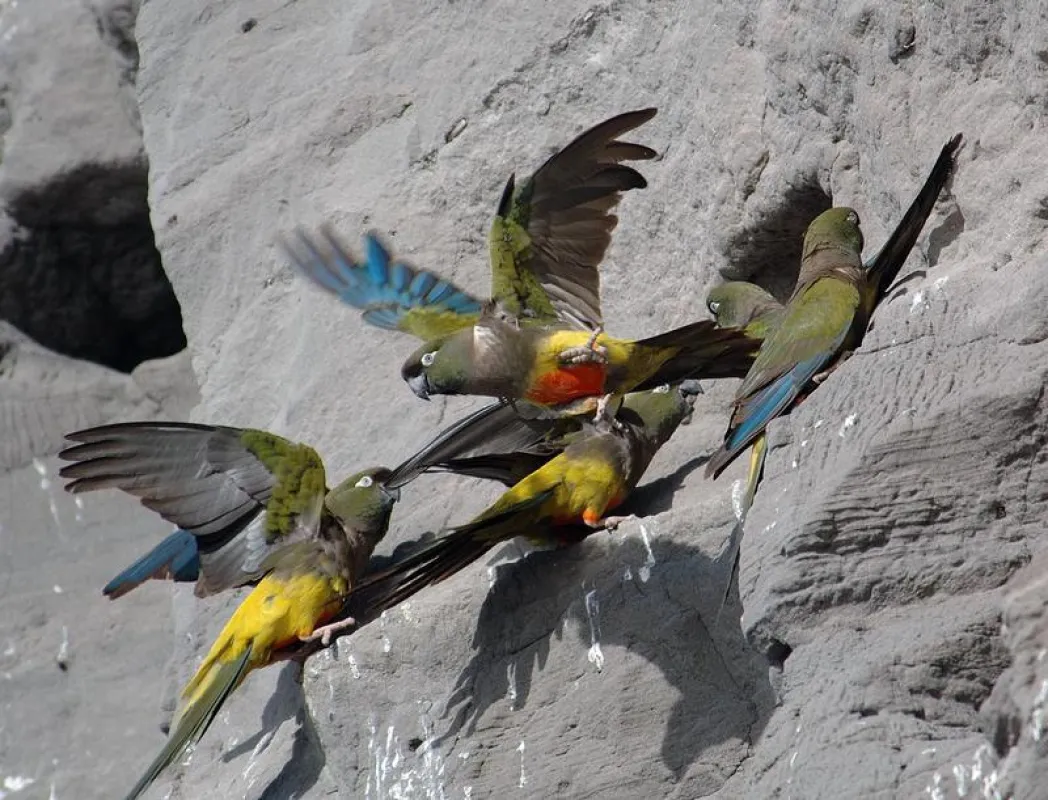
(openPR) More than one hundred experts all around the world demand for conservation actions
---
Parrots are among the most endangered species. Already since the 1990s it is a fact that one third of the parrot species from Central and South America is critically endangered. Led by the biologist Dr. Juan F. Masello of the Justus Liebig University Gießen (JLU), a team of more than one hundred international experts in parrot research and species conservation has come to even more alarming results. “What we discovered is very worrying”, comments Dr. Masello. “Actual species conservation measures are based on completely outdated data and are by no means sufficient.” The study has now been published in the journal “Biological Conservation” and examined the condition of 192 parrot populations in Latin America.
Many of the studied populations are on average exposed to ten different threats, most of them initiated by humankind. Agriculture, for example, affects 72 percent of populations, closely followed by the capture of parrots for the pet trade, which threatens 68 percent of populations. Natural vegetation clearing and other disturbances through human intrusions thus affect more than 55 percent of the examined populations – a result that implies a considerably higher risk than initially thought. In total, 63 percent of Latin American species were studied.
The results of the study show that the capture of wild parrots for the local pet trade correlates strongly with the decreasing population trends. Similar observations can be made with regard to the capture of wild parrots for international trade. The capture for international trade has been a major threat for parrots for decades, already in the 80s and 90s millions of them have been captured in Latin America and imported to the U.S., to Europe as well as to Japan. Intensive poaching led to the extinction of many parrots and is probably the main reason why there are no more free-living Spix Macaws.
Initiatives as the U.S. Wild Bird Conservation Act (1992) or the ban on imports of the European Union (2007) limited the trade in these huge markets, although South America, Southeast Asia and the Middle East still play a major role for the legal and illegal trade of wild parrots. According to the study, Bolivia, Brazil, Mexico and Peru have a flourishing parrot trade, for other countries even continued poaching is reported.
The findings suggest that effective measures need to be implemented urgently and should primarily aim at a prevention of the capture of wild parrots for the pet trade and the protection of parrot populations located near agricultural areas.
Publication
Berkunsky, I., Quillfeldt, P., Brightsmith, D.J., Abbud, M.C., Aguilar, J.M.R.E., Alemán-Zelaya, U., Aramburú, R.M., Arce Arias, A., Balas McNab, R., Balsby, T.J.S., Barredo Barberena, J.M., Beissinger, S.R., Rosales, M., Berg, K.S., Bianchi, C.A., Blanco, E., Bodrati, A., Bonilla-Ruz, C., Botero-Delgadillo, E., Canavelli, S.B., Caparroz, R., Cepeda, R.E., Chassot, O., Cinta-Magallón, C., Cockle, K.L., Daniele, G., de Araujo, C.B., de Barbosa, A.E., de Moura, L.N., Del Castillo, H., Díaz, S., Díaz-Luque, J.A., Douglas, L., Figueroa Rodríguez, A., García-Anleu, R.A., Gilardi, J.D., Grilli, P.G., Guix, J.C., Hernández, M., Hernández-Muñoz, A., Hiraldo, F., Horstman, E., Ibarra Portillo, R., Isacch, J.P., Jiménez, J.E., Joyner, L., Juarez, M., Kacoliris, F.P., Kanaan, V.T., Klemann-Júnior, L., Latta, S.C., Lee, A.T.K., Lesterhuis, A., Lezama-López, M., Lugarini, C., Marateo, G., Marinelli, C.B., Martínez, J., McReynolds, M.S., Mejia Urbina, C.R., Monge-Arias, G., Monterrubio-Rico, T.C., Nunes, A.P., Nunes, F., Olaciregui, C., Ortega-Arguelles, J., Pacifico, E., Pagano, L., Politi, N., Ponce-Santizo, G., Portillo Reyes, H.O., Prestes, N.P., Presti, F., Renton, K., Reyes-Macedo, G., Ringler, E., Rivera, L., Rodríguez-Ferraro, A., Rojas-Valverde, A.M., Rojas-Llanos, R.E., Rubio-Rocha, Y.G., Saidenberg, A.B.S., Salinas-Melgoza, A., Sanz, V., Schaefer, H.M., Scherer-Neto, P., Seixas, G.H.F., Serafini, P., Silveira, L.F., Sipinski, E.A.B., Somenzari, M., Susanibar, D., Tella, J.L., Torres-Sovero, C., Trofino-Falasco, C., Vargas-Rodríguez, R., Vázquez-Reyes, L.D., White Jr, T.H., Williams, S., Zarza, R. & Masello, J.F. (2017) Current threats faced by Neotropical parrot populations. Biological Conservation, 214, 278-287.
https://doi.org/10.1016/j.biocon.2017.08.016
Contact
Dr. Juan F. Masello
Department of Animal Ecology & Systematics
Phone: +49 641 99-35775
E-Mail:

Justus Liebig University Giessen (JLU), founded in 1607, is a research university steeped in tradition. Today, it attracts around 28,000 students. The university offers a huge spread of subjects, ranging from the traditional Sciences to Law and Economics, from Social and Educational sciences to Languages and Cultural Studies. It is unique, not only in Hesse, for the comprehensive spectrum within the life sciences – Medicine, Veterinary Medicine, Agricultural Sciences, Nutritional Sciences, Environmental Management and Food Chemistry. JLU is famous for a long history of illustrious teachers and researchers, including Nobel Prize winners such as Wilhelm Conrad Röntgen (Nobel Prize for Physics, 1901) and Wangari Maathai (Nobel Prize for Peace, 2004). Since 2006, the university has received funding in the Excellence Initiative (Excellence Cluster Cardio-Pulmonary System – ECCPS; International Graduate Centre for the Study of Culture – GCSC).
Quelle: idw