openPR Recherche & Suche
Presseinformation

Win-win strategies for climate and food security

02.10.201709:00 UhrWissenschaft, Forschung, Bildung
Bild: Win-win strategies for climate and food security
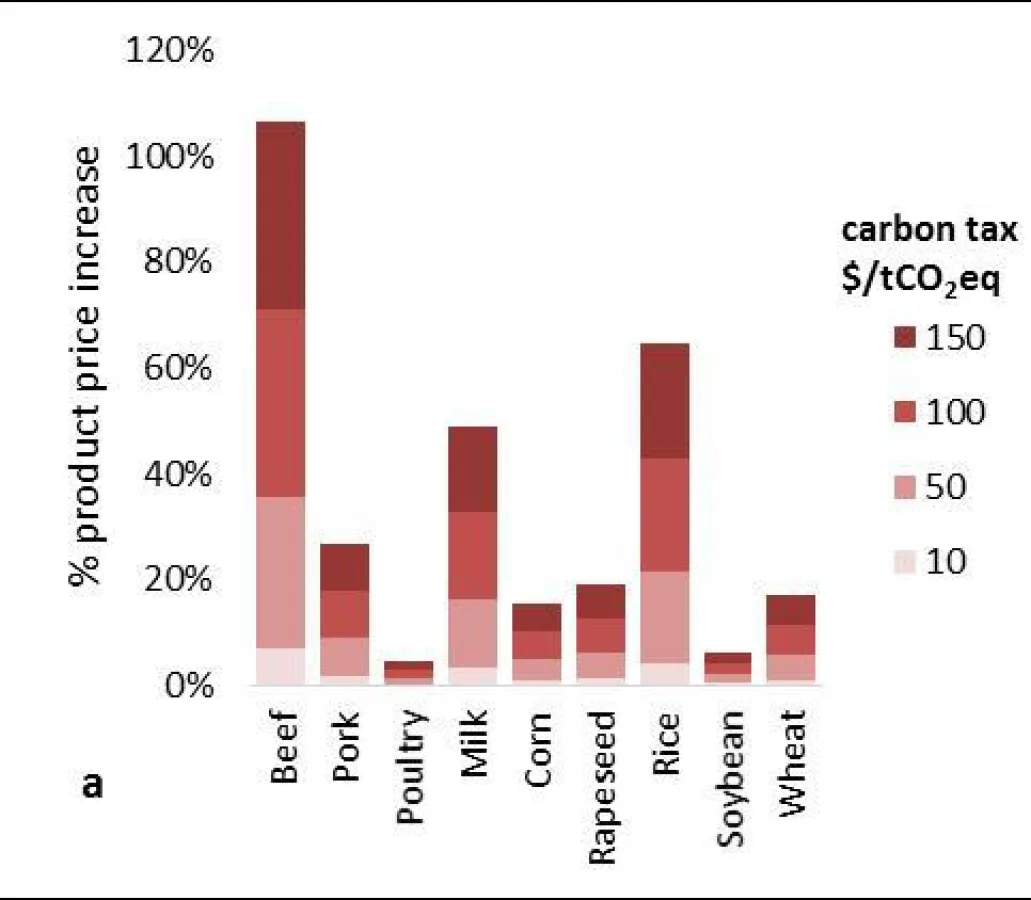
Relative price impact of a carbon tax (0 – 150 $/tCO2eq) on emissions from agriculture on global commodity prices and regional food price index (Frank et al 2017)

(openPR) Efforts to reduce greenhouse gas emissions from the agriculture and forestry sectors could lead to increased food prices—but new research identifies strategies that could help mitigate climate change while avoiding steep hikes in food prices.


---
Climate policies that target agriculture and forests could lead to increased food prices, but reducing deforestation and increasing soil carbon sequestration in agriculture could significantly reduce greenhouse gas emissions while avoiding risk to food security, according to new research published in the journal Environmental Research Letters.

As countries look to reduce their greenhouse gas emissions, many see potential in their forests and farms. The land-use sector, which includes agriculture and forestry, contributes approximately 25% of the human-caused greenhouse gas emissions that are contributing to climate change. At the same time, vegetation, including natural as well as agricultural lands, take up CO2 from the atmosphere and can store it in biomass and the soil.

“The land-use sector is key for successful climate change mitigation,” explains IIASA researcher Stefan Frank, who led the study. “But providing an increasing amount of biomass for energy production to substitute fossil fuels while at the same time reducing emissions from the land use sector, for example through a carbon tax, could also have the effect of raising food prices and reducing food availability.”

In the study, Frank and colleagues explored the impacts of climate mitigation policies on food prices. They examined the potential impacts of both global action, represented by a carbon tax, and regional and national policies.

The study showed that a stringent mitigation target for the agriculture and forestry sectors could lead to increased food prices and reduced food production. Though globally coordinated mitigation policies outperform regional or national policies both with respect to emission abatement and food security, adverse impacts on food security remain. The study presents two strategies that could bring benefits for climate while simultaneously maintaining food security: reducing deforestation and increasing soil carbon sequestration.

Reducing deforestation is not a one-size-fits-all solution
The study found that in countries with a lot of land and a high proportion of emissions from land-use change, such as Brazil or Congo Basin countries, there is a large potential for forest restoration and preventing deforestation. However, in more densely populated countries with emission intensive agriculture such as China and India, strict efforts to reduce agricultural emissions could lead to substantial impacts on food security, while not providing big climate benefits due to emission leakage. Emission leakage means that emissions that are saved due to a policy within one country would be replaced by additional emissions outside the country.

“In some countries, stopping deforestation could provide a big reduction in emissions with only a marginal effect on food availability,” says Frank. “But a one-size-fits-all approach will not work. In places like China and India, the focus should be on soil organic carbon sequestration and other win-win options that decrease the emission intensity of agriculture.”

Increasing soil carbon sequestration
Certain farming practices, such as crop rotation, cover cropping, and residue management, can preserve greater amounts of carbon stored in soils. It turns out that these practices also generally lead to greater crop yields.

“You keep the soil healthy, you offset greenhouse gas emissions, and you preserve crop yields at the same time,” says Frank. In fact, under a carbon price policy, soil carbon sequestration measures could even provide additional revenue for farmers as they get paid for the carbon sink they provide.

Depending on the climate policy design, the researchers found that soil carbon sequestration on agricultural land could either deliver the same levels of greenhouse gas abatement in the land use sector at considerably lower calorie costs compared to a policy that does not consider the potential of soil carbon sequestration, or even higher greenhouse gas abatement and less pronounced benefits for food security. The study estimated that increased soil carbon sequestration could offset up to 3.5 GtCO2 (7% of the total 2010 emissions) in 2050, and could reduce the food security impacts of a carbon tax by as much as 65% compared to a scenario without soil carbon sequestration incentives.

“This study shows the major role of soil organic carbon sequestration for ensuring food security under climate stabilization scenarios,” says Jean-Francois Soussana, a study coauthor from the French National Institute for Agricultural Research (INRA). “Agricultural soils could provide a key solution for climate change mitigation and adaptation and for food security, but changing land management to store carbon in soil organic matter will require large efforts that could be facilitated by multi-stakeholder platforms like the 4 per 1000 initiative.”

This study shows how including an existing but largely ignored mitigation option in policy planning could substantially improve the climate policy performance with respect to food security. “Given the challenge of stabilizing climate change below 2 degrees, all options need to be carefully considered to minimize trade-offs, and potentially achieve complementarity, with other Sustainable Development Goals,” concludes IIASA researcher Petr Havlík, another study coauthor.

Reference
Frank S, Havlík P, Soussana JF, Levesque A, Valin H, et al. (2017) Reducing greenhouse gas emissions in agriculture without compromising food security? Environmental Research Letters. 2 October 2017. https://doi.org/10.1088/1748-9326/aa8c83

Quelle: idw

Diese Pressemeldung wurde auf openPR veröffentlicht.

Verantwortlich für diese Pressemeldung:

News-ID: 971844
 344

Kostenlose Online PR für alle

Jetzt Ihren Pressetext mit einem Klick auf openPR veröffentlichen

Jetzt gratis starten

Pressebericht „Win-win strategies for climate and food security“ bearbeiten oder mit dem "Super-PR-Sparpaket" stark hervorheben, zielgerichtet an Journalisten & Top50 Online-Portale verbreiten:

PM löschen PM ändern
Disclaimer: Für den obigen Pressetext inkl. etwaiger Bilder/ Videos ist ausschließlich der im Text angegebene Kontakt verantwortlich. Der Webseitenanbieter distanziert sich ausdrücklich von den Inhalten Dritter und macht sich diese nicht zu eigen. Wenn Sie die obigen Informationen redaktionell nutzen möchten, so wenden Sie sich bitte an den obigen Pressekontakt. Bei einer Veröffentlichung bitten wir um ein Belegexemplar oder Quellenennung der URL.

Pressemitteilungen KOSTENLOS veröffentlichen und verbreiten mit openPR

Stellen Sie Ihre Medienmitteilung jetzt hier ein!

Jetzt gratis starten

Weitere Mitteilungen von International Institute for Applied Systems Analysis (IIASA)

Switch from wood to gas for cooking is not a climate problem
Switching from using fuelwood to liquefied petroleum gas (LPG) for cooking would provide modest climate benefits, but the extent of these depend on whether the wood is renewably sourced, and if the short-lived emissions from burning wood are taken into account, according to a new analysis focused on India. --- About 3 billion people around the world cook with polluting and inefficient solid fuels like fuelwood, resulting in 4 million premature deaths annually. Several governments, including India’s, have implemented policies that encourage p…
Bild: FotoQuest GO: Citizen science campaign targets land-use change in AustriaBild: FotoQuest GO: Citizen science campaign targets land-use change in Austria
FotoQuest GO: Citizen science campaign targets land-use change in Austria
FotoQuest GO—a citizen science campaign aimed at collecting observations of land use and land cover across Austria—launches this week. Researchers hope it will bring a leap forward in community-based land-use change monitoring. --- Today IIASA researchers launched their latest citizen science campaign, Fotoquest GO. The aim of the campaign, which will run for around three months, is to collect an updated comprehensive data set of land use and land cover in Austria. Participants are asked to go to specific locations and take photographs using…

Das könnte Sie auch interessieren:

Führung 3.0: Der 9-fache Pfad erfolgreicher Führung- Kommunikation
… bei sich selbst zu beginnen. Im vorletzten Schritt des Pfades geht es um Kooperation. Bei dem Punkt Kooperation geht es dem Autor im Kern um ein tief verankertes win-win Denken. Um Gottes Willen werden Sie vielleicht sagen. „Win-win“ ist doch wirklich nichts Neues. Das wissen wir doch, dass man heutzutage kooperativ nach der besten gemeinsamen Lösung …
Bild: Win-win-Kooperationsangebot für SchulenBild: Win-win-Kooperationsangebot für Schulen
Win-win-Kooperationsangebot für Schulen
… Getreu dem Motto „Nicht klagen, sondern konstruktiv handeln“, unterstützt das Beratungsbüro Böhme engagierte und kreativ agierende Schulen im Rahmen von Win-win-Kooperationen. Grundlage dieser Kooperationsangebote ist das neu implementierte Seminar „Lernpsychologie und Motivationscoaching“, das von Herrn Aribert Böhme, Psychologischer Berater (SGD-Dipl.) …
OGD D-A-CH-LI Konferenz: Wolters Kluwer über Nutzen von Open Government Data für Informationsdienstleister
… Informationsdienstleister“ erklärt Dirschl dabei anhand zweier von Wolters Kluwer entwickelter und veröffentlichter juristischer Fachthesauri, wie aus einer Investition in OGD eine Win-Win-Win-Situation zwischen Verwaltung, Industrie und Bürgern entstehen kann. Im Juni 2012 hat Wolters Kluwer Deutschland zwei juristische Fachthesauri als Linked Open …
BERA unterzeichnet WIN-Charta
Verantwortung für ein nachhaltiges Handeln übernehmen, auch Corporate Social Responsibility (CSR) genannt, zählt zu den Grundwerten der BERA. Daher gehörte der Personalexperte 2012 auch zu den Erstunterzeichnern der Heilbronner Erklärung. Mit der Unterzeichnung der WIN-Charta des Landes Baden-Württemberg weitet das Unternehmen nun sein Engagement für Nachhaltigkeit in der Wirtschaft über die Grenzen der Region hinaus aus. Das Land Baden-Württemberg gründete 2010 die Wirtschaftsinitiative Nachhaltigkeit (WIN), auf deren Empfehlung die WIN-Cha…
Bild: Software für die Nebenkostenabrechnung - Win-CASA 2009 ab sofort lieferbarBild: Software für die Nebenkostenabrechnung - Win-CASA 2009 ab sofort lieferbar
Software für die Nebenkostenabrechnung - Win-CASA 2009 ab sofort lieferbar
Die Software24.com GmbH entwickelt und vertreibt seit nunmehr über 10 Jahre Softwarelösungen für die Immobilienwirtschaft. Mit der aktuellen Version der Hausverwaltungssoftware Win-CASA 2009 werden dem User eine Vielzahl an neuen und interessanten Verbesserungen an die Hand gegeben. Win-CASA 2009 kann mit einer kostenlosen 30-Tage Testversion unverbindlich auf Herz und Nieren geprüft werden. Die Hausverwaltungssoftware Win-CASA hat sich in den letzten Jahren einen ausgezeichneten Ruf in der Branche erarbeitet. Nicht ohne Grund vertrauen inzw…
Bild: G-WIN - robuster Panel PC und Monitor für industrielle und kommerzielle VerwendungBild: G-WIN - robuster Panel PC und Monitor für industrielle und kommerzielle Verwendung
G-WIN - robuster Panel PC und Monitor für industrielle und kommerzielle Verwendung
IPC2U erweitert seine Palette von robusten Display und Panel PC um G-WIN Rugged Panel PC- W12I93S-VMM9 und G-WIN Monitor W12L100-VMM9. Beide Geräte liefern eine für industriellen und kommerziellen Einsatz gute Auflösung von 1280 x 800 und Helligkeit von 500 nits. Zugleich zeichnen sich sowohl der Panel PC als auch der Monitor durch ein breites Temperaturspektrum von -20°C bis +55°C, robustes Aluminiumgehäuse mit Antikorrosionsbeschichtung sowie Staub- und Wasserschutz nach IP65-Standard (abgesehen von Schnittstellen) aus. Dank 9V ~ 36V Stromv…
Win Race und bwin schließen langfristige Kooperation
Totalisator-Pferdewetten ab sofort auch beim Marktführer für Sportwetten spielbar Berlin/Hamburg, 01. Oktober 2010. Der internationale Online-Gaming-Anbieter bwin und der Vermarkter Win Race haben eine langfristige Kooperation im Bereich Pferdewetten geschlossen. Damit ist es der Win Race gelungen, einen weiteren wichtigen Absatzkanal für die klassische Totalisatorwette zu erschließen. In Deutschland sind Pferdewetten durch das seit 1922 geltende Rennwett- und Lotteriegesetz geregelt. Die Totalisatorwetten sorgen für einen gesicherten Rückf…
Bild: RC-Win 2.5 - Mobile Navigations-Software importiert nun auch Outlook-Adressen als POI-FahrtzielBild: RC-Win 2.5 - Mobile Navigations-Software importiert nun auch Outlook-Adressen als POI-Fahrtziel
RC-Win 2.5 - Mobile Navigations-Software importiert nun auch Outlook-Adressen als POI-Fahrtziel
Das Problem bei jedem Navigationsgerät: Die eigenen Zieladressen müssen allesamt von Hand erfasst werden. Krämer Automotive spart allen Autofahrern ab sofort viel Zeit ein und stattet die eigene Navigations-Software RC-Win 2.5 mit einem umfangreichen Daten-Import aus. Outlook-Datensätze lassen sich nun in einem Rutsch in Navigationspunkte umrechnen und als POIs mit in die Routenplanung übernehmen. RC-Win verwandelt Notebooks, Subnotebooks, UMPCs und Car-PCs in echte Navigationsgeräte. Schnell, sicher und ohne Umwege ans Ziel zu gelangen, das…
Bild: Wolfgang G. Sonnenburg, in den Bundessenat des BWA berufenBild: Wolfgang G. Sonnenburg, in den Bundessenat des BWA berufen
Wolfgang G. Sonnenburg, in den Bundessenat des BWA berufen
schaft besonders bewusst. Sie sind Botschafter der Ziele des BWA und tragen durch ihre per-sönliche Mitgliedschaft dazu bei, die Ziele des BWA im Dialog mit Entscheidungsträgern aus Politik, Wirtschaft, Kultur und Medien umzusetzen. Mehr zur WIN WIN AG und Wolfgang G. Sonnenburg finden Sie unterwww.win-win.agwww.sonnenburg.tv
Neue Norman Starterpakete für Netzwerk Virenschutz
  Ab sofort bietet NORMAN kleinen und mittleren Unternehmen den bewährten Virenschutz für Netzwerke als Starterpakete.   Solingen, April 2003 – Durch die globale Vernetzung und die zunehmende Nutzung von Internet und E-Mail  als Kommunikations- und E- Commerce Plattform ergeben sich auch für kleine und mittlere Unternehmen neue bis dato unbekannte Gefahrenpotentiale. Vor allem im ‚Small Business’-Bereich, d.h. in Netzwerken zwischen 5 und 25 Usern, wird die Wichtigkeit des Themas IT-Security häufig unterschätzt. Kleine Netzwerke sind An…
Sie lesen gerade: Win-win strategies for climate and food security