openPR Recherche & Suche
Presseinformation

Medication for the unborn baby

07.08.201717:00 UhrWissenschaft, Forschung, Bildung
Bild: Medication for the unborn baby
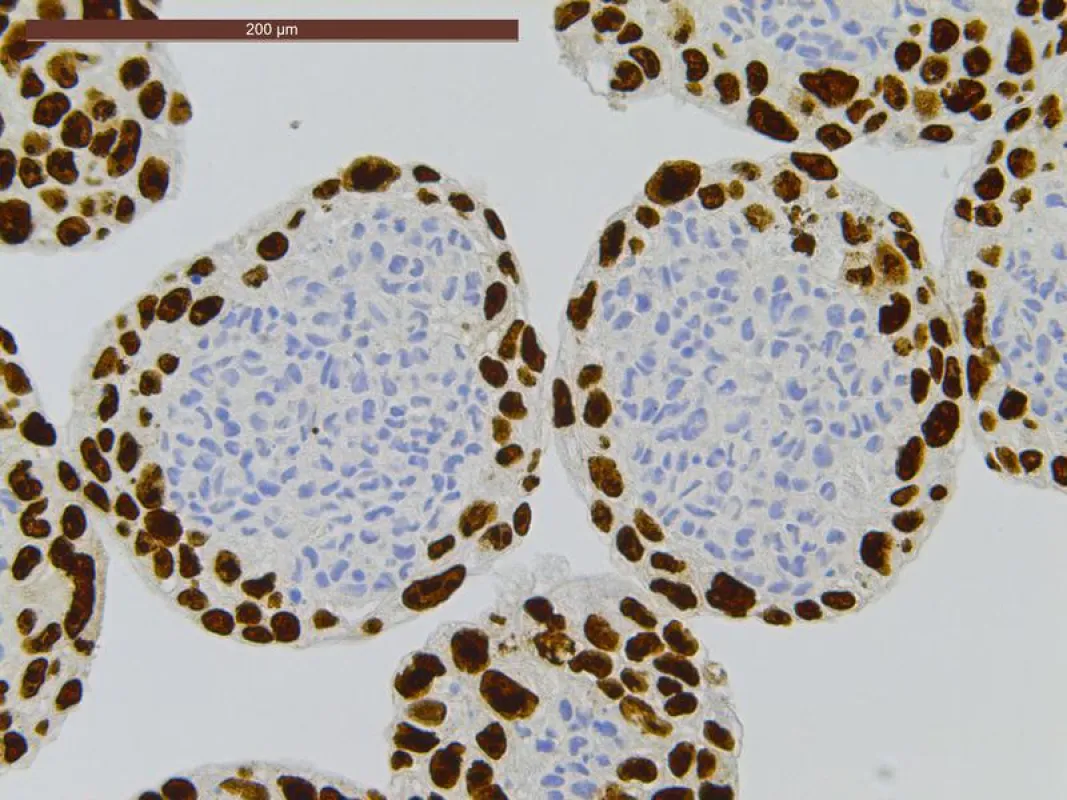
Empa’s multicellular model, which is mimicking the placental barrier: a core of connective tissue cells, surrounded by trophoblast cells. (Empa)

(openPR) An Empa team has succeeded in developing a new three-dimensional cell model of the human placental barrier. The "model organ" can quickly and reliably deliver new information on the intake of substances, such as nano-particles, by the placental barrier and on any possible toxic effects for the unborn child. This knowledge can also be used in the future for the development of new approaches to therapy during pregnancy.


---
During its development, the foetus is extremely susceptible to toxic substances. Even the tiniest doses can cause serious damage. In order to protect the unborn child,one of the tasks of the placenta is to act as a barrier to "filter out" harmful substances, while at the same time providing the foetus with the nutrients it needs. In recent years, however, evidence has increasingly suggested that the placental barrier is not 100% effective and that nano-particles are actually able to penetrate it.
Nano-particles are being used in ever more varied areas of our lives. They are used, for example, in sun creams to protect against sunburn; they are used in condiments to stop them getting lumpy; they are used to make outdoor clothing waterproof and they are likely to be used in the future to transport medicines to their rightful destinations in the body . "At the moment, pregnant women are not being exposed to problematic amounts of nano-particles, but in the future that could well happen due to the ever increasing use of these tiny particles", suggests Tina Buerki of the "Department of Particles-Biology Interactions".
In order to ensure the safe development of nano-particles in the most diverse areas of application, their absorption mechanism at the placental barrier and their effect on the mother, foetus and placenta itself must be looked at more closely. It is the size, charge, chemical composition and shape of the nano-particles that could have an influence on whether they actually penetrate the placental barrier and, if so, in what way they are able to do so. At the moment, however, this research is only in its infancy. Since the function and structure of the human placenta is unique, studies undertaken on pregnant mammals are problematic and often inconclusive. Traditional models of the human placental barrier are either very time consuming to construct, or are extremely simplified.

A 3D model of the human placental barrier

Tests of this nature are best carried out on donated placentas that become available after childbirth by Caesarean section. The organs are connected as quickly as possible to a perfusion system and this ensures the tissue is provided with nutrients and oxygen. This model is, indeed, the most accurate, i.e. the most clinically relevant. It is, however, very technically demandingand, moreover,restricted to a perfusion time window of six to eight hours. Against that, such placentas can be used to reliably test the ability of any given nano-particle to penetrate the placental barrier. The model does not, however, yield any information on the mechanism used by the particle to penetrate this complex organ.
Researchers are therefore tending to fall back on the use of simple cell cultures and other modelling systems. An individual cell, possibly taken fromthe epithelium andsubsequently cultivated and propagated in a petri dish, is perfectly suited to a whole range of different experiments. However, researchers cannot be certain that the cells in the petri dish will ultimately behave like those in the human body. The new model that the Empa team under Tina Buerki described in the scientific journal "Nanoscale" at the end of last year is, by contrast, three-dimensional and consists of more than one cell type. The cells exist in a tissue-like environment analogous to the placenta and can be experimented on for a longer period of time.

Golden test candidate

In order to create the model, the research team used the "hanging drop" technology developed by Insphero AG. This technology allows models to be created without "scaffolding", which can hinder free access of the nano-particles to the cells in the subsequent transport tests. Rather than introducing the cells in a flat petri dish, a special device, in which the cells in the hanging drops combine to form spherical micro-tissue, is used. The resulting micro-tissue mimics the human placenta much more closely than cells cultivated on a "rigid" culture dish. Experiments can be carried out much more quickly using the 3D model than with the real placenta and, significantly, on the most widely differing types of nano-particle. In this way, those nano-particles that show potentially toxic effects or demonstrate desirable transport behaviour can be efficiently pre-selected and the results verified using a real placenta.
The model has already proved itself in a second study, which the team has just published in the scientific journal "Nanomedicine". Buerki's team has come up with an absorption mechanism for gold particles that could be used in a range of medicinal applications. The Empa team looked at gold particles of various sizes and different surface modifications. In accordance with the results of other studies, the researchers discovered that small gold particles were able to penetrate the placental barrier more easily. In addition, fewer particles passed through the barrier if they were carrying polyethylene glycol (PEG) on their surfaces. These are chain-forming molecules that almost completely envelope the particles. PEG is often used in medicine to allow particles and other small structures to travel "incognito" in the body, thus preventing them being identified and removed by the immune system. "It therefore appears possible to control the movement of nano-particles through the placenta by means of their properties", Buerki explains.

Medicines for pregnant women that do not harm the child

Empa's research team is keen to further develop this 3D model in the future. The team is hoping to augment the model using a dynamic component. This would, for example, mean introducing the micro-tissue in a micro-fluid system able to simulate blood circulation in the mother and child. Another approach would be to combine the model of the placenta with other models. "With the model of a foetus, for example", Buerki suggests. In this way, complex organ interactions could also be incorporated and it would be possible, for example, to discover whether the placenta releases foetus-damaging substances as a reaction to certain nano-particles.
"With these studies, we are hoping to lay the foundations for the safe but nevertheless effective use of nano-medicines during pregnancy", Buerki continued. If we understand the transport mechanisms of nano-materials through the placental barrier well enough, we believe we can develop new carrier systems for therapeutic agents that can be safely given to pregnant women. This is because many women are forced to take medicines even during pregnancy – patients suffering from epilepsy or diabetes, for example, or patients that have contracted life-threatening infections. Nano-carriers must be chosen which are unable to penetrate the placental barrier. It is also possible, for example, to provide such carriers with "address labels", which ensure that the medicine shuttle is transported to the correct organ – i.e. to the diseased organ – and is unable to penetrate the placenta. This would allow the medicine to be released first and foremost into the mother. Consequently, the amounts absorbed by the foetus or embryo - and therefore the risk to the unborn child - are significantly reduced.

Weitere Informationen:
- https://www.empa.ch/web/s604/placental-barrier

Quelle: idw
Diese Pressemeldung wurde auf openPR veröffentlicht.

Verantwortlich für diese Pressemeldung:

News-ID: 962490
 142

Kostenlose Online PR für alle

Jetzt Ihren Pressetext mit einem Klick auf openPR veröffentlichen

Jetzt gratis starten

Pressebericht „Medication for the unborn baby“ bearbeiten oder mit dem "Super-PR-Sparpaket" stark hervorheben, zielgerichtet an Journalisten & Top50 Online-Portale verbreiten:

PM löschen PM ändern
Disclaimer: Für den obigen Pressetext inkl. etwaiger Bilder/ Videos ist ausschließlich der im Text angegebene Kontakt verantwortlich. Der Webseitenanbieter distanziert sich ausdrücklich von den Inhalten Dritter und macht sich diese nicht zu eigen. Wenn Sie die obigen Informationen redaktionell nutzen möchten, so wenden Sie sich bitte an den obigen Pressekontakt. Bei einer Veröffentlichung bitten wir um ein Belegexemplar oder Quellenennung der URL.

Pressemitteilungen KOSTENLOS veröffentlichen und verbreiten mit openPR

Stellen Sie Ihre Medienmitteilung jetzt hier ein!

Jetzt gratis starten

Weitere Mitteilungen von Empa - Eidgenössische Materialprüfungs- und Forschungsanstalt

Bild: Die Salzwasser-BatterieBild: Die Salzwasser-Batterie
Die Salzwasser-Batterie
Wasser könnte die Basis bilden für zukünftige, besonders preisgünstige aufladbare Batterien. Empa-Forschern ist es mit einer speziellen Salzlösung gelungen, die elektrochemische Stabilität von Wasser zu verdoppeln. Damit rückt eine wirtschaftliche Nutzung der Technologie näher. --- Auf der Suche nach sicheren, preisgünstigen Akkus für die Zukunft stellt sich irgendwann die Frage: Warum nehmen wir nicht einfach Wasser als Elektrolyt? Wasser ist preisgünstig, überall verfügbar, brennt nicht und kann Ionen leiten. Doch Wasser hat einen entschei…
Bild: Ein Thermometer für den OzeanBild: Ein Thermometer für den Ozean
Ein Thermometer für den Ozean
Die Durchschnittstemperatur des Meeres ist ein wesentlicher Parameter des globalen Klimas –der allerdings nur sehr schwer zu messen ist. Zumindest bis jetzt, denn ein internationales Forscherteam mit Beteiligung der Empa hat nun eine entsprechende Methode entwickelt, und zwar mittels Edelgasen im ewigen Eis. Damit lassen sich Rückschlüsse auf die Veränderungen in der Meerestemperatur von der letzten Eiszeit bis heute ziehen, wie die Forscher in der aktuellen Ausgabe des renommierten Wissenschaftsmagazins «Nature» berichten. --- Die Weltmeere…

Das könnte Sie auch interessieren:

Bild: Broken Skull haben eine "Message in a bottle"Bild: Broken Skull haben eine "Message in a bottle"
Broken Skull haben eine "Message in a bottle"
Broken Skull ist eine junge Alternative Hardrock Band aus Helmstedt in Niedersachsen. Nun veröffentlichen sie die erste Single aus ihrem am 20. April 2018 erscheinenden Debütalbum "Medication". Der Name der Single dürfte jedem Rock-Fan dieser Welt ein Begriff sein: "Message in a bottle" von den legendären Police - in diesem Soundgewand, das Broken Skull …
OLIG AG stellt bahnbrechende Quantum Medication Transporter (QMT) Technologie und dampffreie Zigarette vor
… von Medikamenten durch Inhalationstechnologien Schweiz - 9. Juli 2024 - Die OLIG AG, ein Schweizer Entwicklungsunternehmen, gibt die Entwicklung des Quantum Medication Transporters (QMT) sowie einer innovativen dampffreien Zigarette bekannt. Innovative dampffreie Zigarette Nach vielen Jahren der Forschung hat OLIG eine dampffreie Zigarette entwickelt, …
Smart Infusion Pumps Get Smarter by Getting Connected
… among the various components, elements and steps that a caregiver must navigate to successfully execute a drug infusion have – according to several recent studies – contributed to medication errors and risks to patient safety. The current generation of what can be referred to as advanced infusion pumps – ‘smart’ pumps – are attempting to address the …
Bild: Broken Skull veröffentlichen Musikvideo zu "Covered in Silence"Bild: Broken Skull veröffentlichen Musikvideo zu "Covered in Silence"
Broken Skull veröffentlichen Musikvideo zu "Covered in Silence"
… am jeweiligen Erscheinungstag direkt in den Amazon Charts platzieren! Für Broken Skull scheint es nur einen Weg zu geben: Steil nach oben! Das Debütalbum "Medication" erscheint am 20.04.2018 - jetzt vorbestellbar. Broken Skull ist eine junge Alternative Hardrock Band aus Helmstedt in Niedersachsen. Den einzigartigen Sound des Trios charakterisiert ein …
MTS Blister Symposium in Darmstadt
… findet im Darmstädter Kongresszentrum Darmstadtium das 6. MTS Blister Symposium statt. Mit der Veranstaltung hat die ebenfalls in Darmstadt ansässige MTS Medication Technologies GmbH (mts-mt.de) eine gefragte und bedeutende Informationsplattform zum Thema "patientenindividuelle Verblisterung von Medikamenten" geschaffen. Erwartet werden ca. 150 Gäste …
MTS präsentiert easyblist® auf der expopharm
… einen professionellen Medikationsmanagement aus der inhabergeführten Apotheke vor Ort souverän begegnet werden. Hierfür bietet die in Darmstadt ansässige MTS Medication Technologies (http://www.mts-mt.de) mit dem Blisterkartensystem easyblist® ein spezielles System, das auf die manuelle Verblisterung in Apotheken ausgerichtet ist. Live-Demonstration …
Bild: Alles andere als "silent" - Broken Skull veröffentlichen zweite Single!Bild: Alles andere als "silent" - Broken Skull veröffentlichen zweite Single!
Alles andere als "silent" - Broken Skull veröffentlichen zweite Single!
… Broken Skull geschrieben: Klar strukturiert, düster, kraftvoll und eingängig - typisch Broken Skull eben! Und am Montag folgt ein aufregendes Musikvideo! Das Album "Medication" erscheint am 20.04.2018! Broken Skull ist eine junge Alternative Hardrock Band aus Helmstedt in Niedersachsen. Den einzigartigen Sound des Trios charakterisiert ein überwiegend …
Bild: Webinar: MedDRA – Hands-on, 15. Dezember 2023Bild: Webinar: MedDRA – Hands-on, 15. Dezember 2023
Webinar: MedDRA – Hands-on, 15. Dezember 2023
… Umgang mit "Special situations" im Kodieralltag widmet. Das Webinar bietet einen Überblick über den Hintergrund und die Entwicklung von MedDRA, aktuelle Themen wie Medication Errors und eine praktische Einführung in die neueste MedDRA Version 25.1.Webinarinhalte im Überblick:Hintergrund und Entwicklung von MedDRAMedication Errors & Co.What's new in …
easyblist® Blisterkarten als wirtschaftliche Lösung für Pflegeheime
Die in Darmstadt ansässige MTS Medication Technologies GmbH (mts-mt.de) bietet verschiedene Lösungen für die manuelle Verblisterung an, mit denen Pflegeeinrichtungen und auch Privatpersonen viel Zeit und auch Geld sparen können. Das easyblist® System ist speziell auf die manuelle Verblisterung in der Apotheke vor Ort ausgerichtet. Die Auslagerung des …
Bild: Broken Skull veröffentlichen Debütalbum "Medication"Bild: Broken Skull veröffentlichen Debütalbum "Medication"
Broken Skull veröffentlichen Debütalbum "Medication"
… konnten (#16 Message in a bottle, #20 Covered in silence), ist es endlich so weit: Die junge Alternative Rock Band Broken Skull veröffentlicht ihr erstes Full-Length Album "Medication". Und auch das Album tat es den beiden Vorab-Singles gleich und stieg am Erscheinungstag auf Platz 44 der iTunes Charts ein! Sowohl Kritiker als auch Fans sind der Meinung, …
Sie lesen gerade: Medication for the unborn baby