openPR Recherche & Suche
Presseinformation

The way to a more sustainable world

27.07.201709:52 UhrWissenschaft, Forschung, Bildung
Bild: The way to a more sustainable world
The collaborative project analyses how bioeconomic goals are implemented in the best way and resources are used environmentally sustainable.  (Illustration: Holly McKelvey)
The collaborative project analyses how bioeconomic goals are implemented in the best way and resources are used environmentally sustainable. (Illustration: Holly McKelvey)

(openPR) Kiel research team investigates the political balance between economy and ecology

Car tires from dandelions, aircraft fuel from algae, or plastic from potatoes: bioeconomy combines natural raw materials with new concepts. Governments, researchers and companies from around the globe are striving for a fundamental transformation of our economy, and they hope for solutions to the central question of the 21st century: in times of climate change, how can more and more people be supplied from ever dwindling resources with the food, energy and materials they need - all at the same time?


---
In a collaborative project between Kiel University (CAU) and the Kiel Institute for the World Economy (IfW), scientists from Kiel want to help search for answers. On the basis of selected industrialised and developing countries, such as Germany and Senegal, political economy processes for the transition to a sustainable economy will be modelled.

Since the beginning of the year, the project "Bioökonomie als gesellschaftlicher Wandel” (Bioeconomy as Societal Change) is being funded by the German Federal Ministry of Education and Research, with around 1.1 million euros available over three years. A balance between ecology and economy requires appropriate political intervention. A key aspect is the formulation of sustainable policies for agricultural, energy and climate protection. But under what circumstances do governmental and non-governmental organizations - as well as voters - act bio-economically? The project participants will analyse, amongst others, the process of how public opinion is formed. "Our society should consume these new sustainable products, therefore we dare not neglect the attitude of the end consumer," explains project coordinator Professor Christian Henning. For the transition to a bioeconomy brings conflicts: "Every change to a sustainable economic model involves sacrifices." Efficient policy processes which can achieve viable social compromise are therefore necessary.

The aim of the Kiel-based project is to bring together social demands, possible technical solutions, and their political feasibility. And this is not that easy, if - for example - biased beliefs on how climate change impact on the economy become ingrained in people’s heads. Henning’s team considers it important to examine how policy beliefs, i.e. these "naive" ideas, arise, and how they can be systematically changed. "Our project is innovative, because not only do policy practitioners learn from scientific models, but also vice versa - the models learn from the specialist knowledge of the experts," says Henning. Since science and politics usually don’t speak the same language, a special human-to-model translation technology is required. This is one of the areas in which computer scientists Professor Bernhard Thalheim and Johannes Hedtrich have specialised. Altogether, the research team consists of experts in international climate and energy policy (Dr Ruth Delzeit, IfW), in developmental economics and poverty research (Professor Manfred Wiebelt, IfW), as well as in European agricultural policy and the economic theory of policy (Professor Henning, CAU), and in computer science (Professor Thalheim, CAU).

Henning, Wiebelt and Delzeit presented the project proposal to the general public today (Wednesday 26 July). Wiebelt emphasised that the transformation towards bioeconomy within the 2030 Agenda for Sustainable Development is targeting both, environmental, economic, and social goals: “Our projects helps identifying possible conflicts, as well as synergies between sustainability goals for the 2030 Agenda, thereby supporting evidence-based political decision making and priority setting.” This is particularly important for low-income countries such as Senegal, where large segments of society are living in extreme poverty and public means for wealth and income redistribution are limited and finance for public goods is scarce. Delzeit added: “Economic growth has almost always coincided with high use of our resources. If we are going to take climate protection seriously, we need methods and solutions from this dilemma which are also socially acceptable - so a slower but more sustainable growth. Politics will only define the appropriate course for this when it is accepted by society.”

But Henning is sure that we should not always follow the "optimal" route for climate, energy, agricultural and development policies. The researchers therefore also want to identify alternative options, which may be more feasible in the given political systems, and in doing so, take the work of interest groups into account. "At the end of the day, it’s about realistic recommendations for more efficient policy," says Henning.

More information:
www.bio-pop.agrarpol.uni-kiel.de

Photos/illustrations are available for download under:
http://www.uni-kiel.de/download/pm/2017/2017-244-1.gif
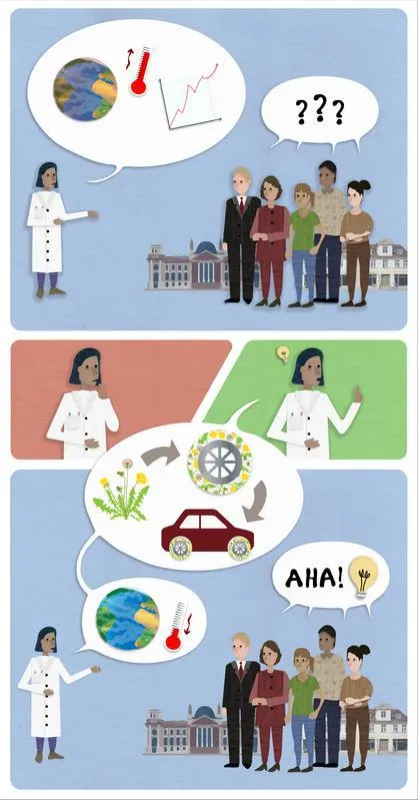
Car tires from dandelions are only one example for the use of environmentally sustainable products. Important is that the messages of experts for a sustainable world get into the heads of people in politics, society and organisations.
Illustration: Holly McKelvey

http://www.uni-kiel.de/download/pm/2017/2017-244-2.jpg
The project, where among others coordinator Christian Henning (r.), Manfred Wiebelt (l.) and Ruth Delzeit take part, is being funded by the German Federal Ministry of Education and Research with around 1.1 million euros.
Image: Raissa Nickel, Uni Kiel

http://www.uni-kiel.de/download/pm/2017/2017-244-3.png
The collaborative project analyses how bioeconomic goals are implemented in the best way and resources are used environmentally sustainable.
Illustration: Holly McKelvey

Contact:
Prof. Dr Dr Christian Henning
Department of Agricultural Economics at Kiel University
Tel.: +49 (0)431/880-4453
E-mail: E-Mail

Kiel University
Press, Communication and Marketing, Dr Boris Pawlowski, Editing: Raissa Nickel
Postal address: D-24098 Kiel, Germany,
Telephone: +49 (0)431 880-2104, Fax: +49 (0)431 880-1355
E-mail: E-Mail, Internet: www.uni-kiel.de, Twitter: www.twitter.com/kieluni

Facebook: www.facebook.com/kieluni, Instagram: www.instagram.com/kieluni

Weitere Informationen:
- http://www.uni-kiel.de/pressemeldungen/index.php?pmid=2017-244-biooekonomie&lang=en

Quelle: idw
Diese Pressemeldung wurde auf openPR veröffentlicht.

Verantwortlich für diese Pressemeldung:

News-ID: 960728
 129

Kostenlose Online PR für alle

Jetzt Ihren Pressetext mit einem Klick auf openPR veröffentlichen

Jetzt gratis starten

Pressebericht „The way to a more sustainable world“ bearbeiten oder mit dem "Super-PR-Sparpaket" stark hervorheben, zielgerichtet an Journalisten & Top50 Online-Portale verbreiten:

PM löschen PM ändern
Disclaimer: Für den obigen Pressetext inkl. etwaiger Bilder/ Videos ist ausschließlich der im Text angegebene Kontakt verantwortlich. Der Webseitenanbieter distanziert sich ausdrücklich von den Inhalten Dritter und macht sich diese nicht zu eigen. Wenn Sie die obigen Informationen redaktionell nutzen möchten, so wenden Sie sich bitte an den obigen Pressekontakt. Bei einer Veröffentlichung bitten wir um ein Belegexemplar oder Quellenennung der URL.

Pressemitteilungen KOSTENLOS veröffentlichen und verbreiten mit openPR

Stellen Sie Ihre Medienmitteilung jetzt hier ein!

Jetzt gratis starten

Weitere Mitteilungen von Christian-Albrechts-Universität zu Kiel

Bild: Bürgerschaftliches Engagement für die Energiewende im Ostseeraum stärkenBild: Bürgerschaftliches Engagement für die Energiewende im Ostseeraum stärken
Bürgerschaftliches Engagement für die Energiewende im Ostseeraum stärken
Ein neues Projekt an der Christian-Albrechts-Universität zu Kiel (CAU) stärkt die partnerschaftliche Zusammenarbeit für erneuerbare Energien. „Co2mmunity“ möchte Bürgerinnen und Bürger im Ostseeraum unterstützen, erneuerbare Energieanlagen zu errichten und von Erfahrungen aus anderen Ländern zu lernen. Das von der Europäischen Union im Rahmen des INTERREG-Ostseeraum-Programms geförderte Projekt startete am 1. Oktober 2017. Es hat eine Laufzeit von drei Jahren und ist mit einem Budget von knapp 3,15 Millionen Euro ausgestattet. 496.000 Euro da…
Bild: 2 Millionen Euro für die Forschung zur technischen Nachbildung von GehirnprozessenBild: 2 Millionen Euro für die Forschung zur technischen Nachbildung von Gehirnprozessen
2 Millionen Euro für die Forschung zur technischen Nachbildung von Gehirnprozessen
DFG verlängert Verbundprojekt der Universitäten Kiel, Bochum, Hamburg-Harburg, Brandenburg und dem Leibniz-Institut Frankfurt (Oder). Die an der Christian-Albrechts-Universität zu Kiel (CAU) angesiedelte Forschergruppe 2093 „Memristive Bauelemente für neuronale Systeme“ wird von der Deutschen Forschungsgemeinschaft (DFG) mit 2 Millionen Euro für drei weitere Jahre gefördert. In dem interdisziplinären Verbundprojekt erforschen seit 2014 Wissenschaftlerinnen und Wissenschaftler aus der Neurologie, Systemtheorie, Materialwissenschaft, Nanoelekt…

Das könnte Sie auch interessieren:

Bild: Cross-media Spatial Brand Experience – “from scratch”Bild: Cross-media Spatial Brand Experience – “from scratch”
Cross-media Spatial Brand Experience – “from scratch”
For the 9th time in a row, the Neuss D’art Design Gruppe took part in EuroShop 2017 in Dusseldorf and made the processually creation principle a reality. The agency’s own presence at the leading international trade fair for retail was dedicated to the most exciting moment of the creative process: the inspiration. The designers brought this moment to …
Bild: With or without Vacuum? The Flexible 2-in-1 Solution for Reflow SolderingBild: With or without Vacuum? The Flexible 2-in-1 Solution for Reflow Soldering
With or without Vacuum? The Flexible 2-in-1 Solution for Reflow Soldering
… vacuum unit now enables convection soldering processes with or without vacuum – with only one soldering system. Vacuum in electronics production It was when Galileo Galilei (1564-1641) posed the question of the existence of absolute emptiness (lat. vacuus) that this concept was first brought from the philosophical realm into the field of physics and …
Bild: Michel Montecrossa's 'A Song' wendet sich an das Gewissen der Herrscher von Iran, Russland, Israel und AmerikaBild: Michel Montecrossa's 'A Song' wendet sich an das Gewissen der Herrscher von Iran, Russland, Israel und Amerika
Michel Montecrossa's 'A Song' wendet sich an das Gewissen der Herrscher von Iran, Russland, Israel und Amerika
Mira Sound Germany veröffentlicht auf CD und DVD ‘A Song‘, Michel Montecrossa’s Topical-Evolver-Song & Film (aus dem Slam Poetry Earth and Peace Musical ‘The Invisible Wall), der ein leidenschaftlicher, nicht-propagandistischer Aufruf an das Gewissen der Herrscher von Iran, Russland, Israel und Amerika ist, das Augenmerk nicht von den Menschen abzuwenden …
Bild: Usage of foreign trademarks as keywords/adwordsBild: Usage of foreign trademarks as keywords/adwords
Usage of foreign trademarks as keywords/adwords
Due to a variety of advertising opportunities, which are available to companies by using the internet, many litigations arise between competitors about the admissibility of different advertisements. A high potential for an argument is thereby laid by advertising with foreign trademarks as keywords or adwords. What is prohibited and what is permitted? …
Sustainability is the business model of tomorrow
Pioneering: The Sustainable Textile School, September 18 till 20, 2017, of Chemnitz University of Technology supports the ecological textile production --- Dyeing factories contaminating rivers, usage of pesticides in the cotton production, or pathogenic chemicals in clothes – there are many reasons for the production of ecological textiles. And incentives …
Bild: Expedition to study air quality and climate change around the Arabian Peninsula completedBild: Expedition to study air quality and climate change around the Arabian Peninsula completed
Expedition to study air quality and climate change around the Arabian Peninsula completed
An international team investigated interactions between gaseous and particulate pollutants with aerosol particles of dust and sea salt in the atmosphere --- After a good two months and nearly 20,000 kilometers at sea, an adventurous expedition to study air quality and climate change was completed. On September 3rd, the research vessel Kommandor Iona …
Bild: The Wadden Sea and the Elbe Studied with Zeppelin, Drones and Research ShipsBild: The Wadden Sea and the Elbe Studied with Zeppelin, Drones and Research Ships
The Wadden Sea and the Elbe Studied with Zeppelin, Drones and Research Ships
The 20th of September, 2017, marks the start of a special Wadden Sea and Elbe expedition under the leadership of the Helmholtz-Zentrum Geesthacht (HZG). Scientists from the HZG and the Alfred Wegener Institute, Helmholtz Centre for Polar and Marine Research (AWI) as well as from the Helmholtz Centre for Environmental Research (UFZ) in Leipzig will be …
Bild: Amendments in the Polish regulations on mortgages macerate the real collateralization of receivablesBild: Amendments in the Polish regulations on mortgages macerate the real collateralization of receivables
Amendments in the Polish regulations on mortgages macerate the real collateralization of receivables
On 20 February 2011, a substantial amendment in the law on the registry of deeds and mortgages came into force in Poland. The changes in the regulations on mortgages shall lead to an improvement in the functionality of collaterals in rem. The significant amendment is the unification of mortgages and the waiver of the hitherto existing two kinds of mortgages, …
Bild: Global Seasonings and Spices Market Analysis, Development and Demand Forecast 2020Bild: Global Seasonings and Spices Market Analysis, Development and Demand Forecast 2020
Global Seasonings and Spices Market Analysis, Development and Demand Forecast 2020
Seasonings and spices form an integral part of any cuisine, as they are responsible for developing the taste and aroma associated with the cuisine. Globalization and varying demographics, and medicinal benefits of spices are some of the factors, driving the growth of the global seasonings and spices market. The consumers trying new and expensive food …
Bild: Max Planck research kicked off in WürzburgBild: Max Planck research kicked off in Würzburg
Max Planck research kicked off in Würzburg
Studying the immune system: That is the goal of a new Max Planck Research Group at the University of Würzburg which is currently being set up. --- With the cooperation agreement signed four years ago, work in the laboratories is now picking up momentum: With the appointment of Professor Georg Gasteiger, the new Max Planck Research Group for System Immunology …
Sie lesen gerade: The way to a more sustainable world