openPR Recherche & Suche
Presseinformation

Lessons for the future from past storm waves

02.11.201711:02 UhrWissenschaft, Forschung, Bildung
Bild: Lessons for the future from past storm waves
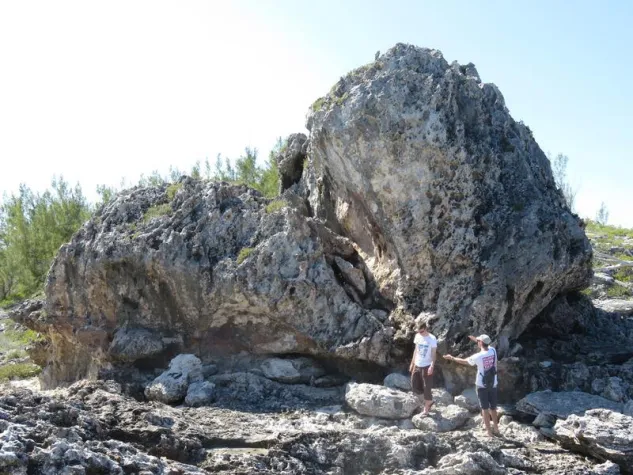
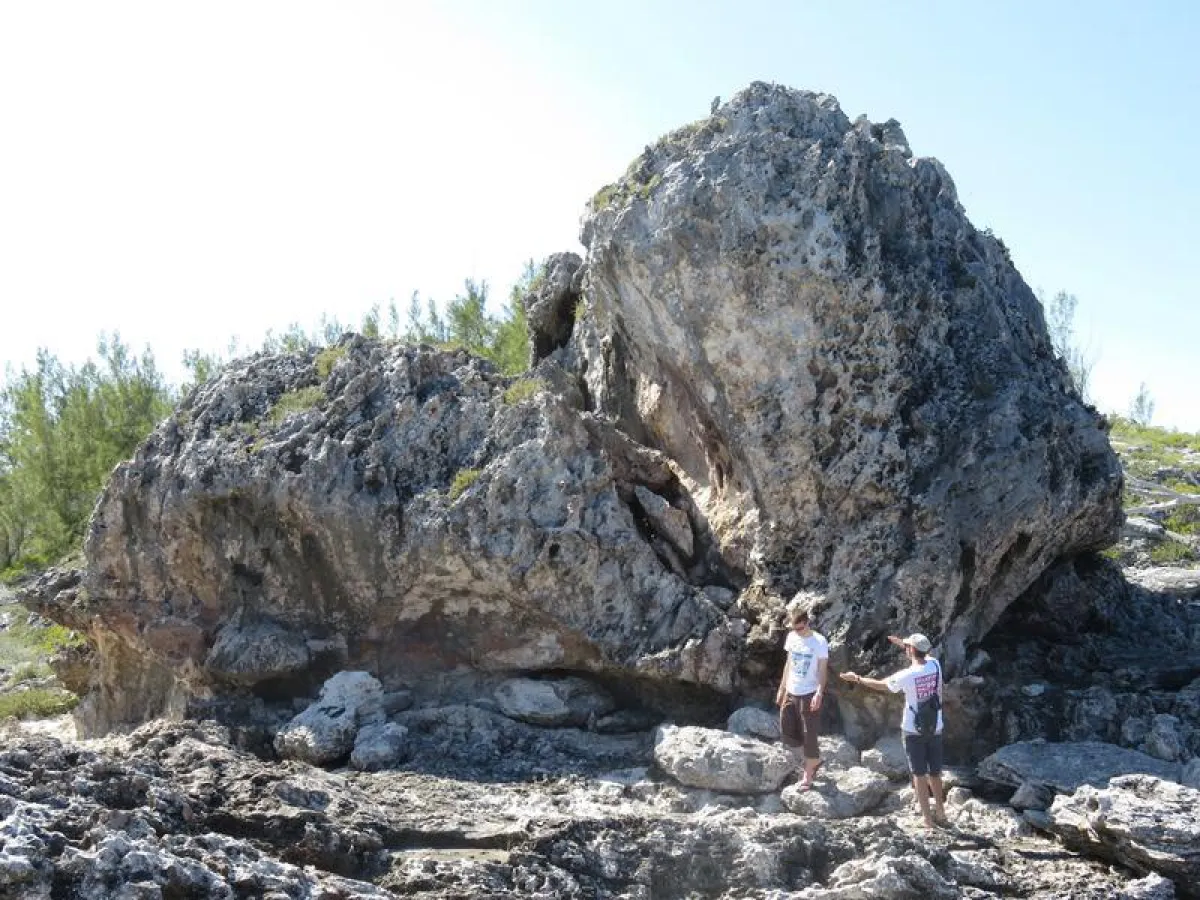
Dr. Alessio Rovere and PhD student Thomas Lorscheid standing by the boulder called “bull”.   (Photo: Elisa Casella, ZMT)
Dr. Alessio Rovere and PhD student Thomas Lorscheid standing by the boulder called “bull”. (Photo: Elisa Casella, ZMT)

(openPR) Joint press release – MARUM and ZMT

Over 100,000 years ago, boulders weighing many tons were washed onto a cliff in the Bahamas. It has been long debated whether the rocks were actually transported by ancient “super storms”. Dr. Alessio Rovere, along with scientific colleagues from MARUM – Center for Marine Environmental Sciences of the University of Bremen and from the Leibniz Centre for Tropical Marine Research (ZMT), have now discovered that storms with intensities that are not uncommon today combined with a few meters increase in sea level would be sufficient to achieve the feat. The journal Proceedings of the National Academy of Sciences published their results on October 30, 2017.


---
Coastal regions worldwide are threatened by climate change and sea-level rise. Warmer climate conditions can increase the strength of storms and cause floods to occur more often – a growing hazard for the populations, the infrastructures and industries near the coasts. It is therefore important to improve our predictions regarding the magnitude that extreme storms will increase in intensity and frequency in the future. For this, climate researchers rely on weather observations and model calculations, but also look beyond these into the past.

Super storms in the past

The last warm period, between around 128,000 and 116,000 years ago, is often used as a measure for comparison. This was the last period in Earth’s history during which the climate was warmer than in the pre-industrial era. Sea level was higher than it is today. It is thought that the North Atlantic was characterized at that time by “super storms”, which were stronger than any storms that have occurred since instruments have been used to record them. On the east coasts of Bermuda and the Bahamas, various deposits that include giant boulders testify to erstwhile storm waves that engulfed the land. Dr. Alessio Rovere, leader of the Junior Research Group “Sea Level and Coastal Changes” at MARUM – Center for Marine Environmental Sciences of the University of Bremen and the Leibniz Centre for Tropical Marine Research (ZMT), has studied this in some detail together with his colleagues. “We wanted to know how much energy is required for a storm wave to move such huge boulders from the cliff edge to their present positions, and whether modern storms possess the energy to accomplish this feat.”

Storm waves transport boulders

On the Bahamian island of Eleuthera seven massive boulders are positioned atop a 15-meter-high cliff. According to a number of studies they were transported there by super storms. They are so gigantic that it is almost inconceivable that they could have been deposited there by waves. Two of the larger boulders are known in the region by the names “cow” and “bull”. Rovere and his team have measured these two boulders, estimated their volumes and densities, and calculated a weight of 383 tons for the “cow” and 925 tons for the “bull”. The researchers fed the data collected on location into their computer model and adjusted for sea level at the time of deposition, which was up to 15 meters higher than today. Using their wave model they simulated waves that were generated by three modern-era storms that hit Eleuthera especially hard: the “Perfect Storm” of 1991, Hurricane Andrew a year later, and Hurricane Sandy in 2012. The team of researchers carried out a scenario in the model where these storm waves strike the cliffs of Eleuthera, in order to calculate the wave height and length, as well as current speed, required to move the rocks.

Lessons for the future from waves in the distant past

“Our results indicate that a super storm was not necessary to explain the present positions of the two boulders,” says Rovere. “Even if we assume a sea level only six meters higher than that of today, waves such as those produced by Hurricane Sandy would have been sufficient to transport the boulders “cow” and “bull” to their present positions.” So for future storms it can be concluded that, even if the intensity of storms does not become greater, the rise of sea level alone would be enough to increase the frequency of strong waves during a storm as well as the current speed, which increases the wave energy.

Contact:
Dr. Alessio Rovere
Telephone: 0421-218 65771
Email: E-Mail

Original publication:
Giant boulders and Last Interglacial storm intensity in the North Atlantic
Alessio Rovere, Elisa Casella, Daniel L. Harris, Thomas Lorscheid, Napayalage A. K. Nandasena, Blake Dyer, Michael R. Sandstrom, Paolo Stocchi, William J. D’Andrea, Maureen E. Raymo
doi: 10.1073/pnas.1712433114

Participating institutes:
Lamont-Doherty Earth Observatory, Columbia University, USA
Leibniz Centre for Tropical Marine Research (ZMT), Bremen
MARUM – Center for Marine Environmental Sciences, University of Bremen
NIOZ Royal Netherlands Institute for Sea Research, The Netherlands
University of Auckland, New Zealand
University of Queensland, Australia

Further information – Photo material:

Jana Stone
MARUM Public Relations
Telephone: 0421 218 65541
Email: E-Mail

MARUM – Center for Marine Environmental Sciences of the University of Bremen, using state-of-the-art methods and through participation in international projects, investigates the role of the ocean in the Earth’s system, particularly with respect to global change. It quantifies the interactions between geological and biological processes in the ocean and contributes to the sustainable use of the oceans. MARUM comprises the DFG Research Centre and the Excellence Cluster “The Oceans in the Earth System.”

Leibniz Centre for Tropical Marine Research (ZMT)
Since 1991 the Leibniz Centre for Tropical Marine Research (ZMT) has dedicated its training and research to the better understanding of coastal ecosystems in the tropics. The ZMT focuses on the structure and functioning of these habitats, their response to anthropogenic and natural influences and the use of resources. In close cooperation with partners in the tropics, the ZMT leads interdisciplinary projects combining natural and social sciences. Scientists at the ZMT also support the development of expertise and structures in its partner countries to allow for sustainable coastal zone management.

Weitere Informationen:
- http://www.marum.de
- http://www.pnas.org/content/early/2017/10/23/1712433114.abstract

Quelle: idw
Diese Pressemeldung wurde auf openPR veröffentlicht.

Verantwortlich für diese Pressemeldung:

News-ID: 977698
 425

Kostenlose Online PR für alle

Jetzt Ihren Pressetext mit einem Klick auf openPR veröffentlichen

Jetzt gratis starten

Pressebericht „Lessons for the future from past storm waves“ bearbeiten oder mit dem "Super-PR-Sparpaket" stark hervorheben, zielgerichtet an Journalisten & Top50 Online-Portale verbreiten:

PM löschen PM ändern
Disclaimer: Für den obigen Pressetext inkl. etwaiger Bilder/ Videos ist ausschließlich der im Text angegebene Kontakt verantwortlich. Der Webseitenanbieter distanziert sich ausdrücklich von den Inhalten Dritter und macht sich diese nicht zu eigen. Wenn Sie die obigen Informationen redaktionell nutzen möchten, so wenden Sie sich bitte an den obigen Pressekontakt. Bei einer Veröffentlichung bitten wir um ein Belegexemplar oder Quellenennung der URL.

Pressemitteilungen KOSTENLOS veröffentlichen und verbreiten mit openPR

Stellen Sie Ihre Medienmitteilung jetzt hier ein!

Jetzt gratis starten

Weitere Mitteilungen von MARUM - Zentrum für Marine Umweltwissenschaften an der Universität Bremen

Bild: Nährstoffüberschuss lässt Ozeane erstickenBild: Nährstoffüberschuss lässt Ozeane ersticken
Nährstoffüberschuss lässt Ozeane ersticken
Kombination aus Erdumlaufbahn und Biomasse verursacht Aussterbeereignis im Devon Was hat das Aussterbeereignis im Devon vor rund 300 Millionen Jahren begünstigt? Anhand von Gesteinsproben hat ein Team von Wissenschaftlerinnen und Wissenschaftlern aus Deutschland, Belgien, China und den USA die so genannten rhythmischen Klimazyklen identifiziert und herausgefunden, warum die Ozeane damals so schnell so lebensfeindlich werden konnten. Ihre Ergebnisse haben sie jetzt unter der Leitung von Dr. David De Vleeschouwer vom MARUM – Zentrum für Marine…
Bild: Schrumpfen oder Ausdehnen – Wie reagiert Eisdecke in der Ostantarktis unter wärmerem Klima?Bild: Schrumpfen oder Ausdehnen – Wie reagiert Eisdecke in der Ostantarktis unter wärmerem Klima?
Schrumpfen oder Ausdehnen – Wie reagiert Eisdecke in der Ostantarktis unter wärmerem Klima?
Internationale Expedition untersucht, wie sich das antarktische Eisschild im Lauf von Tausenden bis Millionen von Jahren verändert hat --- Ein Team des internationalen Forschungsprojekts MAGIC-DML („Mapping, Measuring and Modeling Antarctic Geomorphology and Ice Change in Dronning Maud Land“) ist im Dezember in die Antarktis aufgebrochen. Ziel ist es herauszufinden, wie sich das Volumen des Eisschildes verändert hat und künftig verändern wird. Die Modelle dafür werden unter der Leitung von Dr. Irina Rogozhina am MARUM – Zentrum für Marine Um…

Das könnte Sie auch interessieren:

Bild: Lessons Learned - Impulse und Tipps für die Startup-Szene SchweizBild: Lessons Learned - Impulse und Tipps für die Startup-Szene Schweiz
Lessons Learned - Impulse und Tipps für die Startup-Szene Schweiz
Roland Kümin lüftet in "Lessons Learned" die Geheimnisse und Erfolgsrezepte erfolgreicher Unternehmer. ------------------------------ Viele Menschen möchten gerne ihr eigenes Unternehmen gründen und ihr eigener Chef sein. Sie möchten Geld verdienen, aber auch gesellschaftlich etwas bewirken, u.a. Jobs für andere Menschen schaffen und/oder den Bürgern …
Bild: Mobile Social Media: Diskussion aktueller Trends auf der Konferenz MCTA 2012 am 30. und 31. Januar 2012Bild: Mobile Social Media: Diskussion aktueller Trends auf der Konferenz MCTA 2012 am 30. und 31. Januar 2012
Mobile Social Media: Diskussion aktueller Trends auf der Konferenz MCTA 2012 am 30. und 31. Januar 2012
… sich dabei für Unternehmen ergeben, aber auch, welche Gefahren und rechtliche Risiken dieser Trend birgt, diskutieren Experten im Workshop „Mobile Social Media @ Banken – Lessons Learned or Scorched Earth“ und am Conference Day der 12. Konferenz Mobile Communications - Technologien, Märkte, Anwendungen (MCTA 2012) in Berlin. Trend Social Media Noch vor …
Bild: And the MTV Woodie Award 2009 goes to ... MATT & KIM!Bild: And the MTV Woodie Award 2009 goes to ... MATT & KIM!
And the MTV Woodie Award 2009 goes to ... MATT & KIM!
Und schon wieder gewonnen. Nachdem MATT & KIM dieses Jahr schon der MTV Music Award in der Kategorie ‘Breakthrough Video’ mit "Lessons Learned" verliehen wurde, folgt nun die nächste Auszeichnung. Für das ‘Best Video’ erhielten sie jetzt den mtvU Woodie Award. mtvU ist ein an Studenten gerichteter Tochtersender von MTV Networks, der in den USA an …
Bild: Qualitätsmanagement in der AutomobilbrancheBild: Qualitätsmanagement in der Automobilbranche
Qualitätsmanagement in der Automobilbranche
Pumacy demonstriert zusammen mit TE Connectivity, wie der Einsatz eines geeigneten Lessons-Learned-Werkzeugs für Qualitätssicherung, Transparenz und die systematische Anwendung von Erfahrungswissen in weltweit agierenden Unternehmen sorgen kann. Bernburg, 23. Oktober 2012 - Mit einem Praxisbeispiel aus der Automobilbranche präsentiert sich Pumacy auf …
Bild: Die 'Eco-Lessons' von KYOCERA erreichen in Japan und China über 100.000 GrundschülerBild: Die 'Eco-Lessons' von KYOCERA erreichen in Japan und China über 100.000 Grundschüler
Die 'Eco-Lessons' von KYOCERA erreichen in Japan und China über 100.000 Grundschüler
… (Deutschland) – Die Kyocera Corporation hat heute berichtet, dass in Japan und China bereits mehr als 100.000 Kinder an über 1.500 Grundschulen an den „Eco-Lessons“ zum Thema Umweltschutz – als Bestandteil der Corporate Social Responsibility (CSR)-Aktivitäten des Unternehmens – teilgenommen haben. Die „Eco-Lessons“ werden von über 200 speziell ausgebildeten …
Bild: Lessons from World War I for the Rise of AsiaBild: Lessons from World War I for the Rise of Asia
Lessons from World War I for the Rise of Asia
… power China and great powers like India to be recognized by the West could set off a chain of events resulting in the nightmare of a great power war?Lessons from World War I for the Rise of Asia by Andreas Herberg-Rothe (ed.) Vol. 13 of the Interdisciplinary Series of the Centre for Intercultural and European Studies offers a historical comparison between …
Bild: CeBIT 2015 – Forum Public Sector Parc:Bild: CeBIT 2015 – Forum Public Sector Parc:
CeBIT 2015 – Forum Public Sector Parc:
Dr. Donovan Pfaff referiert über Lessons Learned aus der Einführung der E-Rechnung „Umsetzungserfahrung und Lessons Learned aus der Einführung der E-Rechnung“ – so lautet der spannende Titel eines Vortrags, den Dr. Donovan Pfaff, Geschäftsführer der Bonpago GmbH, auf der CeBIT 2015 hält. Die weltweit größte Messe für digitale Lösungen aus der Informations- …
Bild: Fehlervermeidung leicht gemacht durch Lessons LearnedBild: Fehlervermeidung leicht gemacht durch Lessons Learned
Fehlervermeidung leicht gemacht durch Lessons Learned
… für die GfWM (Gesellschaft für Wissensmanagement e.V.) am 12. Juni 2012 in Kiel organisiert wird. Berlin, 5. Juni 2012 - Unter dem Titel "Lessons Learned - Projekterfahrungen wiederverwenden" präsentiert die nördlichste GfWM-regional-Gruppe die Diskussionsrunde Fishbowl "Wissen" am 12. Juni 2012 ab 18:00 Uhr im Wissenschaftszentrum Kiel. Lessons Learned …
Bild: CK Voice Lessons: Creative Songwriting Workshop mit Christof LittmannBild: CK Voice Lessons: Creative Songwriting Workshop mit Christof Littmann
CK Voice Lessons: Creative Songwriting Workshop mit Christof Littmann
… Neben einem analytischen Gehör zählen grundlegende Kenntnisse über das Komponieren und Arrangieren als feste Bestandteile dazu. Im Creative Songwriting Workshop der Music Academy CK Voice Lessons (http://www.ckvoicelessons.de ) am Samstag, den 21. und Sonntag, den 22.September in der Callinstraße 42 in Hannover, jeweils von 11 bis 17 Uhr, lernen junge …
Bild: Dieter Jakob Stiftung spendet für R2B Student am KITBild: Dieter Jakob Stiftung spendet für R2B Student am KIT
Dieter Jakob Stiftung spendet für R2B Student am KIT
… Mitglied des r2b-student e.V. Zusätzlich zu der Spende gab es auch einen inspirierenden Vortrag von Dieter Jakob, welcher auf www.dieterjakob.de über Themen wie Persönlichkeitsentwicklung, Charkterbildung und Online Marketing schreibt, mit praktischen Tipps zu den Themen: Lessons Learned in einem Startup, SEO (Suchmaschinenoptimierung) und Life Lessons.
Sie lesen gerade: Lessons for the future from past storm waves