openPR Recherche & Suche
Presseinformation

Ancient Preen Oil: Researchers Discover 48-million-year-old Lipids in a Fossil Bird

18.10.201702:00 UhrWissenschaft, Forschung, Bildung
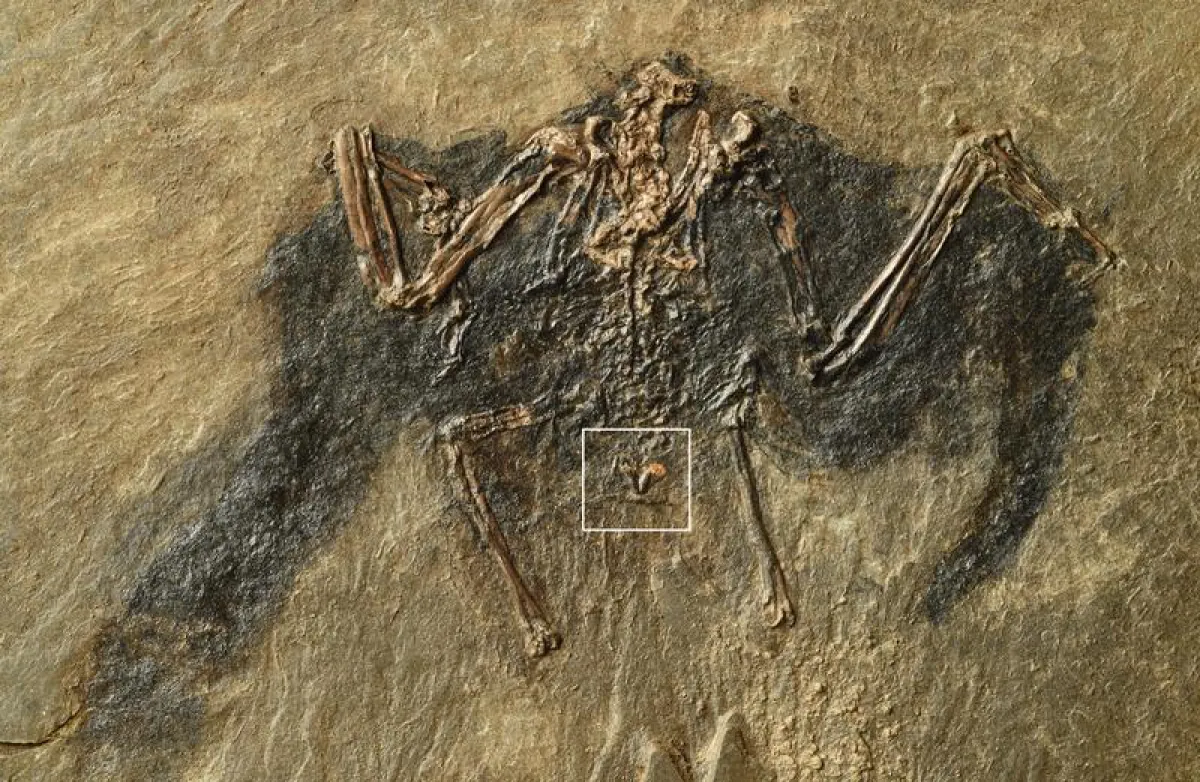
Bild: Ancient Preen Oil: Researchers Discover 48-million-year-old Lipids in a Fossil Bird
48-million-year old bird fossil excavated at the “Messel Pit“ in Germany. Markings show the uropygial gland.  (Copyright: Sven Traenkner/  Senckenberg)
48-million-year old bird fossil excavated at the “Messel Pit“ in Germany. Markings show the uropygial gland. (Copyright: Sven Traenkner/ Senckenberg)

(openPR) Frankfurt / Germany, 17th October 2017. As a rule, soft parts do not withstand the ravages of time; hence, the majority of vertebrate fossils consist only of bones. Under these circumstances, a new discovery from the UNESCO World Heritage Site “Messel Pit” near Darmstadt in Germany comes as an even bigger surprise: a 48-million-year old skin gland from a bird, containing lipids of the same age. The oldest lipids ever recorded in a fossil vertebrate were used by the bird to preen its plumage. The study is now published in the scientific journal “Royal Society Proceedings B.”


---
Birds spend a large amount of time preening their plumage. This makes sense, since the set of feathers adds to each bird’s particular appearance, isolates and enables them to fly. In this preening ritual, the uropygial gland, located at the lower end of the bird’s back, plays an important role. It produces an oily secretion used by the birds to grease their plumage in order to render it smoother and water-repellent.

Together with a group of international colleagues, Dr. Gerald Mayr, head of the Ornithology Section at the Senckenberg Research Institute, now discovered the oldest occurrence of such preen oils in birds known to date. With an age of 48 million years, this ancient preen oil constitutes a small scientific sensation. “The discovery is one of the most astonishing examples of soft part preservation in animals. It is extremely rare for something like this to be preserved for such a long time,” says Mayr.

The organic materials that the soft parts consist of usually decompose within decades, or even just a few years. Several-million-year-old feathers and fur remnants are only known from a small number of fossil sites to date, including the oxygen-poor oil shale deposits of the Messel fossil site. This site also yielded the uropygial gland and the contained lipids examined in the course of this study.

“As shown by our detailed chemical analysis, the lipids have kept their original chemical composition, at least in part, over a span of 48 million years. The long-chain hydrocarbon compounds from the fossil remains of the uropygial gland can clearly be differentiated from the oil shale surrounding the fossil,” explains Mayr. The analysis offers proof that the fossil artifact constitutes one of the oldest preserved uropygial glands – a suspicion which had already been suggested by the arrangement at the fossil bird skeleton, albeit not finally confirmed.

To date, it is not clear why the lipids from the uropygial gland were able to survive for so long. It is possible that hey hardened into nore decomposition-resistant waxes under exclusion of oxygen. In addition, the researchers assume that one of the properties of the preen oil played a role that is still shown by modern birds today – its antibacterial components. They may have been the reason that after the bird’s death only few bacteria were able to settle in, preventing the full-on decomposition.

For Mayr and his colleagues, the discovery constitutes a milestone for paleontologists. “The 40-million-year-old lipids demonstrate the potential extent of preservation possible under favorable conditions – not just bones and hairs and feathers, as previously assumed. If we find more of these lipids, we will be able to better reconstruct the lifestyle of these animals. For example, it would be interesting to find out whether feathered dinosaurs, as the ancestors of birds, already possessed uropygial glands and preened their plumages,” adds Jakob Vinther of the University of Bristol, one of the study’s co-authors, in closing.

Contact

Dr. Gerald Mayr
Senckenberg Research Institute and Nature Museum Frankfurt
Section Ornithology
Phone +49 (0)69- 7542 1348

E-Mail

Sabine Wendler
Press officer
Senckenberg Gesellschaft für Naturforschung
Phone +49 (0)69- 7542 1818

E-Mail

Publication

O’Reilly, S., Summons, R., Mayr,G., Vinther, J. (2017) Preservation of uropygial gland lipids in a 48-million-year-old bird.Proceedings of the Royal Society B, doi: 10.1098/rspb.2017.1050

To study and understand nature with its limitless diversity of living creatures and to preserve and manage it in a sustainable fashion as the basis of life for future generations – this has been the goal of the Senckenberg Gesellschaft für Naturforschung (Senckenberg Nature Research Society) for 200 years. This integrative “geobiodiversity research” and the dissemination of research and science are among Senckenberg’s main tasks. Three nature museums in Frankfurt, Görlitz and Dresden display the diversity of life and the earth’s development over millions of years. The Senckenberg Nature Research Society is a member of the Leibniz Association. The Senckenberg Nature Museum in Frankfurt am Main is supported by the City of Frankfurt am Main as well as numerous other partners. Additional information can be found at www.senckenberg.de.

200 years of Senckenberg! 2017 marks Senckenberg’s anniversary year. For 200 years, the society, which was founded in 1817, has dedicated itself to nature research with curiosity, passion and involvement. Senckenberg will celebrate its 200-year success story with a colorful program consisting of numerous events, specially designed exhibitions and a grand museum party in the fall. Of course, the program also involves the presentation of current research and future projects. Additional information can be found at: www.200jahresenckenberg.

Quelle: idw
Diese Pressemeldung wurde auf openPR veröffentlicht.

Verantwortlich für diese Pressemeldung:

News-ID: 974826
 179

Kostenlose Online PR für alle

Jetzt Ihren Pressetext mit einem Klick auf openPR veröffentlichen

Jetzt gratis starten

Pressebericht „Ancient Preen Oil: Researchers Discover 48-million-year-old Lipids in a Fossil Bird“ bearbeiten oder mit dem "Super-PR-Sparpaket" stark hervorheben, zielgerichtet an Journalisten & Top50 Online-Portale verbreiten:

PM löschen PM ändern
Disclaimer: Für den obigen Pressetext inkl. etwaiger Bilder/ Videos ist ausschließlich der im Text angegebene Kontakt verantwortlich. Der Webseitenanbieter distanziert sich ausdrücklich von den Inhalten Dritter und macht sich diese nicht zu eigen. Wenn Sie die obigen Informationen redaktionell nutzen möchten, so wenden Sie sich bitte an den obigen Pressekontakt. Bei einer Veröffentlichung bitten wir um ein Belegexemplar oder Quellenennung der URL.

Pressemitteilungen KOSTENLOS veröffentlichen und verbreiten mit openPR

Stellen Sie Ihre Medienmitteilung jetzt hier ein!

Jetzt gratis starten

Weitere Mitteilungen von Senckenberg Forschungsinstitut und Naturmuseen

Bild: Der Buche in die Gene schauen - Vollständiges Genom der Rotbuche entschlüsseltBild: Der Buche in die Gene schauen - Vollständiges Genom der Rotbuche entschlüsselt
Der Buche in die Gene schauen - Vollständiges Genom der Rotbuche entschlüsselt
Frankfurt, 11.12.2017. Senckenberg-Wissenschaftlern ist es gelungen das vollständige Genom der Rotbuche zu entschlüsseln. Die Erfassung des Genoms zeigt unter anderem, dass es keinen Genaustausch mit den zahlreichen Pilzarten, die in enger Symbiose mit der Buche leben, gibt. Die Genomsequenz gibt Wissenschaftlern ein Werkzeug in die Hand, das für nachfolgende naturschutzgenetische Untersuchungen wichtig ist und mittelfristig ermöglicht, trockenresistente Genotypen zu identifizieren und für die Forstwirtschaft in Anpassung an den Klimawandel z…
Bild: Insekt des Jahres 2018: Die SkorpionsfliegeBild: Insekt des Jahres 2018: Die Skorpionsfliege
Insekt des Jahres 2018: Die Skorpionsfliege
Berlin/Müncheberg, den 06.12.2017. Heute wurde in der Bundesgeschäftsstelle des NABU die Gemeine Skorpionsfliege Panorpa communis zum Insekt des Jahres 2018 gekürt. Das Kuratorium unter dem Vorsitz von Prof. Dr. Thomas Schmitt, Senckenberg Deutsches Entomologisches Institut in Müncheberg, prämierte das harmlose Insekt mit dem gefährlichen Namen aus einer Reihe von Vorschlägen. Die Skorpionsfliege ist in Europa weit verbreitet, aber dennoch kaum bekannt. Unter anderem zeichnet sich diese Schnabelfliegenart durch einen komplizierten Akt in ihre…

Das könnte Sie auch interessieren:

Modern domestic dog has a single geographic origin
… dogs. The study also suggests that all contemporary dogs have a common origin and emerged through a single domestication process of wolves 20,000 to 40,000 years ago. Researchers at Johannes Gutenberg University Mainz (JGU) also participated in the study, the results of which recently have been published in Nature Communications. Dogs were the first …
Bild: Large-Mouthed Fish Was Top Predator After Mass ExtinctionBild: Large-Mouthed Fish Was Top Predator After Mass Extinction
Large-Mouthed Fish Was Top Predator After Mass Extinction
… of the food chain did not appear until the Middle Triassic epoch about 247 to 235 million years ago. Unexpected find of a large predatory fish Swiss and U.S. American researchers led by the Paleontological Institute and Museum of the University of Zurich have discovered the fossil remains of one of the earliest large-sized predatory fishes of the Triassic …
Bild: EMBO at Basel Life, a new conference on current and emerging life science researchBild: EMBO at Basel Life, a new conference on current and emerging life science research
EMBO at Basel Life, a new conference on current and emerging life science research
… this international and broad-scope scientific conference on current and emerging life science research to be held as part of Basel Life (www.basellife.org). --- “Established and young researchers will present and discuss work on all aspects of genome biology, ranging from microbial genomes and genome evolution to transcription, inheritance and clinical …
Bild: Noisy cell membranesBild: Noisy cell membranes
Noisy cell membranes
Rapid information transfer is vital for the inner workings of body tissues. With computer simulations, researchers from Colombia and Germany found that mechanical pulses travel through membranes for biologically relevant distances at the speed of sound. The researchers think that membranes could serve as a tin can telephone for the cell. --- Biological …
Our muscles measure the time of day
Researchers funded by the SNSF have discovered a biological clock at work in our muscle cells. It could be a factor in regulating our metabolism and play a role in diabetes. --- Biological clocks are ticking everywhere throughout our body. They trigger the release of the hormone melatonin during sleep, favour the secretion of digestive enzymes at lunchtime …
Bild: From bacteria to birds: tropical plantations disrupt biodiversityBild: From bacteria to birds: tropical plantations disrupt biodiversity
From bacteria to birds: tropical plantations disrupt biodiversity
… has conducted a large-scale study in Indonesia to understand how the conversion of rainforest to rubber and oil palm plantations alters biodiversity of these ecosystems. The researchers found that land-use change directly reduces the number of different species as well as the number of individual plants and animals, especially at the highest trophic …
Sizing up our ape past
Researchers suggest the last common ancestor of the apes was substantially smaller than previously thought --- The last common ancestor of apes and humans remains a mysterious animal. Dr. Mark Grabowski from the Senckenberg Centre for Human Evolution and Palaeoenvironment at the University of Tübingen together with his colleague Professor William L. …
Bild: Tübingen archaeologists uncover cuneiform archive in Iraq’s Kurdish regionBild: Tübingen archaeologists uncover cuneiform archive in Iraq’s Kurdish region
Tübingen archaeologists uncover cuneiform archive in Iraq’s Kurdish region
… Assyrian clay tablets to yield their secrets --- University of Tübingen archaeologists headed by Professor Peter Pfälzner have made sensational finds in the Kurdistan region of northern Iraq. The researchers from the Institute for Ancient Near Eastern Studies found a cuneiform archive of 93 clay tablets dating from 1250 BCE - the period of the Middle …
Bild: Gemeinsame Vorfahren – DNA enthüllt die Geschichte der SäbelzahnkatzenBild: Gemeinsame Vorfahren – DNA enthüllt die Geschichte der Säbelzahnkatzen
Gemeinsame Vorfahren – DNA enthüllt die Geschichte der Säbelzahnkatzen
… Naturhistorisches Museum Rotterdam) Veröffentlichung: Current Biology, Paijmans et al.: “Evolutionary History of Saber-Toothed Cats Based on Ancient Mitogenomics” http://www.cell.com/current-biology/fulltext/S0960-9822(17)31198-3 DOI: 10.1016/j.cub.2017.09.033 Medieninformation 20-10-2017 / Nr. 158 Prof. Dr. Michael Hofreiter / Dr. Barbara Eckardt Universität …
Bild: Physicists find strange state of matter in superconducting crystalBild: Physicists find strange state of matter in superconducting crystal
Physicists find strange state of matter in superconducting crystal
… the DC Field Facility’s 45-tesla hybrid showed that the nematic phase appears in very high fields, beginning at 30 tesla and remaining through the hybrid’s full field. Researchers wanted to understand how far this phase extended and, through experiments at the Pulsed Field Facility, found that at around 50 tesla, the nematicity vanishes, possibly even …
Sie lesen gerade: Ancient Preen Oil: Researchers Discover 48-million-year-old Lipids in a Fossil Bird