openPR Recherche & Suche
Presseinformation

Neglected diseases: Dogs are a possible source of for zoonotic strongyloidasis

21.08.201713:00 UhrWissenschaft, Forschung, Bildung
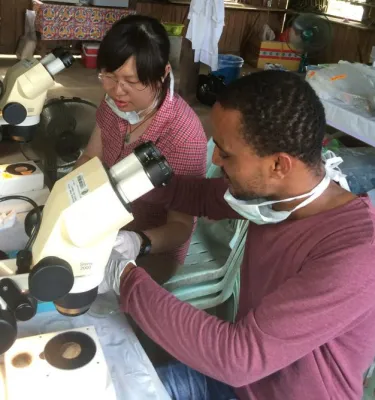
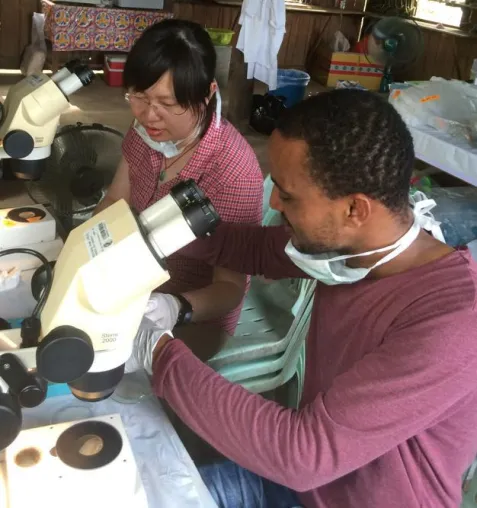
Bild: Neglected diseases: Dogs are a possible source of for zoonotic strongyloidasis
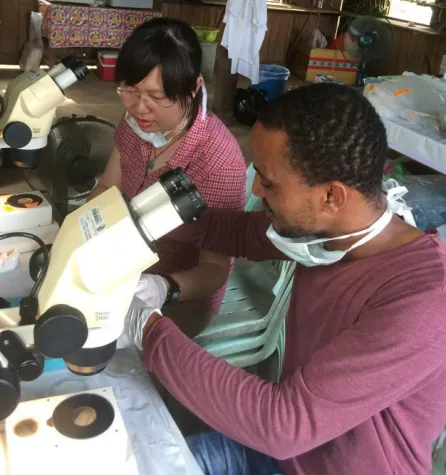
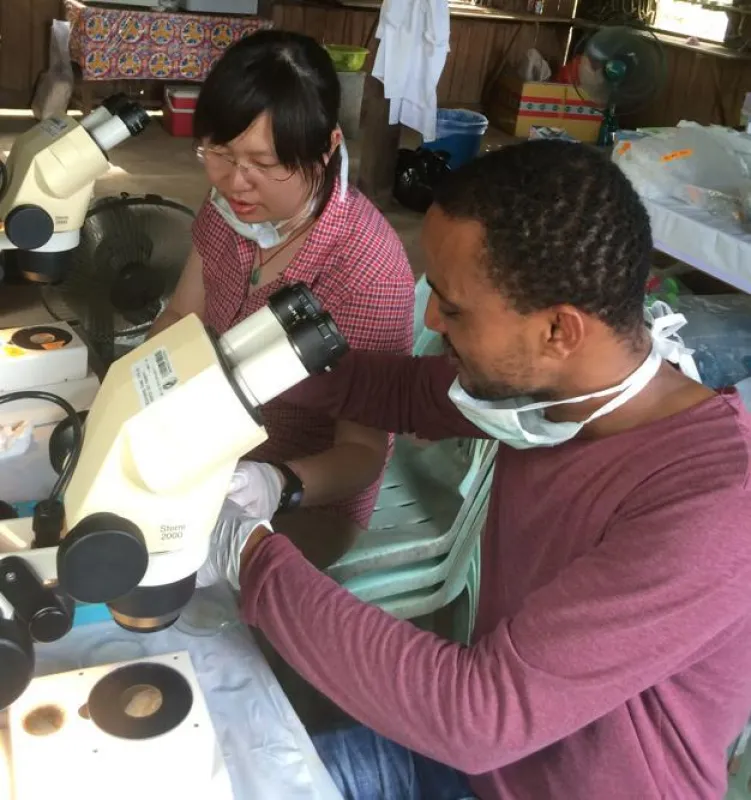
Siyu Zhou and Tegen G. Jaleta  ((© Tegen G. Jaleta))
Siyu Zhou and Tegen G. Jaleta ((© Tegen G. Jaleta))

(openPR) Tübingen, 21th of August 2017. Scientists from the Max Planck Institute for Developmental Biology Tübingen isolated the nematode Strongyloides stercoralis from humans and their dogs in rural Cambodia and compared the worms using molecular-biological analyses. The aim of the study was to find out whether dogs are a potential source of zoonotic transmission of this parasite or not. S. stercoralis causes the much-neglected soil born helminthiasis strongyloidiasis, wich is listed on the WHO list of neglected tropical diseases. The results of the study are now published in the journal PLOS Neglected Diseases.


---
It is a well-known saying that dog owners look like their pets. Apart from outward appearances – they are sure to share their parasites. And even these are sometimes that very much alike, so they can only be distinguished by genetic analyzes. Researchers from the MPI for developmental Biology now did this distinction using nuclear and mitochondrial DNA sequence polymorphisms.

Strongyloidiasis - a neglected disease

S. stercoralis, a soil-transmitted nematode, causes a neglected tropical helminthiasis and is endemic in tropical, subtropical and temperate settings with poor sanitary and hygiene conditions. Strongyloidiasis is a chronic parasitic infection of humans and animals. Some 300 million people are estimated to be infected worldwide. Usually, strongyloidiasis has mild manifestations, the infection may be severe and life-threatening in cases of immunodeficiency. Therefore it is important that a public health strategy will be developed to control strongyloidiasis.

People and their dogs - a relationship with side effects

The prevalence of S. stercoralis in rural Cambodia is very high and people live in close coexistence with their dogs. This setting made it easy for Siyu Zhou and Tegen G. Jaleta from the Department of Evolutionary Biology at the MPI for Developmental Biology to take fecal samples from humans and dogs of the same household.

In collaboration with colleagues from the Swiss Tropical and Public Health Institute in Basel, and from the Cambodian Ministry of Health, they isolated S. strecoralis larvae from the collected samples and analyzed the worms derived from these two host species using nuclear and mitochondrial DNA sequence polymorphisms. They found that in dogs there exist two populations of S. stercoralis, which are clearly separated from each other genetically based on the nuclear and the mitochondrial, sequence. One population, to which the majority of the worms belong to, appears to be restricted to dogs. The other population is indistinguishable from the population of S. stercoralis isolated from humans.

Effective disease control only with broad knowledge

The results strongly suggest that there is a considerable risk for a dog to human transmission. The potential of dogs as reservoirs for zoonotic transmission of S. stercoralis to humans suggests that in order to reduce the exposure of humans to infective S. stercoralis larvae, it might be beneficial to treat dogs for the infection along with their owners and to reduce the exposure of humans to dog feces.

Original Publication:
Jaleta TG, Zhou S, Bemm FM, Schär F, Khieu V, Muth S, et al. (2017) Different but overlapping populations of Strongyloides stercoralis in dogs and humans—Dogs as a possible source for zoonotic strongyloidiasis. PLoS Negl Trop Dis 11(8): e0005752.

Weitere Informationen:
- https://doi.org/10.1371/journal.pntd.0005752

Quelle: idw
Diese Pressemeldung wurde auf openPR veröffentlicht.

Verantwortlich für diese Pressemeldung:

News-ID: 964359
 404

Kostenlose Online PR für alle

Jetzt Ihren Pressetext mit einem Klick auf openPR veröffentlichen

Jetzt gratis starten

Pressebericht „Neglected diseases: Dogs are a possible source of for zoonotic strongyloidasis“ bearbeiten oder mit dem "Super-PR-Sparpaket" stark hervorheben, zielgerichtet an Journalisten & Top50 Online-Portale verbreiten:

PM löschen PM ändern
Disclaimer: Für den obigen Pressetext inkl. etwaiger Bilder/ Videos ist ausschließlich der im Text angegebene Kontakt verantwortlich. Der Webseitenanbieter distanziert sich ausdrücklich von den Inhalten Dritter und macht sich diese nicht zu eigen. Wenn Sie die obigen Informationen redaktionell nutzen möchten, so wenden Sie sich bitte an den obigen Pressekontakt. Bei einer Veröffentlichung bitten wir um ein Belegexemplar oder Quellenennung der URL.

Pressemitteilungen KOSTENLOS veröffentlichen und verbreiten mit openPR

Stellen Sie Ihre Medienmitteilung jetzt hier ein!

Jetzt gratis starten

Weitere Mitteilungen von Max-Planck-Institut für Entwicklungsbiologie

Bild: Das Leben am Rande bereitet die Pflanzen auf den Klimawandel vorBild: Das Leben am Rande bereitet die Pflanzen auf den Klimawandel vor
Das Leben am Rande bereitet die Pflanzen auf den Klimawandel vor
Tübingen, 18.12.2017. In der ersten Vorhersage, ob sich verschiedene Populationen derselben Pflanzenart an den Klimawandel anpassen können, stellen Wissenschaftler des Max-Planck-Instituts für Entwicklungsbiologie fest, dass mitteleuropäische Pflanzen-Populationen am bedrohtesten sind. --- Die Forscher untersuchten die Ackerschmalwand (Arabisopsis thaliana), die in Europa, Asien und Nordwestafrika heimisch ist. Überraschenderweise bewältigen skandinavische Exemplare dieser Art extreme Dürreperioden ähnlich gut wie solche in Mittelmeerländern…
Bild: Patrick Müller receives the „EMBO Young Investigator” AwardBild: Patrick Müller receives the „EMBO Young Investigator” Award
Patrick Müller receives the „EMBO Young Investigator” Award
Tübingen, 25 October 2017. Patrick Müller, a group leader at the Friedrich Miescher Laboratory, is one of the “EMBO Young Investigators” 2017. EMBO announces today the selection of 28 young scientists as EMBO Young Investigators. Selection to the EMBO Young Investigator Programme is recognition of exceptional research and scientific potential. The award winners join a network of some of the best up-and-coming group leaders in the life sciences in Europe and beyond. --- Patrick Müller’s research focuses on the question: How do extracellular s…

Das könnte Sie auch interessieren:

Manager beißt Hund
Manager beißt Hund
Coach dogs – ein neues Trainingskonzept „Der Mensch – ein Alphatier? Führungsqualitäten überprüfen, um authentisch führen zu können.“ Oder: „Mein Rudel – mein Team? Produktives Miteinander oder unproduktives Gegeneinander?“ Mit diesen und vielen weiteren Fragen und den dazugehörenden Antworten arbeitet „coach dogs“. Ein neues, ein anderes, ein überraschendes …
Bild: coach-dogs-Training ab sofort onlineBild: coach-dogs-Training ab sofort online
coach-dogs-Training ab sofort online
Presseinformation - Laubach, 17.6.2007 - Coach-dogs-Training ab sofort online Der VOX-Beitrag gibt konkrete Einblicke in das neue Management-Training „Viele finden unser Training sehr interessant und spannend. Aber wenige können sich vorstellen, wie dies praktisch umgesetzt wird“, so Nadja Merl-Stephan (35), Pressesprecherin und Trainerin bei coach dogs. …
Neue Termine für coach-dogs-Seminare
Trainingskonzept wird erweitert Lich/Laubach, 22.3.2007. Die Agentur für kreative Unternehmensentwicklung „coach dogs“ gibt die neuen Termine für die offenen Seminare bekannt. coach dogs steht für das ‚andere’ Training. Für die ganz neue Lern-Erfahrung aus der Verbindung zwischen Mensch und Hund. Geprägt durch weit mehr als diktatorische Unterordnung. …
Bild: Großes Finale in DortmundBild: Großes Finale in Dortmund
Großes Finale in Dortmund
Die Trick Dogs von der Markus Mühle wählen die SUPERPFOTE® 2009 Letzte Chance für alle sportbegeisterten Hunde-Freunde: Am Freitag (16. Oktober) und Samstag (17. Oktober) findet das abschließende Regionalcasting der Trick Dogs von der Markus Mühle statt. Veranstaltungsort: Dortmunder Westfalenhallen. Interessenten können sich direkt im Messezentrum …
Bild: coach dogs in RTLBild: coach dogs in RTL
coach dogs in RTL
Pilot-Seminar der coach dogs auf Schloss Romrod - RTL filmte neues Training 21.11.2006. Am zweiten Novemberwochenende veranstalteten die coach dogs ein Pilot-Seminar auf Schloss Romrod bei Alsfeld. Neun Führungspersönlichkeiten aus verschiedenen Branchen nahmen an dem Seminar teil. „Ein Trainerteam mit ausgeprägtem Fachwissen, lebensnahen Beispielen …
Bild: Vernachlässigte Krankheiten: Hunde sind mögliche Quelle für Zwergfadenwurm-Infektionen des MenschenBild: Vernachlässigte Krankheiten: Hunde sind mögliche Quelle für Zwergfadenwurm-Infektionen des Menschen
Vernachlässigte Krankheiten: Hunde sind mögliche Quelle für Zwergfadenwurm-Infektionen des Menschen
… den Fadenwürmern ausgelöste Infektion steht auf der WHO-Liste der vernachlässigten tropischen Krankheiten. Die Ergebnisse der Untersuchung werden nun in der Zeitschrift „PLOS Neglected Diseases“ veröffentlicht. --- Es ist ein altbekanntes Klischee, dass sich Hunde und ihre Besitzer verblüffend häufig ähneln. Abgesehen von Äußerlichkeiten - ganz sicher …
WELTWEITE ERSTAUSSTRAHLUNG VON EUKANUBAS TV-SERIE „EXTRAORDINARY DOGS“
… Dokumentationsreihe werden in mehr als 130 Ländern ausgestrahlt; ?die Dokumentationsreihe begleitet den Relaunch der globalen Marke Eukanuba; ab 7. Mai 2011 deutschlandweite Erstausstrahlung von "Extraordinary Dogs - Helden auf vier Pfoten“, immer samstags um 10.15 Uhr bei VOX. Eukanuba freut sich, die Premiere von Extraordinary Dogs bekannt geben zu …
Bild: DNDi: PowerFolder verstärkt Engagement im Bereich HealthcareBild: DNDi: PowerFolder verstärkt Engagement im Bereich Healthcare
DNDi: PowerFolder verstärkt Engagement im Bereich Healthcare
PowerFolder hat seine seit 2014 bestehende Zusammenarbeit mit der „Drugs for Neglected Diseases initiative“ (DNDi) weiter vertieft und der Non-Profit-Organisation - zusätzlich zu den bereits genutzten PowerFolder-Lizenzen - weitere zum Kampf gegen bisher wenig erforschte Krankheiten gestiftet. Pascal Carpentier, Head of Information Systems and Technology …
Bild: Domestication has not made dogs cooperate more with each other compared to wolvesBild: Domestication has not made dogs cooperate more with each other compared to wolves
Domestication has not made dogs cooperate more with each other compared to wolves
Following domestication, dogs should be more tolerant and cooperative with conspecifics and humans compared to wolves. This is at least often hypothesized. But, looking at wolves and dogs in more naturalistic living conditions speaks for more cooperative behavior of wolves. Researchers at Vetmeduni Vienna have now shown that the wild ancestors are actually …
Bild: Wolves understand cause and effect better than dogsBild: Wolves understand cause and effect better than dogs
Wolves understand cause and effect better than dogs
… are better at this than their domesticated descendants. Researchers at the Wolf Science Center of the Vetmeduni Vienna say that wolves have a better causal understanding than dogs and that they follow human-given communicative cues equally well. The study in Scientific Reports provides the insight that the process of domestication can also affect an …
Sie lesen gerade: Neglected diseases: Dogs are a possible source of for zoonotic strongyloidasis