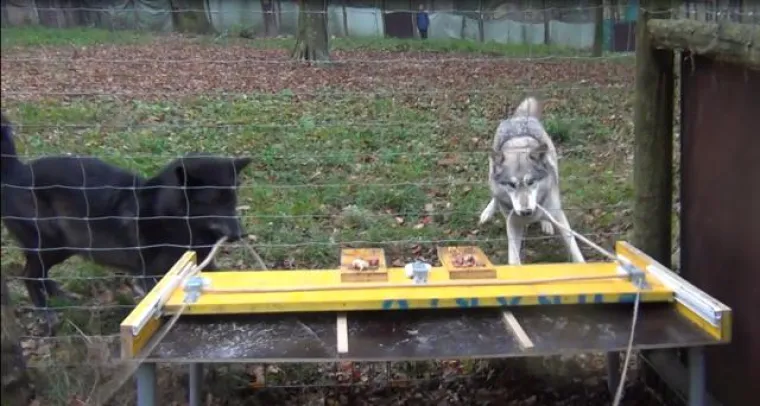
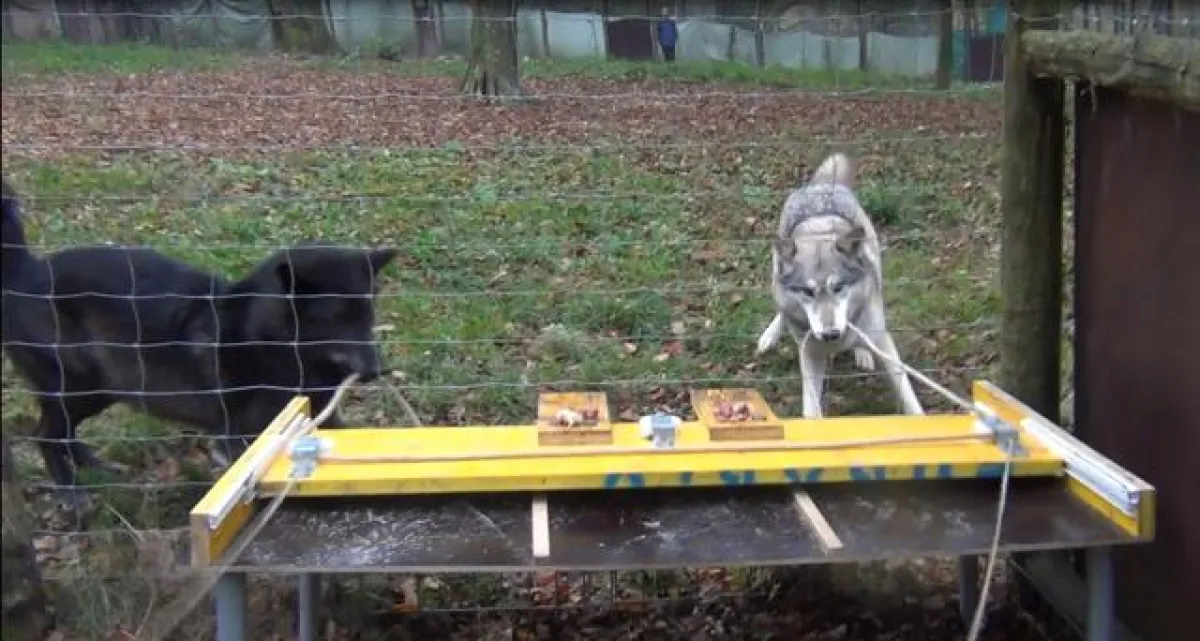
(openPR) Following domestication, dogs should be more tolerant and cooperative with conspecifics and humans compared to wolves. This is at least often hypothesized. But, looking at wolves and dogs in more naturalistic living conditions speaks for more cooperative behavior of wolves. Researchers at Vetmeduni Vienna have now shown that the wild ancestors are actually excelling their domesticated relatives in teamwork. In an experimental approach dogs failed to cooperatively pull the two ends of a rope at the same time to obtain a piece of food. The wolves, on the other hand, showed perfect teamwork. They even waited for a partner to come before pulling the rope ends together for food. PNAS
---
Dogs were domesticated so that man had a perfect companion at his side. Therefore, a lot of importance has been attached to properties such as tolerance and cooperative behavior. In line with this there are many hypotheses that dogs have also become more tolerant and co-operative with conspecifics compared to wolves. But The socio-ecological background of wolves, shows that they depend on cooperation for many aspects of their life from hunting to pup rearing, speaking against these theories.
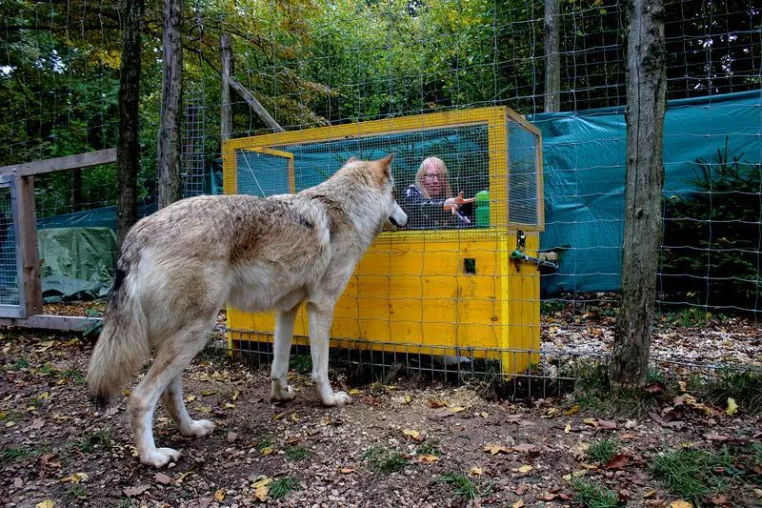
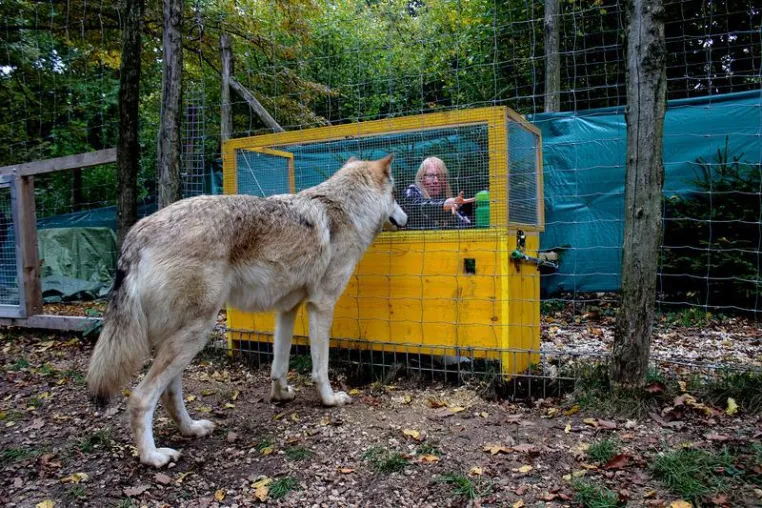
Researchers from the Wolf Science Center of the Vetmeduni Vienna now tested with a so-called "loose-string" test setup, whether the domesticated dog really is the better team player. The study showed that wolves can perfectly work together, if they need to co-operate for a piece of food. Similarly raised and kept dogs – although having the same interest in the task – in contrast were not able to co-operate and failed the test.
Teams of two pulling together
In order to determine whether wolves or dogs can co-operate better, the researchers grouped dogs and wolves, which were raised and held under equal conditions, into different dyads. Subsequently, these teams of two had to pull the two ends of a rope at the same time in order to move a feeding tray towards them. "In the loose-string paradigm, a rope is drawn through eyelets in a tray. It is not fixed and can be removed if two animals do not pull at both ends at the same time. If for example one animal prevents a conspecific from getting close to the rope and pulls alone, it will drag the rope out of the device and the food will remain unattainable“, explains first author Sarah Marshall-Pescini.
Teamwork is an easier task for wolves and not for dogs
First the different dyads had to solve a spontaneous condition. They were not specially prepared for the test, but should, on their own initiative, understand the task over several attempts. Five of the seven wolf-teams managed to cooperatively pull at the same time. Regarding the dogs, only one out of eight dyads was able to solve the task. In a second test, four wolf and six dog dyads were first trained on the string pulling apparatus and then had six attempts to properly work out the task. Again the wolves showed the better teamwork. Three of the four wolf dyads could repeatedly pull the tray at the same time. In the dogs, there were just two dyads solving the problem once.
The successful wolves were even able to manage more difficult tasks. If they started the experiment individually, they were waiting for the partner before they pulled the rope. Even if there were two separate apparatuses, the animals were able to coordinate and to solve both tasks one after the other. An important aspect, however, was the rank of the animals in the pack. Animals closer in rank worked better as a team compared to dyads where one animals was much higher in rank than the other.
Being a better team player was not necessarily selected for during domestication
The result of this experiment clearly shows that the socio-ecological background of wolves gives them an advantage when it comes to teamwork. "Wolves generally have a stronger exploratory urge to investigate things. However, they clearly outperformed the dogs when co-operating was the only chance for success "says lastauthor Friederike Range. In nature, they also hunt and raise their pups together. Free-ranging dogs, on the other hand, take care of their offspring on their own, and also individually scavange for food. The tendency to co-operatively solve a problem seems more likely to be in the blood of the wolves than being strengthened by domestication.
The hypotheses about the positive influence of domestication on tolerance and co-operation with conspecifics should be called into question, according to Marshall-Pescini and Range. "Studies with pet dogs showed that dogs are also able to work well together. However, it is likely that in this case education by owners plays a decisive role. Whoever keeps several dogs at home will educate them in such a way that they tolerate each other facilitating cooperation.Because of this is was essential to test wolves and dogs raised in the same way that in a pack environment" the two researchers said.
Service:
The article „The importance of a species’ socio-ecology: Wolves outperform dogs in a conspecific cooperation task“ by Sarah Marshall-Pescini, Jonas F.L. Schwarz, Inga Kostelnik, Zsófia Virányi and Friederike Range is published in PNAS.
About the University of Veterinary Medicine, Vienna
The University of Veterinary Medicine, Vienna in Austria is one of the leading academic and research institutions in the field of Veterinary Sciences in Europe. About 1,300 employees and 2,300 students work on the campus in the north of Vienna which also houses five university clinics and various research sites. Outside of Vienna the university operates Teaching and Research Farms. The Vetmeduni Vienna plays in the global top league: in 2017, it occupies the excellent place 8 in the world-wide Shanghai university veterinary in the subject "Veterinary Science".
Scientific Contact:
Sarah Marshall-Pescini
Unit of Comparative Cognition
Messerli Research Institute
University of Veterinary Medicine Vienna (Vetmeduni Vienna)
T +39 3479862168
and
Priv.-Doz. Friederike Range, PhD
Unit of Comparative Cognition
Messerli Research Institute
University of Veterinary Medicine Vienna (Vetmeduni Vienna)
T +43 1 25077-2685
Released by:
Georg Mair
Science Communication / Corporate Communications
University of Veterinary Medicine Vienna (Vetmeduni Vienna)
T +43 1 25077-1165
Weitere Informationen:
- http://www.vetmeduni.ac.at/en/infoservice/presseinformation/press-releases-2017/domestication-has-not-made-dogs-cooperate-more-with-each-other-compared-to-wolves/
Quelle: idw