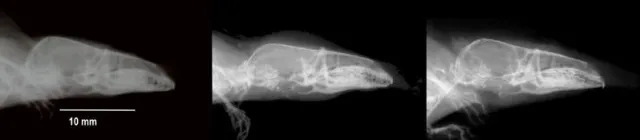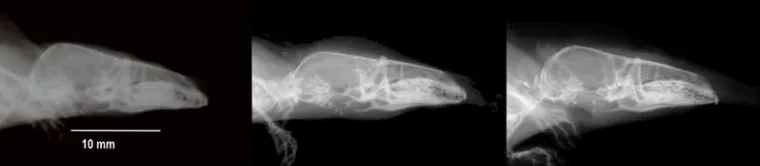
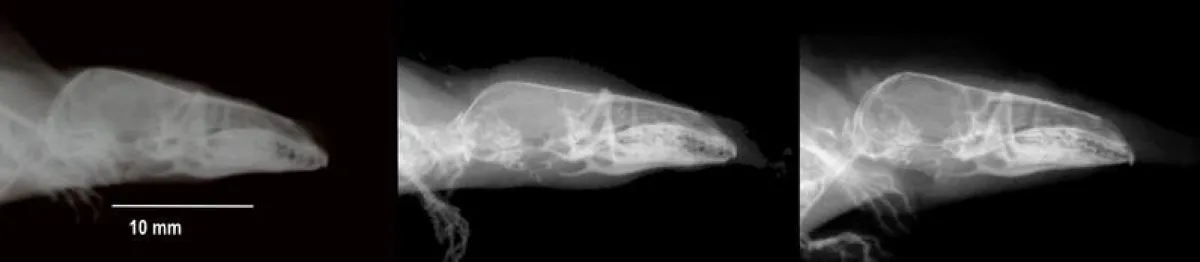
(openPR) During winter, the skull of common shrews shrinks by up to 15 per cent, only to grow back during spring by up to nine per cent. The animals lose almost a fifth of their body weight in the cold months, and nearly double their body mass again during warmer periods. Scientists from the Max Planck Institute for Ornithology in Radolfzell and Seewiesen found that not only bones, but also organs and even the brain itself take part in this depletion. In their study, the scientists assume that this reversible shrinkage ensures the survival of these highly energetic animals during the penurious winter months.
---
Shrews live their lives on the fast track. These constantly active insect eaters with a weight of only 10 grams are closely related to moles and hedgehogs. Their apparent close relationship to mice is only because of their body shape. The energy requirement of a shrew is so high that it will starve if it does not find any food for two to three hours. Neither the day time nor the seasons keep them from feeding during their short, no more than thirteen-months long life. In summer, shrews feed mainly on worms and larvae in the soil. In winter, under unequally tougher life conditions, shrews live primarily from insects and spiders.
In the 1950s the Polish zoologist August Dehnel noticed that shrews caught in winter are not only lighter, but actually smaller. His surveys show that the skulls are flatter and the spine is shorter. But also many organs and particularly the brain of his animals showed a smaller volume than during the summer, with seasonal fluctuations in a size range of not insignificant 20 per cent.
Could shrinkage be a previously unknown adaptation to the winter's living conditions?
In order to investigate whether single individuals actually altered their body size in that way, or whether this was only a selection process in the population studied by Dehnel, the PhD student Javier Lazaro from the Max Planck Institute for Ornithology in Radolfzell caught around 100 common shrews around the campus close to the Lake Constance. He equipped the animals with rice grain-sized electronic ID chips, as they are also used - somewhat bigger - for pets. All of the animals’ skulls were X-rayed before releasing them back into the wild. Through regular recapture initiatives, approximately one-third of the animals could be recaptured at least once, and again got X-rayed.
All the investigated individuals had shrunk in the winter and had regrown in spring. “In winter, the skull height decreased by an incredible 15 percent and even up to a maximum of 20 percent, to then increase again in spring by up to nine percent”, says Javier Lazaro. Dina Dechmann, co-author of the study, interprets this phenomenon as a previously unknown strategy of this highly metabolic animal, to survive the lack of food and the low temperatures during winter. “Normally, animals in colder zones are larger and have a good volume-to-surface ratio to compensate for heat losses. The shrew, on the other hand, has a low volume-to-surface ratio and could possibly save vital energy through shrinking”, says Dechmann. Recently her working group succeeded in demonstrating similar changes in the skull of the weasel. These small predators, members of a completely different mammalian group, also have an extremely high energy requirement and do not have the option of avoiding winter or entering hibernation.
“The measured changes found on the bone and organ levels provide some starting points for further exciting research. Currently, in collaboration with colleagues of a university hospital, we are looking at changes in the bone substance and observe reversible processes that are reminiscent of lesions in osteoporotic bones. The alterations of the brain and heart also underline medically interesting similarities”, says Moritz Hertel from the sub-institute in Seewiesen, senior-author of the study. This study connecting shrew fieldwork to medical research is a good example of how basic research of the Max Planck Society can lead to unexpected discoveries.
Contact:
Javier Lazaro
Max-Planck-Institute for Ornithology, Seewiesen
Am Obstberg 1
78315 Radolfzell

+49 7732 1501-34
Quelle: idw