openPR Recherche & Suche
Presseinformation

Individual Receptors Caught at Work

18.10.201720:00 UhrWissenschaft, Forschung, Bildung
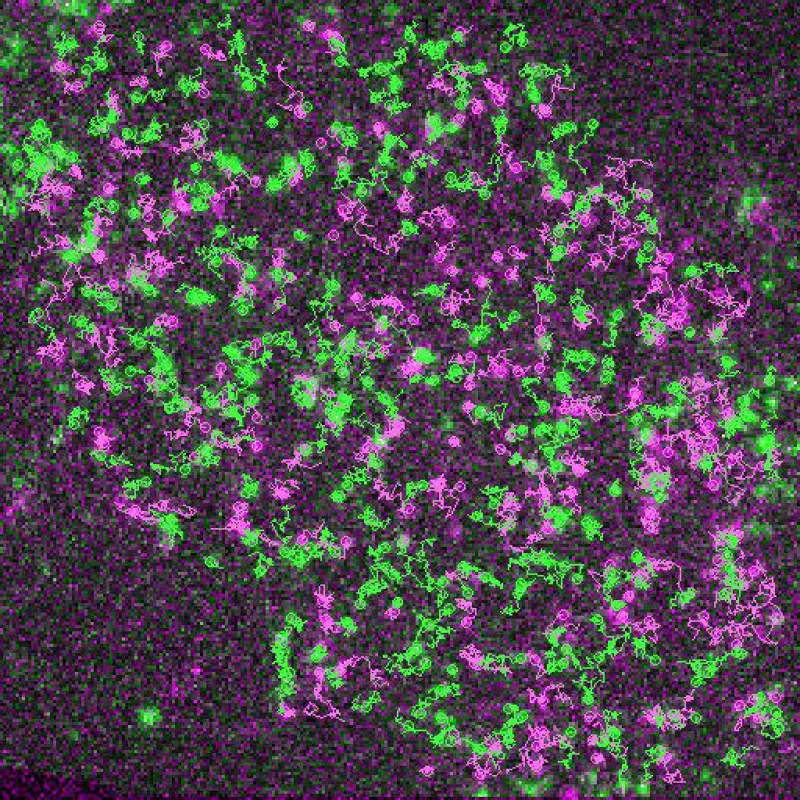
Bild: Individual Receptors Caught at Work
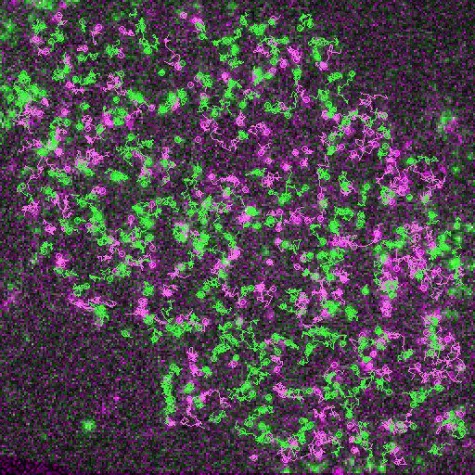
Simultaneous visualization and tracking of individual receptors (green) and G proteins (magenta) at the surface of a living cell. (Photo: Team Calebiro)

(openPR) Using a revolutionary live-cell microscopy technique, an international team of scientist has observed for the first time individual receptors for hormones and widely used drugs at work in intact cells.

---
G protein-coupled receptors (GPCRs) are among the "hottest” targets for the therapy of diseases such as hypertension, asthma or Parkinson´s. These receptors are the site of action of many hormones and neurotransmitters and allow them to regulate the activity of our cells. As a result, around half of all currently prescribed drugs are targeting these receptors to treat several widespread diseases.


As their name suggests, these receptors have to “find” and interact with so-called G proteins on the cell membrane in order to initiate and regulate intracellular processes. How and where this happens has long been the subject of numerous hypotheses, which, however, could never be confirmed. An international team of scientists from the Universities of Würzburg, Birmingham and Wroclaw has now succeeded for the first time to directly observe and investigate the initial contacts between individual receptors and G proteins and the following events taking place at the surface of living cells.

Publication in Nature

"We were able to show that receptors and G proteins preferentially meet at special sites on the cell membrane, which we call hot spots", explains Professor Davide Calebiro, the senior author of the study, which has just appeared in the prestigious scientific journal Nature. Prof. Calebiro is working at the Institute of Pharmacology and Toxicology and at the Bio-Imaging Center of the University of Würzburg as well as at the Center of Membrane Proteins and Receptors of the Universities of Birmingham and Nottingham.

These detailed observations at the cell membrane of living cells were made possible by the use of a highly sophisticated method based on single-molecule microscopy. The authors also observed that receptors and G proteins usually remain associated only for a short time. Indeed, most interactions terminated after just one second. Furthermore, the researchers found that the cytoskeleton underneath the cell membrane plays an important role in the formation of the hot spots. The existence of these hot spots for receptor signaling was hitherto unknown.

Technological developments allow new insights

Davide Calebiro and his co-authors are convinced that the hot spots exert an important influence on receptor signaling by increasing both the speed and efficiency of G protein activation. At the same time, they allow the resulting signals to stay local. According to the scientists, their new findings show that "apparently simple biological processes can be highly sophisticated once observed from a short distance". They anticipate that the current “exceptional advances” in imaging techniques will lead to a much deeper understanding of these processes in the near future.

According to the authors, the newly gained insights provide the opportunity for new therapeutic approaches. "Currently used drugs can only either activate or block the receptors," explains Davide Calebiro. In the future, it might be possible to influence these processes much more precisely ? for example by manipulating the mobility of receptors and G proteins on the cell membrane or their interactions at the hot spots.

This study was supported by the Deutsche Forschungsgemeinschaft (DFG).

Single-molecule imaging reveals receptor-G protein interactions at cell surface hot spots. Titiwat Sungkaworn, Marie-Lise Jobin, Krzysztof Burnecki, Aleksander Weron, Martin J. Lohse & Davide Calebiro. Nature, published online 18 October 2017, doi: 10.1038 / nature24264

Contact

Prof. Dr. med. Dr. Davide Calebiro, T: +49 931 31-80067, E-Mail

Weitere Informationen:
- https://youtu.be/7vsc9DnGhsM Simultaneous visualization and tracking of individual receptors (green) and G proteins (magenta) at the surface of a living cell. The receptors and G proteins undergo transient interactions, which occur preferentially at “hot spots” on the cell membrane. (Video: Team Calebiro)

Quelle: idw

Diese Pressemeldung wurde auf openPR veröffentlicht.

Verantwortlich für diese Pressemeldung:

News-ID: 975085
 517

Kostenlose Online PR für alle

Jetzt Ihren Pressetext mit einem Klick auf openPR veröffentlichen

Jetzt gratis starten

Pressebericht „Individual Receptors Caught at Work“ bearbeiten oder mit dem "Super-PR-Sparpaket" stark hervorheben, zielgerichtet an Journalisten & Top50 Online-Portale verbreiten:

PM löschen PM ändern
Disclaimer: Für den obigen Pressetext inkl. etwaiger Bilder/ Videos ist ausschließlich der im Text angegebene Kontakt verantwortlich. Der Webseitenanbieter distanziert sich ausdrücklich von den Inhalten Dritter und macht sich diese nicht zu eigen. Wenn Sie die obigen Informationen redaktionell nutzen möchten, so wenden Sie sich bitte an den obigen Pressekontakt. Bei einer Veröffentlichung bitten wir um ein Belegexemplar oder Quellenennung der URL.

Pressemitteilungen KOSTENLOS veröffentlichen und verbreiten mit openPR

Stellen Sie Ihre Medienmitteilung jetzt hier ein!

Jetzt gratis starten

Weitere Mitteilungen von Julius-Maximilians-Universität Würzburg

Bild: Georg Gasteiger erforscht das ImmunsystemBild: Georg Gasteiger erforscht das Immunsystem
Georg Gasteiger erforscht das Immunsystem
Seit Juni 2017 hat Georg Gasteiger den Lehrstuhl für Systemimmunologie II an der Universität Würzburg inne. Diese neu geschaffene Professur ist Teil der Max-Planck-Forschungsgruppe für Systemimmunologie, die an der Universität aufgebaut wird. --- Der Typ von Zellen, für die sich Georg Gasteiger interessiert, existiert nicht! So lautete die vorherrschende Meinung in der Wissenschaft über viele Jahre. Erst als Forscher an den richtigen Stellen im Körper danach suchten, wurden neue Zelltypen des angeborenen Immunsystems entdeckt, sogenannten In…
Wann ist ein Fan ein Fan?
Nicht nur im Sport gibt es begeisterte Anhänger; auch in anderen Bereichen zeigen Fans, für wen oder was ihr Herz schlägt. Fanforscher der Uni Würzburg stellen sie in den Mittelpunkt eines neuen Forschungsprojekts. --- Fußball wäre ohne Fans kaum denkbar. Und auch in anderen Sportarten sorgen begeisterte Anhänger für die passende Stimmung. Kein Wunder, dass in der öffentlichen Wahrnehmung Fans häufig nur mit Sport in Verbindung gebracht werden. Dabei gibt es Fans heutzutage in allen denkbaren Bereichen: Von der 14-Jährigen, die für Justin …

Das könnte Sie auch interessieren:

Bild: UFO sighting goes viralBild: UFO sighting goes viral
UFO sighting goes viral
… frischen Roswell-Alien durchgezogen. Ebenso wird CGI-UFO-Material aufegführt: „An airline passenger recently captured footage of strange UFO orbs over Atlanta, Georgia, USA.“/“An apparent triangular UFO was caught on camera over York, England. What do you think it could possibly be? Something real, or was editing work involved?“ oder „A passenger aboard …
Molecular basis for memory and learning
… new situations through changing, building or reducing the contact points between nerve cells (synapses). In particular, the signal strength is regulated by constantly altering the abundance of receptors in the membrane of nerve cells. This explains why it is easier to remember information that we use frequently as opposed to information that we learned …
Fast and adaptable
Fast and adaptable
… innate immune system reacts immediately to foreign intruders like viruses and bacteria, the adaptive immune system is capable of continually adjusting itself throughout the lifespan of an individual so that it can deal with various new pathogens. It can recognise specific antigens on the surface of invaders, and is thus able to trigger targeted, effective …
Bild: Mixing Artificial Sweeteners Inhibits Bitter Taste ReceptorsBild: Mixing Artificial Sweeteners Inhibits Bitter Taste Receptors
Mixing Artificial Sweeteners Inhibits Bitter Taste Receptors
… Caputo | Press Office | Cell Press 617-397-2802 | | Blends of artificial sweeteners such as saccharin and cyclamate produce less of a bitter off-taste than each of the individual components, but the explanation for this puzzling phenomenon has been elusive ever since its discovery more than 60 years ago. A study published September 14th in the journal …
Zooming-in on protein teamwork
The surface of every cell contains receptors that react to external signals similar to a “gate”. In this way, the cells of the innate immune system can differentiate between friend and foe partly through their “toll-like receptors” (TLRs). Two parts of this gate often work together here, as researchers at Goethe University Frankfurt and their British …
Cliché and reality: new findings on the generational debate
When promoting their employees, companies should consider age less and the individual person more. The reason for this is that the generations are more similar in terms of their needs than previously thought, although they see themselves as being vastly different. This is the key finding of a study conducted by scientists at Jacobs University recently …
Bild: How receptors for medicines work inside cellsBild: How receptors for medicines work inside cells
How receptors for medicines work inside cells
G protein-coupled receptors are the key target of a large number of drugs. Würzburg scientists have now been able to show more precisely how these receptors act in the cell interior. --- The human genome encodes hundreds of G protein-coupled receptors (GPCRs). These form the largest group of receptors through which hormones and neurotransmitters exert …
Bild: m4 Award for cell death researchersBild: m4 Award for cell death researchers
m4 Award for cell death researchers
… Greek word ptosis, meaning “a fall”, and ferrum, the Latin word for iron, and describes a form of regulated cell death in which iron plays an important role. “The individual mechanisms involved in this type of cell death only emerge slowly, and our team has already made some groundbreaking work that that is already contributing towards a better understanding …
Bild: Relocation Services for expats in Hannover GermanyBild: Relocation Services for expats in Hannover Germany
Relocation Services for expats in Hannover Germany
Across the Pond is now offering relocation Services for expats as well as families and individuals that are relcoating to Germany. Based in Hannover (northern Germany), Across the Pond is assisting clients all over Germany getting settled in by offering individual service packages. Our work already starts before the expat leaves the home country. Once …
Bild: Molecular volume controlBild: Molecular volume control
Molecular volume control
About two years ago, scientists from the University of Würzburg discovered that a certain class of receptors is capable of perceiving mechanical stimuli. Now they have begun to unravel the molecular mechanisms behind the discovery. --- The receptor studied by scientists from the universities of Würzburg and Leipzig over the past years works similarly …
Sie lesen gerade: Individual Receptors Caught at Work