openPR Recherche & Suche
Presseinformation

Biodegradable electronics

13.10.201710:00 UhrWissenschaft, Forschung, Bildung
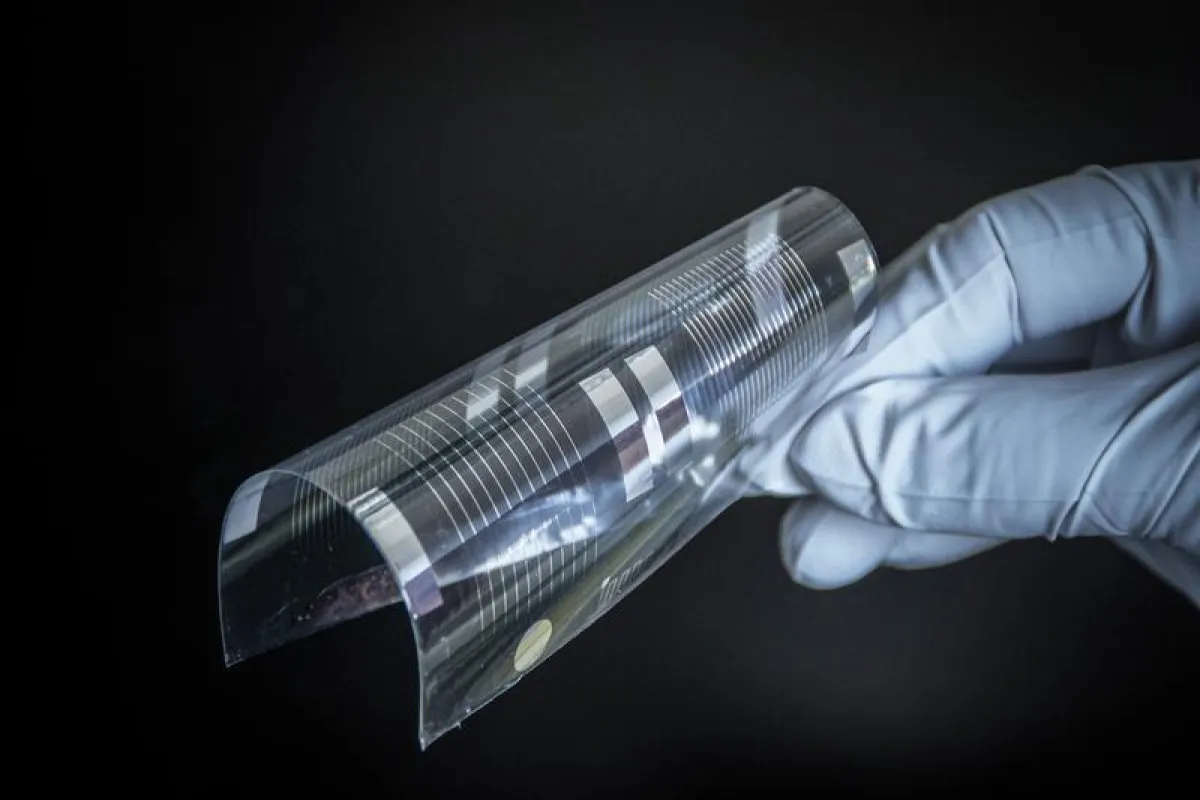
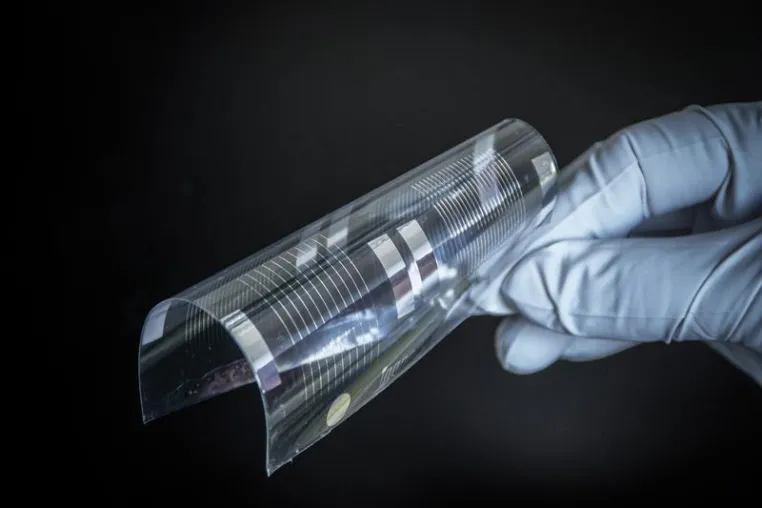
Bild: Biodegradable electronics
Biodegradable conductor structures on biodegradable polymer film (© Fraunhofer FEP)

(openPR) Under the direction of the Fraunhofer FEP, an in-house Fraunhofer project for development of biodegradable electronics was begun last year. The Fraunhofer Institutes ENAS, IBMT, ISC, and the Fraunhofer Project Group IWKS are working together on the project. First results of the Fraunhofer FEP will be presented during Semicon Europe 2017 as part of productronica 2017 in Munich at the Silicon-Saxony joint booth in Hall B, Booth No. B1-416, November 14-17, 2017.


---
Electronic devices that are completely broken down in a biological environment after a pre-defined operating life open up novel applications as well as ways for reducing their ecological footprint.

One enabling technology for such devices is the production of biodegradable conductive traces on biodegradable substrates using vacuum technologies. This technology was developed by Fraunhofer FEP.

A novel application area for these innovative electronic components for example is in the field of active medical implants that after expiration of their operating life are resorbed by tissue, thereby sparing the patient a second surgical intervention.

The Fraunhofer Gesellschaft e. V. is now funding the “bioElektron – Biodegradable Electronics for Active Implants" project through its in-house program (funding No. MAVO B31 301). The goal of the project is the development of essential components for biodegradable electronic parts that can be employed for example in an implant.

This includes in particular
- biodegradable conductor structures
- biodegradable electrodes for collecting electrical signals or delivering electrical stimulation
- biodegradable thin-film transistors and circuitry
- biodegradable barrier coatings as moisture and gas barriers, and electrical insulation layers
These elements will be monolithically integrated into a flexible thin-film device.

Conductor structures and organic thin-film transistors are being developed at Fraunhofer FEP using vacuum technology. Deposition of magnesium via thermal evaporation under high vacuum conditions is being used as an enabling technology for this purpose. Magnesium is known for being a biodegradable and biologically compatible metal that is already employed in clinical environments as an absorbable implant material. The challenge consists of depositing this metal onto biodegradable polymer films that magnesium does not adhere sufficiently to under normal processing conditions. By suitably pre-treating the substrates using a combination of drying, plasma treatment, and utilization of seed layers, finely structured high-quality conductor structures have been produced.

“We are now prepared to discuss these results with interested partners from industry and the scientific community during productronica 2017 at the Silicon-Saxony joint booth (Hall B1, Booth B1-416) in order to be able to implement them in current practical applications”, explains Dr. Michael Hoffmann from Fraunhofer FEP and head of the bioElektron project.

Fraunhofer FEP at productronica 2017 (SEMICON und FlexEurope):

Trade-fair booth: Silicon-Saxony joint booth in Hall B1, Booth No. B1-416

Talks:
Wednesday, 15.11.2017, 2:35 pm, ICM 1st floor, Room 14c
„Biodegradable flexible conductor structures“, Dr. Michael Hoffmann, Fraunhofer FEP

Innovation Forum
Hall B2, next to booth no. 457 OE-A Organic and Printed Electronics Association

Wednesday, 15.11.2017, 3:00 pm, Hall B2 / 453
Session: Printed Electronics Insights: Advancing Wearables
Electronics and OLED lighting in textiles, Jan Hesse, Fraunhofer FEP

Thursday, 16.11.2017, 3:00 pm, Halle B2 / 453
Session: Printed Electronics Insights: Applications and New Developments
Ultra-thin glass as a substrate and encapsulant for bendable OLED devices fabricated in Roll-to-Roll, Dr. Stefan Mogck, Fraunhofer FEP

Press contact:

Mrs. Annett Arnold

Fraunhofer Institute for Organic Electronics, Electron Beam and Plasma Technology FEP
Phone +49 351 2586 333 | E-Mail

Winterbergstraße 28 | 01277 Dresden | Germany | www.fep.fraunhofer.de

Weitere Informationen:
- http://About bioELEKTRON:
- https://www.fep.fraunhofer.de/en/ueber-uns/projekte/bioElektron.html
- http://Link for the press release on the Fraunhofer FEP Website:
- http://s.fhg.de/k5i

Quelle: idw
Diese Pressemeldung wurde auf openPR veröffentlicht.

Verantwortlich für diese Pressemeldung:

News-ID: 974033
 471

Kostenlose Online PR für alle

Jetzt Ihren Pressetext mit einem Klick auf openPR veröffentlichen

Jetzt gratis starten

Pressebericht „Biodegradable electronics“ bearbeiten oder mit dem "Super-PR-Sparpaket" stark hervorheben, zielgerichtet an Journalisten & Top50 Online-Portale verbreiten:

PM löschen PM ändern
Disclaimer: Für den obigen Pressetext inkl. etwaiger Bilder/ Videos ist ausschließlich der im Text angegebene Kontakt verantwortlich. Der Webseitenanbieter distanziert sich ausdrücklich von den Inhalten Dritter und macht sich diese nicht zu eigen. Wenn Sie die obigen Informationen redaktionell nutzen möchten, so wenden Sie sich bitte an den obigen Pressekontakt. Bei einer Veröffentlichung bitten wir um ein Belegexemplar oder Quellenennung der URL.

Pressemitteilungen KOSTENLOS veröffentlichen und verbreiten mit openPR

Stellen Sie Ihre Medienmitteilung jetzt hier ein!

Jetzt gratis starten

Weitere Mitteilungen von Fraunhofer-Institut für Organische Elektronik, Elektronenstrahl- und Plasmatechnik FEP

Bild: Biodegradierbare ElektronikBild: Biodegradierbare Elektronik
Biodegradierbare Elektronik
Unter der Federführung des Fraunhofer FEP wurde im vergangenen Jahr ein Fraunhofer internes Projekt zur Entwicklung biodegradierbarer Elektronik gestartet, an dem auch die Fraunhofer-Institute ENAS, IBMT, ISC und die Fraunhofer-Projektgruppe IWKS arbeiten. Erste Ergebnisse des Fraunhofer FEP werden auf der Semicon Europe 2017 als Teil der productronica 2017, vom 14.-17.11.2017 in München, auf dem Silicon-Saxony-Gemeinschaftsstand, in der Halle B1, Stand Nr. B1-416 vorgestellt. --- Elektronische Bauteile, die nach einer definierten Funktionsz…
Bild: Multifunktionale Datenbrille mit OLED-MikrodisplaysBild: Multifunktionale Datenbrille mit OLED-Mikrodisplays
Multifunktionale Datenbrille mit OLED-Mikrodisplays
Die am Fraunhofer FEP entwickelten bidirektionalen OLED-Mikrodisplays wurden erstmals erfolgreich in einen Datenbrillen-Demonstrator integriert, mit der sowohl AR- und VR- Anwendungen als auch 2D- und 3D-Inhalte dargestellt werden können. Auf der awe europe vom 19.-20. Oktober 2017, im MOC München, wird die neue Entwicklung erstmals am Stand des Fraunhofer FEP, Nr. 420, vorgestellt. --- Datenbrillen und die damit verbundene virtuelle und erweiterte Realität (virtual reality, VR; augmented reality, AR) sind nicht nur aus der Entertainment- un…

Das könnte Sie auch interessieren:

Biokunststoffe und die babylonische Begriffsverwirrung
… Polyethylen und Polypropylen, in denen der Zerfall durch ein katalysierendes Additiv ausgelöst wird. Verbreitet hierfür sind Metallsalze. Der amerikanische Herstellerverband Oxo-Biodegradable Plastics Institute (OPI) http://www.oxobio.org teilt dazu mit, dass häufig Kobaltsalze verwendet werden. Kobalt werde jedoch in so geringer Konzentration eingesetzt, …
Bild: Bio stents increase risk of heart attackBild: Bio stents increase risk of heart attack
Bio stents increase risk of heart attack
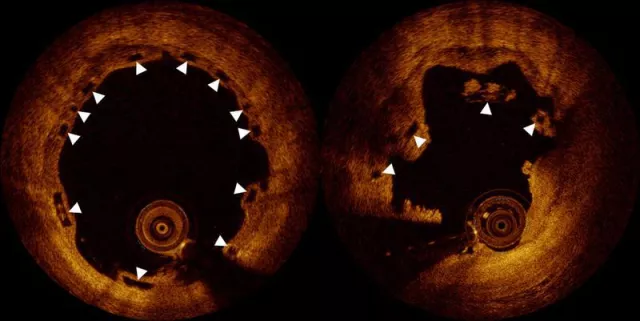
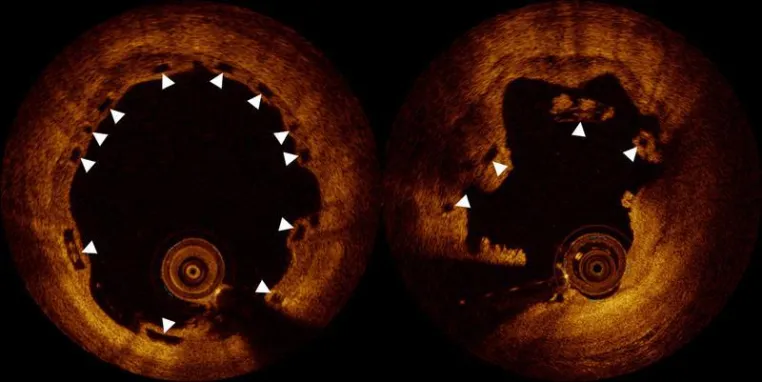
Biodegradable stents were seen as the ideal solution for narrowed coronary vessels. Yet, instead of dissolving satisfactorily, the «bio stents» paradoxically lead to secondary heart attacks more frequently than metal stents. A study by the Department of Cardiology at Bern University Hospital has solved this puzzle. --- Since the first successful use …
Inion Ltd. - Inion introduces its First Biodegradable Spinal Implant in Europe
Inion introduces its First Biodegradable Spinal Implant in Europe CE Mark received for Inion S-1TM Anterior Cervical Fixation System Tampere, Finland and Takeley, UK. 16th August 2005. Inion [LSE: IIN.L], a rapidly growing company focused on the development of novel biodegradable medical implants, has received a CE Mark for the Inion S-1TM Anterior Cervical …
Bild: Dyntex bringt weltweit erste ultraleichte Bio-Funktionsstoffe auf den MarktBild: Dyntex bringt weltweit erste ultraleichte Bio-Funktionsstoffe auf den Markt
Dyntex bringt weltweit erste ultraleichte Bio-Funktionsstoffe auf den Markt
… biosynthetischem Garn und biologisch abbaubarem Stoff. Dyntex, Entwickler und Hersteller von Funktionsmaterialien aus Bregenz (Österreich), bringt zwei Weltneuheiten auf den Markt: Dyntex® Biodegradable ist der weltweit erste, ultraleichte, in nur fünf Jahren biologisch abbaubare Funktionsstoff. Dyntex® Biological Origin ist ebenfalls ultraleicht und vollständig …
Qn group präsentiert Biogeschirr auf Verbrauchermesse Kontakta
… eingehen und deren Vorstellungen bei der Produktion mit berücksichtigen.“ Hergestellt wird das umweltfreundliche Einweggeschirr nach europäischen Standards vom thailändischen Partnerunternehmen Biodegradable Packaging for Environment (BPE) in Bangkok. BPE ist im asiapazifischen Raum Marktführer für biologische Bagasseprodukte und produziert aktuell mehr …
Bild: Plastikmüll im Ozean: Was biologisch abbaubare Kunststoffe zur Lösung des Problems beitragen könnenBild: Plastikmüll im Ozean: Was biologisch abbaubare Kunststoffe zur Lösung des Problems beitragen können
Plastikmüll im Ozean: Was biologisch abbaubare Kunststoffe zur Lösung des Problems beitragen können
… wissenschaftlicher Geschäftsführer | Leibniz-Zentrum für Marine Tropenforschung (ZMT)E-Mail: Originalpublikation:Lahl, R., Bleischwitz, R., Lahl, U., Zeschmar-Lahl, B. (2025): Third-generation biodegradable plastics – A complementary strategy to tackle the marine litter problem. Sustainable Chemistry and Pharmacy 44, 101925. https://doi.org/10.1016/j.scp.2025.101925
Kunststoff geht Bio
Kunststoff geht Bio
… reduzieren. Die Produktionskapazität liegt bei 14.000 Tonnen pro Jahr. Carbomax Bio ist vom TÜV Austria zertifiziert: OK Compost Industrial, OK Compost Home und OK Biodegradable Soil. Das eingesetzte Calciumcarbonat ist nach ISO 14021 erneuerbar und entspricht den Kompostierungskriterien nach EN 13432 (2000), NF T51-800 (2015), ASTM D6400 (2012) und …
Six German-Russian Research Groups Receive Three Years of Funding
… N.N. Blokhin Russian Cancer Research Center, the Institute of Materials Research at the Helmholtz Center Geesthacht (HZG) wants to expand its developments in the area of biodegradable magnesium alloys to new applications. The project addresses a core problem in modern oncology: the application of local chemotherapy that aims to achieve an efficient concentration …
Bild: Der Bio-Mikrosensor für Apfel und FischBild: Der Bio-Mikrosensor für Apfel und Fisch
Der Bio-Mikrosensor für Apfel und Fisch
… noch viel Forschung nötig. Das Team forscht deshalb aktuell an einem biokompatiblen Energieträger für seinen Sensor. Literaturhinweis Salvatore GA et al.: Biodegradable and Highly Deformable Temperature Sensors for the Internet of Things. Advanced Functional Materials 2017. 1702390. doi: 10.1002/adfm.201702390 Weitere Informationen: - https://www.ethz.ch/de/news-und-veranstaltungen/eth-news/news/2017/09/biologisch-abbaubarer-sensor.html Quelle: …
Bild: Biodegradierbare ElektronikBild: Biodegradierbare Elektronik
Biodegradierbare Elektronik
… (SEMICON und FlexEurope) Messestand: Silicon-Saxony-Gemeinschaftsstand, Halle B1, Stand Nr. B1-416 Vorträge: 2017FLEX Europe Conference: Mittwoch, 15.11.2017, 14:35 Uhr, ICM 1. OG, Raum 14c „Biodegradable flexible conductor structures“, Dr. Michael Hoffmann, Fraunhofer FEP Innovation Forum Halle B2, neben Stand 457 OE-A Organic and Printed Electronics …
Sie lesen gerade: Biodegradable electronics