openPR Recherche & Suche
Presseinformation

Breeding Salt-Tolerant Plants

10.10.201714:00 UhrWissenschaft, Forschung, Bildung
Bild: Breeding Salt-Tolerant Plants
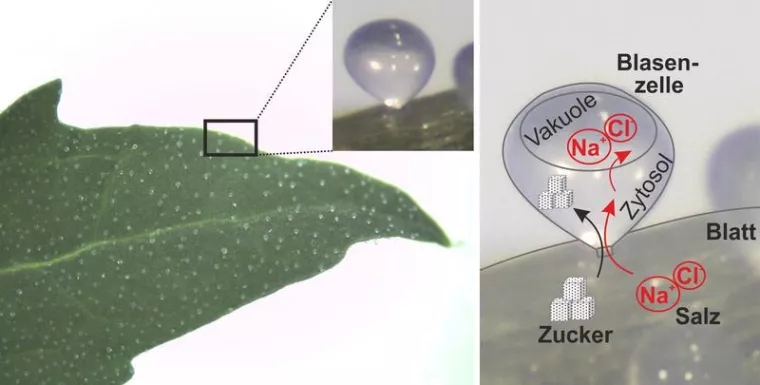
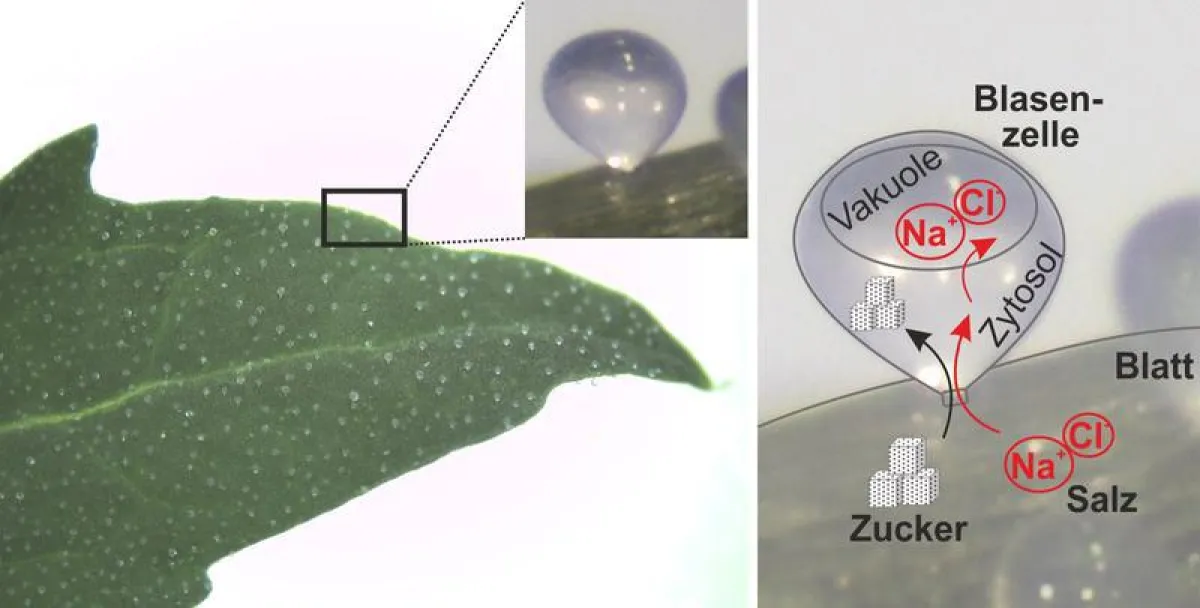
Quinoa leaf with typical salt bladders. Right, you see the plant transporting the dissolved salts into the bladder and then in its vacuoles. The sugar carried along provides the necessary energy. (Pic

(openPR) The quinoa plant might serve as a model for making other crops salt-tolerant. It grows well on saline soils because the excess salt is simply dumped into special bladders on its leaves.

---
Soil erosion is considered as a problem that puts the nutrition of the human population at jeopardy. One of its aspects is soil salination, which affects in particular dry regions of the earth, where farmers are forced to irrigate their fields heavily. Large quantities of the salts dissolved in the water, such as sodium and chloride, are diffused into the soil and remain there after the water has evaporated. The salt stunts the crops and can even make soils infertile in the long run.


“All approaches so far to breed salt-tolerant plants must be considered more or less as failures”, says Professor Rainer Hedrich, plant scientist at the Julius-Maximilians-Universität (JMU) Würzburg in Bavaria, Germany. They all aimed at making crop plants grow on saline soils and to identify salt-tolerant breed lines in the process. But this approach cannot work.

And that is for a reason: “Our crop plants are the result of many years of breeding. During that time, man has sheltered them from nearly all negative environmental influences, so that they have lost a lot of their natural resilience”, explains Hedrich. “As soon as these elite lines come in contact with too much salt, they usually die.”

Salt-tolerant plants serve as model

So Rainer Hedrich, together with Professor Sergey Shabala (University of Tasmania), set out to develop a new strategy. The two scientists placed their bet on plants that are naturally salt-tolerant.

One such plant is quinoa (Chenopodium quinoa). It comes from the Andes, where it has been been used as food for 7,000 years. Meanwhile the seeds of this South American pseudo-cereal, which are free from gluten and rich in vitamins, have found their way to European supermarket shelves.

The plant absorbs salt from the soil and stores it in bladder-shaped cells on the surface of its leaves. This protects the salt-sensitive metabolic processes, and the plant can grow well even on saline soils.
Without bladder cells quinoa suffers from salt stress
The researchers have found a simple way of proving that it is really the bladder cells that ensure the plant’s salt tolerance. “Just a few light brush strokes over a quinoa leaf cause the bladder cells to fall off”, says Professor Shabala. Stripped of their salt bladders, these plants grow on non-saline soils just as well as non-brushed specimens. But an exposure to common salt stunts their growth significantly.

The round to oval bladder cells of quinoa have a diameter of almost half a millimeter. They are veritable giants in the kingdom of plants, and can usually be seen even with the naked eye. Their storage capacity is up to 1000 times higher than that of any normal cell of the leaf surface.

The price of salt disposal is sugar

To get an insight into the “operating system” of quinoa and its bladder cells, the work group of Professor Jian-Kang Zhu (University of Shanghai) has decoded the Andes cereal’s DNA. Professor Hedrich’s team then compared the active genes of leaves and bladder cells. The necessary bioinformatic analyses were performed by experts from the University of Shanghai and from the team of Georg Haberer from the Helmholtz Center Munich.

The result: Even without salt treatment, there are genes working in the bladder cells which are in other species only active when the plant is under stress. They include transporters carrying sodium and chloride ions into the bladder cell. A stimulation with salt triggers the activation of further genes needed to maintain the signal path for the stress hormone ABA.

Storing the salt consumes energy. This energy is generated by the bladder cells from sugar molecules which they specially import from the leaf for that purpose. The bladder cells receive the required energy from the leaf and reciprocate by absorbing the toxic salt”, explains Hedrich.

Crossbreeding salt tolerance into crop plants

The new findings have been published in the “Cell Reports” journal. They are to be used in the long term for the breeding of salt-tolerant plants. “The first step is made”, says Professor Hedrich. “We will now use a combination of developmental genetics and the functional analysis of salt transport proteins to understand the molecular mechanisms that produces and maintains the salt tolerance in quinoa.”

The JMU research team wants to learn from quinoa lines equipped with a very large or a very low number of salt bladders. It has a large pool to draw on: about 2000 wild and cultivated varieties of the plant from the Andes are known so far. The ultimate outcome of their work might be not only the breeding of quinoa varieties with an even higher salt tolerance but also the crossbreeding of salt tolerance genes into related crop plants such as sugar beets or spinach.

“A high-quality genome assembly of quinoa provides insights into the molecular basis of salt bladder-based salinity tolerance and exceptional nutritional value". Heng Zhang, Changsong Zou, Aojun Chen, Lihong Xiao, Meiling Zhang, Wei Jia, Ping Deng, Ru Huang, Feng Li, Jian-Kang Zhu, Heike Muller, Peter Ache, Rainer Hedrich, Georg Haberer, Xiangyun Wu, Hui Zhang, Jennifer Bohm, Sergey Shabala, Renyi Liu, Daniel Lang, and Dongliang Zhan, Cell Reports doi:10.1038/cr.2017.124

Contact

Prof. Dr. Rainer Hedrich, Chair of Molecular Plant Physiology and Biophysics, Biocentre, JMU, T +49 931 31-86100, E-Mail

Quelle: idw

Diese Pressemeldung wurde auf openPR veröffentlicht.

Verantwortlich für diese Pressemeldung:

News-ID: 973338
 658

Kostenlose Online PR für alle

Jetzt Ihren Pressetext mit einem Klick auf openPR veröffentlichen

Jetzt gratis starten

Pressebericht „Breeding Salt-Tolerant Plants“ bearbeiten oder mit dem "Super-PR-Sparpaket" stark hervorheben, zielgerichtet an Journalisten & Top50 Online-Portale verbreiten:

PM löschen PM ändern
Disclaimer: Für den obigen Pressetext inkl. etwaiger Bilder/ Videos ist ausschließlich der im Text angegebene Kontakt verantwortlich. Der Webseitenanbieter distanziert sich ausdrücklich von den Inhalten Dritter und macht sich diese nicht zu eigen. Wenn Sie die obigen Informationen redaktionell nutzen möchten, so wenden Sie sich bitte an den obigen Pressekontakt. Bei einer Veröffentlichung bitten wir um ein Belegexemplar oder Quellenennung der URL.

Pressemitteilungen KOSTENLOS veröffentlichen und verbreiten mit openPR

Stellen Sie Ihre Medienmitteilung jetzt hier ein!

Jetzt gratis starten

Weitere Mitteilungen von Julius-Maximilians-Universität Würzburg

Bild: Georg Gasteiger erforscht das ImmunsystemBild: Georg Gasteiger erforscht das Immunsystem
Georg Gasteiger erforscht das Immunsystem
Seit Juni 2017 hat Georg Gasteiger den Lehrstuhl für Systemimmunologie II an der Universität Würzburg inne. Diese neu geschaffene Professur ist Teil der Max-Planck-Forschungsgruppe für Systemimmunologie, die an der Universität aufgebaut wird. --- Der Typ von Zellen, für die sich Georg Gasteiger interessiert, existiert nicht! So lautete die vorherrschende Meinung in der Wissenschaft über viele Jahre. Erst als Forscher an den richtigen Stellen im Körper danach suchten, wurden neue Zelltypen des angeborenen Immunsystems entdeckt, sogenannten In…
Wann ist ein Fan ein Fan?
Nicht nur im Sport gibt es begeisterte Anhänger; auch in anderen Bereichen zeigen Fans, für wen oder was ihr Herz schlägt. Fanforscher der Uni Würzburg stellen sie in den Mittelpunkt eines neuen Forschungsprojekts. --- Fußball wäre ohne Fans kaum denkbar. Und auch in anderen Sportarten sorgen begeisterte Anhänger für die passende Stimmung. Kein Wunder, dass in der öffentlichen Wahrnehmung Fans häufig nur mit Sport in Verbindung gebracht werden. Dabei gibt es Fans heutzutage in allen denkbaren Bereichen: Von der 14-Jährigen, die für Justin …

Das könnte Sie auch interessieren:

Bild: Plant escape from waterloggingBild: Plant escape from waterlogging
Plant escape from waterlogging
… growth. Using the example of a model plant that is frequently used in labs, Arabidopsis thaliana, also known as thale cress, doctoral researcher Emese Eysholdt-Derzsó investigated how plants respond to low oxygen stress that results from too much water. “In her work, Eysholdt-Derzsó describes for the first time how waterlogging and the related oxygen …
Zielgerichtete Kundenansprache
Mit Lifestyle Daten und Datenqualität zur exakten Zielgruppe Die aktuelle Erweiterung von TOLERANT Post hilft Unternehmen bei der Standortplanung, Zielgruppenanalyse und Marktabschätzung. Dazu verwendet TOLERANT Post CAMEO Daten, welche Konsumenten auf einzigartige Weise anhand ihrer Lebensphase und ihres Wohlstands klassifiziert. Und das ganze Europaweit. Der Einsatz von Lifestyle-Daten ermöglicht es, Ihre Kunden zu kategorisieren und so bessere Ergebnisse in der Ansprache zu erreichen. Zudem können Zielgruppen- und Marktpotenziale erkannt…
Bild: The sweet potato and it´s evolutionary tracesBild: The sweet potato and it´s evolutionary traces
The sweet potato and it´s evolutionary traces
… plants like Arabidopsis thaliana, studies in crop plants is focused by many scientists worldwide. Goals are to gain basic knowledge about different plants as well as reaching breeding aims like the improvement of yield or a higher resistance against changing environmental conditions. In regard to the growing world population these aims are important steps …
Bild: Light pollution as a new threat to pollinationBild: Light pollution as a new threat to pollination
Light pollution as a new threat to pollination
… been largely neglected in the discussion of the worldwide known pollinator crisis", says Knop. However, there are numerous nocturnal pollinators, and they play an important role for plants, as the study in the Bernese Prealps shows. Knop’s team found out, that flowers on meadows which were experimentally illuminated with street lamps are visited around …
Geokodierung und Adressvalidierung mit TOLERANT Post integriert in Siebel CRM
Postalisch einwandfreie, normierte und deduplizierte Adressen spielen eine Schlüsselrolle für den effizienten Betrieb eines CRM-Systems. Neben dem Senken der Porto- und Werbeausgaben hilft eine normierte Speicherung der Daten auch die interaktive Adressuche zu verbessern. Dabei unterstützt TOLERANT Post mit seinen Leistungen zur fehlertoleranten Prüfung und Korrektur von Adressen den Anwender. Nebenbei können Zusatzinformationen zu einer Adresse wie Geokoordinaten, Statistischer Bezirk, Einwohnerzahl der Stadt, Bundesland und ähnliches angere…
Bild: Global Seasonings and Spices Market Analysis, Development and Demand Forecast 2020Bild: Global Seasonings and Spices Market Analysis, Development and Demand Forecast 2020
Global Seasonings and Spices Market Analysis, Development and Demand Forecast 2020
… mentioned in the report are used to enhance the flavor and taste of food. Spices come from the bark, buds, seeds, roots, leaves, stems or fruits of aromatic trees and plants. The market of seasonings and spices can be segmented on the basis of products into salt, pepper, dried herbs, individual and mixed spices, salt substitutes, others. On the basis …
TOLERANT Software neuer IT-Partner der Deutschen Post Adress Spezialist für den Austausch von Fuzzy!-Produkten
Die TOLERANT Software GmbH & Co KG ist neuer IT-Partner der Deutschen Post Adress GmbH & Co. KG, des Marktführers für Adressaktualisierung und -recherche in Deutschland. Das Stuttgarter Softwarehaus hat eine Lösung für die Aktualisierung von Kundendaten mit der Umzugsdatenbank der Deutschen Post Adress entwickelt. Die neue Abgleichsoftware „TOLERANT Move“ wurde im Rahmen eines Prüfverfahrens zertifiziert und ist bereits erfolgreich für die Adresspflege der WGV (Württembergische Gemeinde-Versicherung a.G.) in deren Standardsoftware ICIS® als S…
Vom russischen Giganten zum Global Player
Der größte russische Baumaschinen-Hersteller Tractor Plants setzt auf Qualität, Service und internationale Ausrichtung Cheboksary, Russland/München, 25.04.2007 – Tractor Plants ist in Russland die Nummer eins unter den Herstellern bei Verkauf und Entwicklung von Schwermaschinen. Mit einer Umsatzsteigerung von 138 Prozent auf 0,9 Mrd. USD im vergangenen …
Bild: First Detailed Decoding of Complex Finger Millet GenomeBild: First Detailed Decoding of Complex Finger Millet Genome
First Detailed Decoding of Complex Finger Millet Genome
… food security and to develop the capacity of biotechnological research in India. “The newly available genome data of finger millet opens up numerous possibilities for modern plant breeding,” Shimizu emphasizes. “On the one hand, to help people with mineral deficiencies in India and in industrialized countries and, on the other hand, to make important …
Communication between Wheat Genes Contributes to Increasing Crop Productivity
… increase in the volume of cereal grain produced is not keeping pace with that of the world's population. As explained by Prof. Jochen Reif, the head of the Division of Breeding Research at the IPK in Gatersleben "wheat contributes about a fifth of the total calories for the world’s population and thus represents one of our most important crops. As the …
Sie lesen gerade: Breeding Salt-Tolerant Plants