openPR Recherche & Suche
Presseinformation

Arctic sea ice once again shows considerable melting

15.09.201711:01 UhrWissenschaft, Forschung, Bildung
Bild: Arctic sea ice once again shows considerable melting
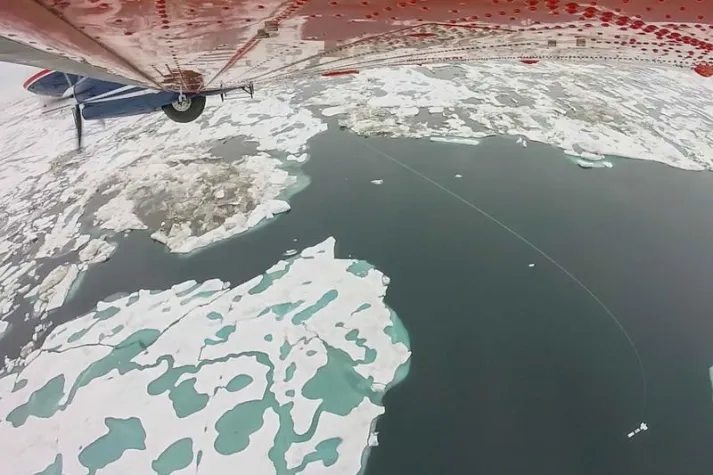
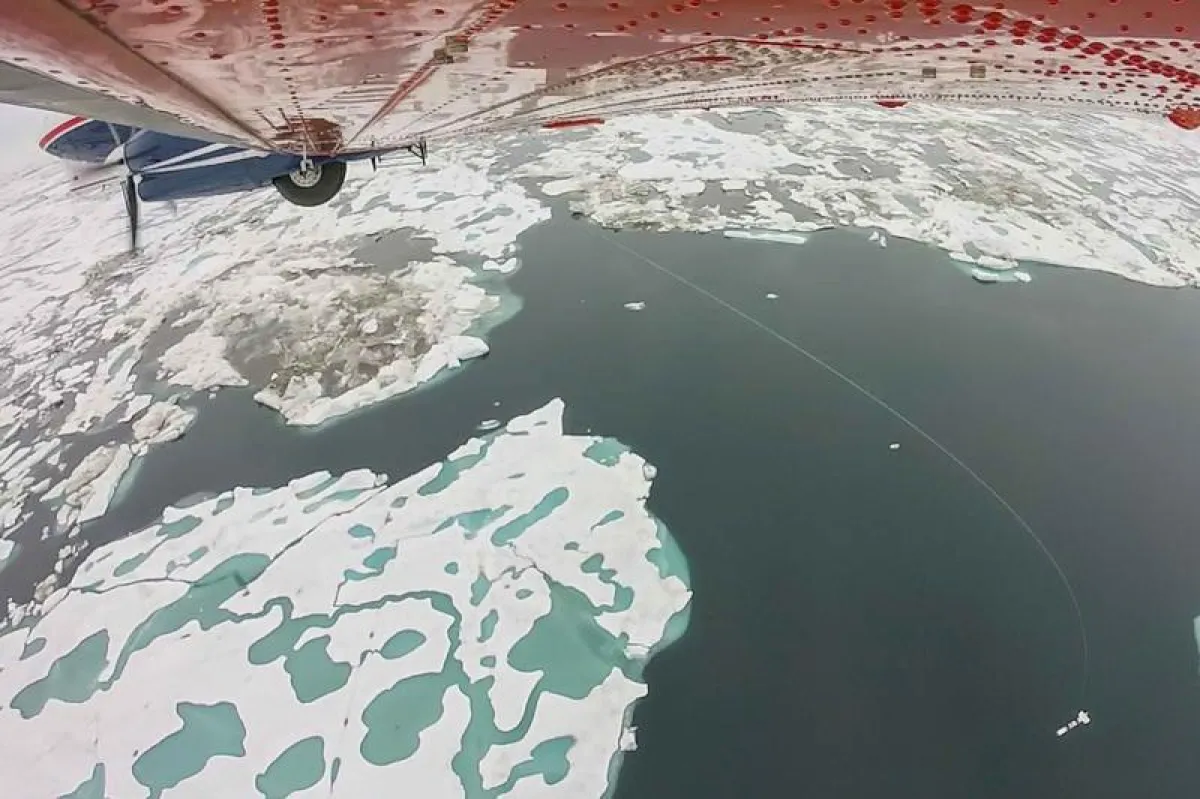
Flight campaign 2016: ice thickness measurement (Arctic Ocean) (Photo: Alfred-Wegener-Institut / E. Horvath)

(openPR) Joint Press Release from the Alfred Wegener Institute Helmholtz Centre for Polar and Marine Research (AWI), the University of Bremen, and the University of Hamburg’s Centre for Earth System Research and Sustainability (CEN)

---
With a minimum extent of ca. 4.7 million square kilometres, Arctic sea ice continues to retreat


This September, the extent of Arctic sea ice shrank to roughly 4.7 million square kilometres, as was determined by researchers at the Alfred Wegener Institute, the University of Bremen and Universität Hamburg. Though slightly larger than last year, the minimum sea ice extent 2017 is average for the past ten years and far below the numbers from 1979 to 2006. The Northeast Passage was traversable for ships without the need for icebreakers.

The sea ice in the Arctic is considered a critical element in climate processes, and a valuable early-warning system for global warming. Accordingly, the September minimum extent is an important indicator of climate change. Despite an especially warm winter, the current extent of sea ice does not represent a new record low; nevertheless, the amount of ice loss is massive. As sea-ice physicist Marcel Nicolaus from the Alfred Wegener Institute, Helmholtz Centre for Polar and Marine Research (AWI) explains, “This year’s sea ice extent is again on a very low level: the observed September value of the past eleven years has consistently been lower than in any of the previous years.”

This winter, the Arctic remained unusually warm, and the sea-ice coverage in March was lower than in any March before. “Thanks to the relatively cold summer, the sea ice managed to bounce back somewhat, but this year’s September minimum is by no means a good sign,” stresses Lars Kaleschke from Universität Hamburg’s Center for Earth System Research and Sustainability. “Though the amount of sea ice is of course subject to natural fluctuations, the long-term decline is obvious.” For comparison, the summertime minimums in the 1970s and 1980s were roughly seven million square kilometres.

The sea-ice covered area is measured with the help of satellites. The high-resolution microwave satellite data are jointly provided by the University of Bremen and Universität Hamburg. They allow to precisely analyse the daily sea-ice extent over the entire Arctic. “That’s particularly important for the shipping industry. This summer, the Northeast Passage along the Russian coast could be used without the need for icebreakers, and many ships also used the Northwest Passage,” says Gunnar Spreen from the University of Bremen’s Institute of Environmental Physics.

AWI prognoses proven to be accurate

Several months before the September minimum, scientists from around the globe provided information on the projected minimum sea-ice areas in the “Sea Ice Outlook”. This year, the Alfred Wegener Institute contributed estimates based on two different forecasting methods for Arctic seasonal sea-ice, which produced similar results very close to the actual September minimum: in July, the AWI’s dynamic forecasting model called for a September minimum of 4.93 million square kilometres, while its static model estimated an area of 4.74 million square kilometres.

This year, the spatial distribution of sea-ice differed from the patterns in recent years, and from the long-term pattern. Less ice than in 2016 was recorded in the Chukchi and East Siberian Seas. In contrast, more ice was observed north of Svalbard and in the Beaufort Sea. In some regions on the fringes of the Artic Ocean, surface melting began fairly early, while in large regions of the central Arctic Ocean, melt onset was observed a few days later than the average for 1981 to 2010. The timing of melt onset is not only important with regard to the overall mass of sea ice; it also determines the lifecycle of the organisms in and below the sea ice.

During the past weeks, sea-ice thickness measurements were the main topic of the TIFAX (Thick Ice Feeding Arctic Export) campaign, which involved research aircraft using laser scanners and a towed electromagnetic probe. In the area surveyed, which lies to the north of the Fram Strait between Greenland and Svalbard, the sea-ice thickness was ca. 1.7 metres, roughly 50 centimetres more than was recorded in 2016. This is most likely due in part to a higher percentage of several-year-old ice in the area. Nevertheless, the measured thickness is ca. 30 per cent lower than between 2001 and 2004. As Marcel Nicolaus summarises, “Despite the warm winter, the sea ice wasn’t unusually thin. Our explanation is that the small and thin ice coverage from the previous summer – the second-smallest area ever recorded – grew faster and thicker than in other years, since thin ice grows faster than thick ice.”

The exact date and value of the minimum sea ice extent in 2017 can only be determined in the coming weeks, after a significant increase. The monthly mean of the September sea ice extent can then only be determined in October. It is expected to be roughly 5 million square kilometres for September 2017. The scientists summarize: “The low Arctic sea ice extent ranks amongst the low values of the last decade. We do not expect an extent of 6 or 7 million square kilometres in the coming decades, as it was typical for the decades up to the year 2000.”

For more detailed information on sea-ice development in the Arctic and the latest sea-ice maps, please visit: http://www.meereisportal.de/en/

Notes for Editors:

Your academic contact partner at the Alfred Wegener Institute is Dr Marcel Nicolaus (Tel.: +49 (0) 471 4831-2905; e-mail: E-Mail).

Your contact partner at the Communications and Media Relations Department is Dr Folke Mehrtens (Tel.: + 49 (0) 471 4831-2007; e-mail: E-Mail).

Your academic contact partner at Universität Hamburg’s Center for Earth System Research and Sustainability is Prof Lars Kaleschke (Tel: +49 (0) 40 42838 6518; e-mail: E-Mail). Your contact partner at the Communications and Media Relations Department is Stephanie Janssen (Tel: +49 (0) 40 42838 7596; e-mail: E-Mail).


Your academic contact partner at the University of Bremen is Dr Gunnar Spreen (Tel: +49 (0) 421 218 62158; email: E-Mail).

Printable images on this topic can be found in the online version of this press release at: https://www.awi.de/nc/en/about-us/service/press/press-release/arktisches-meereis-erneut-stark-abgeschmolzen.html

The Alfred Wegener Institute pursues research in the Arctic, Antarctic and the oceans of the middle and high latitudes. It coordinates polar research in Germany, while also providing essential infrastructure for the international scientific community, including the research icebreaker Polarstern and stations in the Arctic and Antarctic. The Alfred Wegener Institute is one of the 18 Research Centres of the Helmholtz Association, the largest scientific organisation in Germany.

Quelle: idw
Diese Pressemeldung wurde auf openPR veröffentlicht.

Verantwortlich für diese Pressemeldung:

News-ID: 968951
 683

Kostenlose Online PR für alle

Jetzt Ihren Pressetext mit einem Klick auf openPR veröffentlichen

Jetzt gratis starten

Pressebericht „Arctic sea ice once again shows considerable melting“ bearbeiten oder mit dem "Super-PR-Sparpaket" stark hervorheben, zielgerichtet an Journalisten & Top50 Online-Portale verbreiten:

PM löschen PM ändern
Disclaimer: Für den obigen Pressetext inkl. etwaiger Bilder/ Videos ist ausschließlich der im Text angegebene Kontakt verantwortlich. Der Webseitenanbieter distanziert sich ausdrücklich von den Inhalten Dritter und macht sich diese nicht zu eigen. Wenn Sie die obigen Informationen redaktionell nutzen möchten, so wenden Sie sich bitte an den obigen Pressekontakt. Bei einer Veröffentlichung bitten wir um ein Belegexemplar oder Quellenennung der URL.

Pressemitteilungen KOSTENLOS veröffentlichen und verbreiten mit openPR

Stellen Sie Ihre Medienmitteilung jetzt hier ein!

Jetzt gratis starten

Weitere Mitteilungen von Alfred-Wegener-Institut, Helmholtz-Zentrum für Polar- und Meeresforschung

Bild: FS Polarstern startet Richtung AntarktisBild: FS Polarstern startet Richtung Antarktis
FS Polarstern startet Richtung Antarktis
Ozeanographen erforschen Abschmelzprozesse der Schelfeise, die zum Kalben riesiger Eisberge führen können --- Ozeanographen erforschen Abschmelzprozesse der Schelfeise, die zum Kalben riesiger Eisberge führen können Am Mittwoch, den 20. Dezember 2017 läuft das Forschungsschiff Polarstern von Bremerhaven in Richtung Süden aus. Nach einem Zwischenstopp in Kapstadt wird die Neumayer-Station III versorgt. Anschließend sammeln Wissenschaftler im ganzjährig von Meereis bedeckten südlichen Weddellmeer am Filchner-Rønne Schelfeis grundlegende Daten…
Klimakapriolen der Erdgeschichte
Vortragsreihe "AWI hautnah" --- Ein beliebtes Argument in aktuellen Klimadiskussionen lautet: Klimaveränderungen hat es auf der Erde schon immer gegeben. Stimmt! Langfristig bestimmt die Verteilung von Kontinenten und Ozeanen unser Weltklima, mittelfristig drehen die Sonne und ihre anderen Planeten am globalen Thermostat und kurzfristig kann ein Meteoriten-Einschlag der Evolution das für Pflanzen und Tiere gerade eingestellte Klima so verhageln, dass sie fast wieder von vorne anfangen muss. Wie sensibel das Erdklima auf kleinste Veränderung…

Das könnte Sie auch interessieren:

Produktpräsentation Arctic Flash von TEREMED & Otto Bock
Vor kurzem wurde im Rahmen eines internationalen Sledgehockey - Turniers in Wiehl der neue Sledgehockey Schlitten " Arctic Flash" präsentiert. Am Abend des 2. Turniertages wurde eine Players Night mit anschließender Siegerehrung in unserem Sanitätshaus veranstaltet. Turniersieger war die Mannschaft aus Südtirol. Der " Arctic Flash" wurde in Kooperation …
Arctic Monkeys live: Tickets für die Deutschland-Shows 2014 ab sofort exklusiv auf eventim.de
Hamburg, 29.01. Nach den gefeierten Shows im November 2013 kehren die Arctic Monkeys im Sommer für zwei ausgewählte Konzerte nach Deutschland zurück: Die britischen Indie-Rocker um Frontmann Alex Turner spielen am 6. Juni in Bremen (Pier 2) und am 7. Juni in Berlin (Zitadelle) – Tickets sind ab sofort im exklusiven Vorverkauf auf eventim.de erhältlich! Es …
Arctic Wolf und BlackBerry geben Übernahmevereinbarung zu Cylance bekannt
Arctic Wolf erweitert seine Sicherheitsplattform Aurora mit erstklassigen Tools für Endpoint-Schutz, Erkennung und Reaktion auf Bedrohungen WATERLOO, ON und EDEN PRAIRIE, MN / ACCESSWIRE / 16. Dezember 2024 / Arctic Wolf® und BlackBerry Limited (NYSE: BB)(TSX: BB), zwei Weltmarktführer auf dem Gebiet der Sicherheitssoftware und -dienstleistungen, haben …
Bild: Arctic: how do polar bears, crude oil and ethnicity go together?Bild: Arctic: how do polar bears, crude oil and ethnicity go together?
Arctic: how do polar bears, crude oil and ethnicity go together?
The Arctic is often in the headlines: starving polar bears on melting ice, the reckless hunt for raw materials, an increase in shipping, and the dispute over seal hunting. How should protecting the fragile ecosystem and the indigenous peoples who live there also be achieved? The partially conflicting interests are governed by a variety of different legal …
Bild: Yellowknife: Von der Hauptstadt zur HauptrolleBild: Yellowknife: Von der Hauptstadt zur Hauptrolle
Yellowknife: Von der Hauptstadt zur Hauptrolle
Die Northwest Territories überzeugen als Schauplatz der neuen CBC TV-Serie Arctic Air und machen Lust auf Urlaub. Abenteuer pur verspricht Kanadas jüngste TV-Serie Arctic Air rund um eine Gruppe von Piloten einer gleichnamigen Fluggesellschaft aus Yellowknife im hohen Norden des Landes. Mit eindrucksvollen Aufnahmen vor einer fast unwirklich anmutenden …
Capital Markets Media zu Arctic Star: Mein nächster HOME RUN?
Arctic Star: Mein nächster HOME RUN? Gelingt es mir ein weiteres Mal, den Ball über das Spielfeld hinaus zu schlagen? Oder anders gesagt: Werde ich einen verborgenen Schatz entdecken, eine Anlagechance mit spektakulärer Outperformance wie bei Great Bear Resources? Das war jedenfalls mein letzter großer Einsatz. Ein Home Run, wie er im Buche steht. Ja, …
Bild: Produktentankerfonds - GEBAB MT "Arctic Bay" wird im erfolgreichen NORIENT Tanker Pool eingesetzt. INTEGER24Bild: Produktentankerfonds - GEBAB MT "Arctic Bay" wird im erfolgreichen NORIENT Tanker Pool eingesetzt. INTEGER24
Produktentankerfonds - GEBAB MT "Arctic Bay" wird im erfolgreichen NORIENT Tanker Pool eingesetzt. INTEGER24
München/Hauzenberg - Produkten/Chemikalientanker sind begehrt wie nie. Das renommierte Emissionshaus GEBAB bietet interessierten Anlegern mit dem MT "Arctic Bay" hervorragende Chancen. Hierbei handelt es sich um einen modernen Doppelhüllen-Produkten-/Chemikalientanker mit einer Tragfähigkeit von max. 51.000 Tonnen und einem Tankvolumen von rd. 54.000 …
Arctic Wolf und BlackBerry melden Abschluss der Übernahme von Cylance
WATERLOO, ON und EDEN PRAIRIE, MN / ACCESS Newswire / 3. Februar 2025 / Arctic Wolf® und BlackBerry Limited (NYSE:BB)(TSX:BB), zwei Weltmarktführer im Bereich der Sicherheitssoftware und -dienstleistungen, melden heute den erfolgreichen Abschluss der Übernahme der Endpunktsicherheitslösung Cylance® von BlackBerry durch Arctic Wolf. Die beiden Unternehmen …
Arctic Minerals: Kritische Metalle aus Skandinavien für Europas Energiewende
Der schwedische Explorer Arctic Minerals positioniert sich mit Kupfer- und kritischen Metallprojekten in Skandinavien als strategischer Profiteur der europäischen Rohstoffwende. Das Unternehmen nutzt stabile Jurisdiktionen und wachsende Nachfrage nach Schlüsselmetallen für den Aufbau einer nachhaltigen Wachstumsbasis. Kupfer als Schlüsselfaktor für …
Arctic Minerals stärkt sein Führungsteam durch Neuernennung des CEO und Deputy CEO
19. Januar 2026 / IRW-Press / Arctic Minerals AB (publ) (Arctic Minerals oder das Unternehmen) freut sich, einen Wechsel im Führungsteam des Unternehmens bekannt zu geben. Peter George wurde zum Managing Director (MD) und Chief Executive Officer (CEO) ernannt, Erik Lundstam zum Deputy Chief Executive Officer (Deputy CEO) und Chefgeologen. Peter George …
Sie lesen gerade: Arctic sea ice once again shows considerable melting