openPR Recherche & Suche
Presseinformation

Become a “political decision-maker” yourself with the interactive MCC subsidy map

15.09.201711:01 UhrWissenschaft, Forschung, Bildung
Bild: Become a “political decision-maker” yourself with the interactive MCC subsidy map
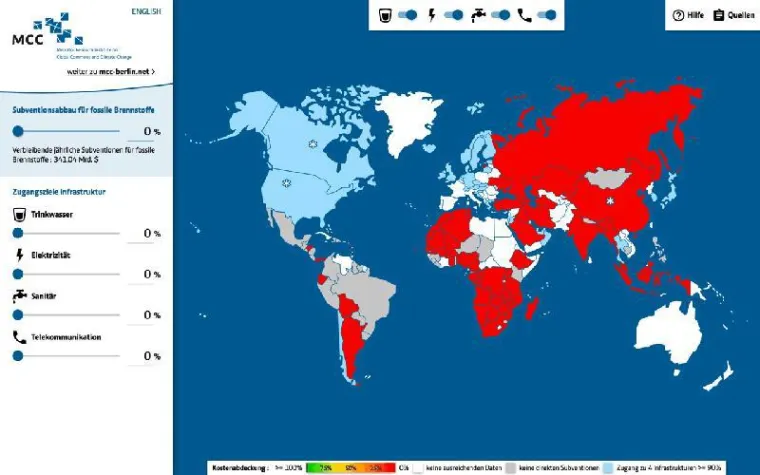
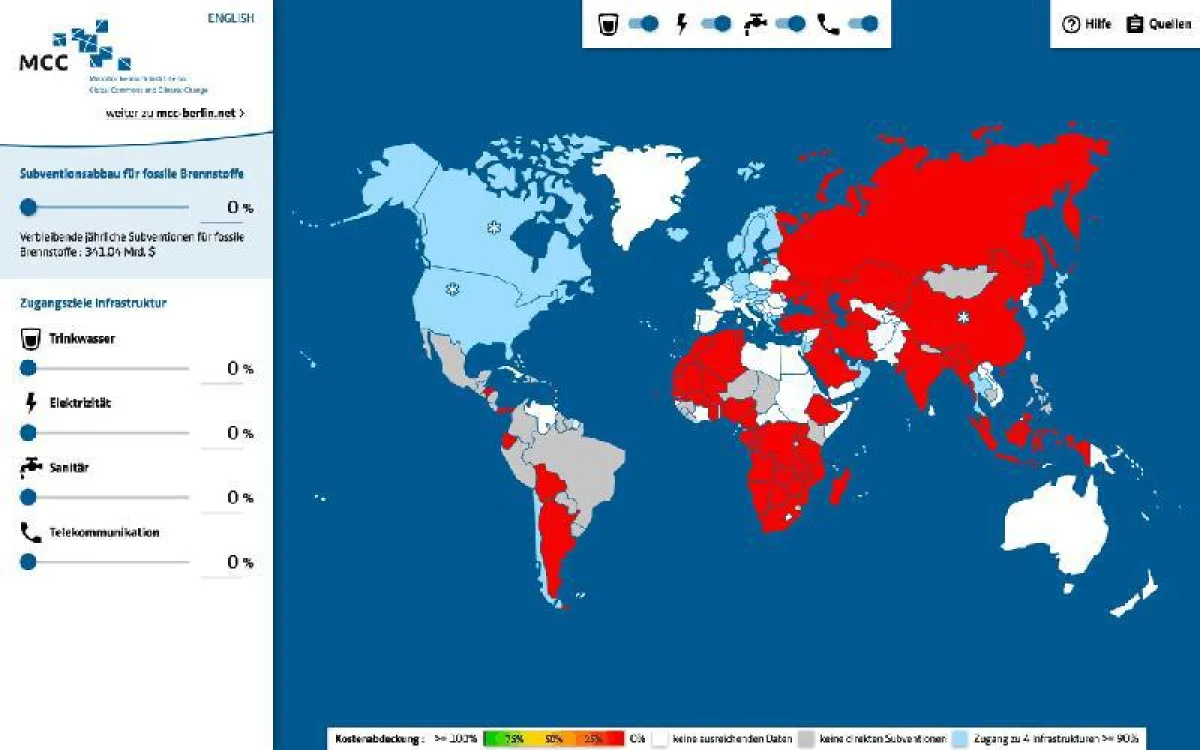
This GIF shows how the subsidy map works (MCC)

(openPR) In almost 80 countries in the world, a significant proportion of the population still lacks access to water, electricity, sanitation or telecommunication. Yet, in many of these states, the governments could ensure almost complete access to the corresponding infrastructures. To do this they would have to abolish fossil-fuel subsidies, which amount to around 550 billion US dollars globally, and invest these funds in infrastructure instead. A new interactive online map from the Mercator Research Institute on Global Commons and Climate Change (MCC) now illustrates what the reduction of subsidies can contribute to the financing of the infrastructure in each country.


---
Users of the MCC Subsidy Map can determine by themselves what proportion of the current subsidies for fossil fuels should be phased out. Afterwards, they can define the rates of access to water, electricity, telecommunications and sanitary facilities that shall be achieved. The map then shows, in red, yellow and green shading, to what extent the freed up financial resources can provide the access target set by the user.

The map is especially relevant with regards to the Sustainable Development Goals (SDGs) of the United Nations. The SDGs include, among other things, access to energy, water and sanitation. They could be decisively pushed forward by abolishing subsidies for fossil fuels. At the same time, cutting fossil-fuel subsidies would reduce greenhouse gas emissions and constitute a first step towards ambitious climate policies.

“Access to basic infrastructure is the foundation for combating poverty, a main objective of the SDGs,” says Michael Jakob, Coordinator of the MCC Task Force Public Economics. “By means of the MCC interactive map, the user can slip into the role of the political decision-makers, and make a value judgement which infrastructure has priority for them. Because even though a lot can be achieved in many countries with the phase-out of the subsidies, access to all infrastructures can by no means be guaranteed in all of them.”

The map user can achieve a relatively strong effect with comparatively modest subsidy reforms in South Asia and some states of sub-Saharan Africa. Countries such as the Republic of the Congo, Zimbabwe and Nigeria, as well as Indonesia and India, have particularly high subsidies for fossil fuels and at the same time a high need for infrastructure development. For example, Nigeria would have to use only four percent of its subsidies for 15 years in order to supply water to the 40 percent of its population who currently have no access to it. In India, for instance, the 370 million people who still lack access to electricity could have it if the country would redirect only six percent of its subsidies.

“The developing and emerging countries play a key role in the future mitigation of carbon emissions. At the same time, public finances are in such a poor condition in many of these states that urgently needed investments into the infrastructure can hardly be made,” says MCC Director Ottmar Edenhofer. “A fossil fuel subsidy reform appears to be required as it regards both environmental and social policies as well as economics. New coalitions should be forged in order to overcome the respective national political obstacles.”

The interactive map is based on calculations of the MCC, which were published in the article “Development incentives for fossil fuel subsidy reform” in the scientific journal Nature Climate Change. It was written by the MCC scientists Michael Jakob, Claudine Chen, Sabine Fuss, Annika Marxen and Ottmar Edenhofer.
For their calculations the authors used data from the International Energy Agency (IEA), the World Bank, as well as numerous studies on infrastructure costs.

In the interactive MCC map, only direct financial support for the consumption of fossil fuels is considered as a subsidy. It is derived from the difference between the world market price and the respective national selling price. Tax reductions as well as the social costs of using fossil fuels (e.g., air pollution) are not included in the data.

Weitere Informationen:
- https://www.mcc-berlin.net/subsidy-map
- http://www.mcc-berlin.net

Quelle: idw

Diese Pressemeldung wurde auf openPR veröffentlicht.

Verantwortlich für diese Pressemeldung:

News-ID: 968946
 132

Kostenlose Online PR für alle

Jetzt Ihren Pressetext mit einem Klick auf openPR veröffentlichen

Jetzt gratis starten

Pressebericht „Become a “political decision-maker” yourself with the interactive MCC subsidy map“ bearbeiten oder mit dem "Super-PR-Sparpaket" stark hervorheben, zielgerichtet an Journalisten & Top50 Online-Portale verbreiten:

PM löschen PM ändern
Disclaimer: Für den obigen Pressetext inkl. etwaiger Bilder/ Videos ist ausschließlich der im Text angegebene Kontakt verantwortlich. Der Webseitenanbieter distanziert sich ausdrücklich von den Inhalten Dritter und macht sich diese nicht zu eigen. Wenn Sie die obigen Informationen redaktionell nutzen möchten, so wenden Sie sich bitte an den obigen Pressekontakt. Bei einer Veröffentlichung bitten wir um ein Belegexemplar oder Quellenennung der URL.

Pressemitteilungen KOSTENLOS veröffentlichen und verbreiten mit openPR

Stellen Sie Ihre Medienmitteilung jetzt hier ein!

Jetzt gratis starten

Weitere Mitteilungen von Mercator Research Institute on Global Commons and Climate Change (MCC) gGmbH

Stiftung Mercator fördert Klimainstitut MCC mit weiteren zwölf Mio. Euro bis 2024
Die Wissenschaftliche Exzellenz, die thematische Fokussierung auf die globalen Gemeinschaftsgüter sowie die Politikberatung durch Assessment-Prozesse haben sich ausgezahlt: Das Mercator Research Institute on Global Commons and Climate Change (MCC) wird bis einschließlich 2024 mit weiteren 12,15 Millionen Euro finanziert. Die Stiftung Mercator hat jüngst beschlossen, das Institut ab 2019 mit etwa zwei Millionen Euro pro Jahr weiter zu fördern. 2012 war das MCC gemeinsam durch die Stiftung Mercator und das Potsdam-Institut für Klimafolgenforsch…
Stiftung Mercator funds climate institute MCC with a further €12 million until 2024
Scientific excellence, the thematic focus on global commons and the policy advice through assessment processes have paid off: The Mercator Research Institute on Global Commons and Climate Change (MCC) will be financed up to and including 2024 with a further €12.15 million. Stiftung Mercator (foundation) decided to continue to fund the institute from 2019, with around €2 million per year. The MCC was jointly founded in 2012 by Stiftung Mercator and the Potsdam Institute for Climate Impact Research (PIK). --- The decision is based on an evalua…

Das könnte Sie auch interessieren:

Stiftung Mercator fördert Klimainstitut MCC mit weiteren zwölf Mio. Euro bis 2024
… Fokussierung auf die globalen Gemeinschaftsgüter sowie die Politikberatung durch Assessment-Prozesse haben sich ausgezahlt: Das Mercator Research Institute on Global Commons and Climate Change (MCC) wird bis einschließlich 2024 mit weiteren 12,15 Millionen Euro finanziert. Die Stiftung Mercator hat jüngst beschlossen, das Institut ab 2019 mit etwa zwei …
Importance of solar energy underestimated  by a factor of three
Importance of solar energy underestimated by a factor of three
… long-term basis,” says Jan Christoph Goldschmidt, leader of the “Novel concepts for solar cells” team at Fraunhofer ISE. “Our study indicates that, under realistic assumptions, photovoltaics will become the most important power source in the world – at least if we take climate protection seriously and focus on the most affordable kind of technology.” This …
Bild: Dell bietet mobile Healthcare-Lösung für KrankenhäuserBild: Dell bietet mobile Healthcare-Lösung für Krankenhäuser
Dell bietet mobile Healthcare-Lösung für Krankenhäuser
Frankfurt am Main, 18. November 2009 - Mit „Mobile Clinical Computing" (MCC) bietet Dell ab sofort eine Healthcare-Lösung, die darauf abzielt, die Effizienz der Arbeitsabläufe in Krankenhäusern zu steigern sowie das Management und den Zugang zu Informationen für Ärzte und das medizinische Fachpersonal zu vereinfachen. MCC von Dell verbessert die Sicherheit …
Bild: Die Leidenschaft für das Kochen und Genießen entdeckenBild: Die Leidenschaft für das Kochen und Genießen entdecken
Die Leidenschaft für das Kochen und Genießen entdecken
mcc-Shop: Wo sich gehobene Köche und wählerische Genießer zuhause fühlen Die einzigartige und gehobene Welt des Kochens sowie des modernen Feinschmeckens erleben. Und dies mit einem Service, der einfach nur begeistert. Im mcc-Shop (mcc = metropolis cooking center) finden nicht nur die Fans der Avantgarde- und Molekular-Küche alles, was sie für ihren …
Stiftung Mercator funds climate institute MCC with a further €12 million until 2024
… excellence, the thematic focus on global commons and the policy advice through assessment processes have paid off: The Mercator Research Institute on Global Commons and Climate Change (MCC) will be financed up to and including 2024 with a further €12.15 million. Stiftung Mercator (foundation) decided to continue to fund the institute from 2019, with around …
MCC Deutschland investiert in Lage/Kreis Lippe (NRW)
Expansion wird fortgesetzt mit einem weiteren Projekt in Lage Kurz vor Weihnachten 2017 hat die MCC Deutschland GmbH in Lage ein Grundstück und die Projektentwicklung für ein modernes Alten- und Pflegeheim erworben. „Wir sind uns mit dem Projektentwickler, der Firma portarion von Thomas Henke, in relativ kurzer Zeit handelseinig geworden“, sagt Thomas …
MEDICA 2011: MEIERHOFER zeigt praxisorientierte IT-Lösungen für Ärzte und Pflege
Vom 16. bis 19. November zeigt MEIERHOFER auf der MEDICA in Düsseldorf, wie Kliniken mit dem skalierbaren Informationssystem MCC ihre Prozesse optimieren. MCC ist ein System, mit dem die verschiedenen Berufsgruppen eines Krankenhauses individuell arbeiten. Es fördert die interprofessionelle Kommunikation, weil es Daten zentral sammelt und situationsgemäß …
Bild: Internationale Studierende als MCC-ZugbegleiterBild: Internationale Studierende als MCC-Zugbegleiter
Internationale Studierende als MCC-Zugbegleiter
… Februar 2012, rei) Zehn Studierende von "Fremde werden Freunde" aus aller Herren Länder begleiten beim großen Rosenmontagsumzug die Wagen des Mainzer Carneval Club 1899 e.V. (MCC). Wie auch im letzten Jahr suchte der MCC Zugbegleiter und wandte sich an das Studierendenwerks Mainz, das mit "Fremde werden Freunde" internationalen Studierenden ihr Gastland …
Bild: Neue Leitung für die Senioreneinrichtung MCC Haus im Park UntermerzbachBild: Neue Leitung für die Senioreneinrichtung MCC Haus im Park Untermerzbach
Neue Leitung für die Senioreneinrichtung MCC Haus im Park Untermerzbach
Daniela Brehm übernimmt die Einrichtungsleitung von Regina Wagner Zum 03. Februar übernimmt Daniela Brehm die Gesamtverantwortung für die Senioreneinrichtung der MCC-Gruppe „MCC Haus im Park“ in Untermerzbach in Bayern. Als neue Einrichtungsleiterin übernimmt Daniela Brehm ein ihr schon bekanntes Amt. Seit Jahrzehnten ist Brehm in der Seniorenpflege …
Sie lesen gerade: Become a “political decision-maker” yourself with the interactive MCC subsidy map