openPR Recherche & Suche
Presseinformation

Obese People Lack Cells with Satiety Hormones

29.08.201716:00 UhrWissenschaft, Forschung, Bildung
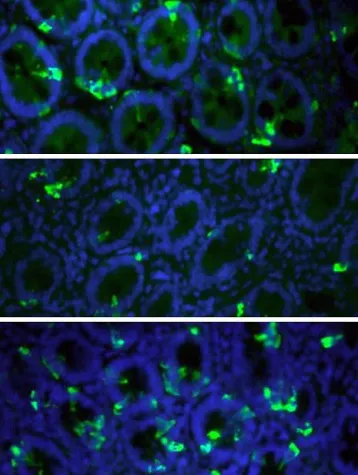
Bild: Obese People Lack Cells with Satiety Hormones
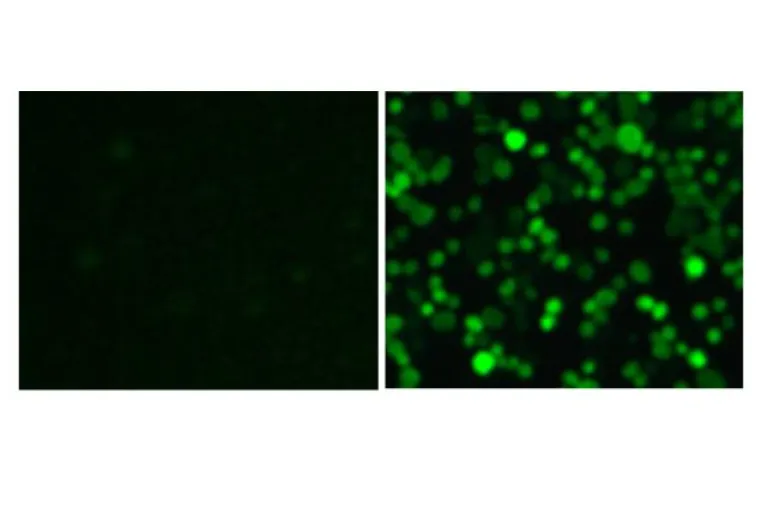
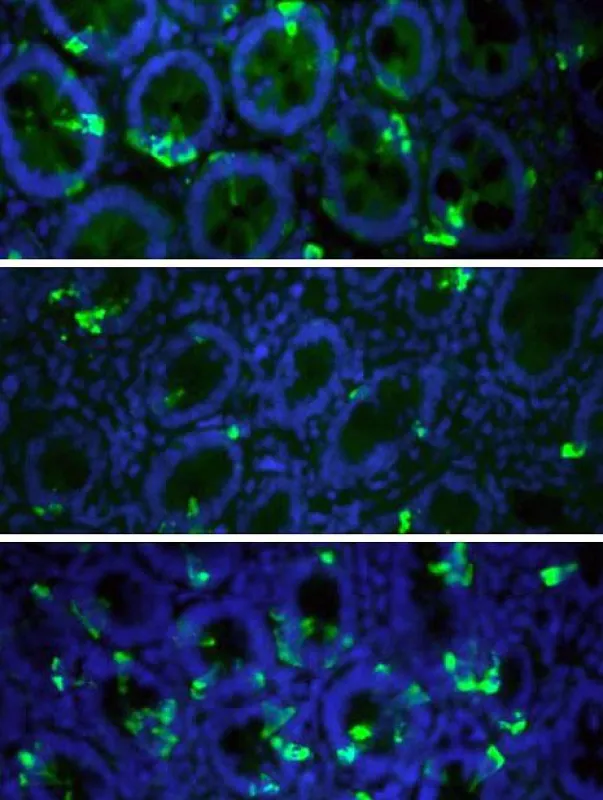
Tissue sections of the duodenum: cells which can release satiety hormones are marked in green. (University of Basel)

(openPR) Individuals with severe overweight have an inhibited sense of satiation - they release fewer satiety hormones than people of normal weight. The reason: the responsible cells in the gastrointestinal tract of obese people are severely reduced. This report Swiss doctors in the journal Scientific Reports. Surgical weight-loss procedures can repair this disorder.


---
The mucous membrane of the upper gastrointestinal tract is home to highly specified cells, the so-called enteroendocrine cells, that constantly analyze our intestinal contents. During a meal, they release satiety hormones into the bloodstream. This signalizes to the body that enough food has been taken in and that the meal can be ended. The sense of satiation is created in the central nervous system.

Tissue samples removed

Compared to lean people, the release of satiety hormones is reduced in obese people. After bariatric surgeries, such as a gastric bypass or sleeve gastrectomy the release of these hormones increases again.

Researchers from the Department of Biomedicine at the University and University Hospital Basel and the St. Claraspital Basel together with colleagues from the University of Liverpool have studied the reasons for this reduced release of satiety hormones. They examined tissue samples of the gastrointestinal tract in 24 lean volunteers and 30 obese patients before and after weight-loss surgery.

“Unfortunately often stigmatized”

The team of researchers led by Dr. Bettina Wölnerhanssen was able to show that the number of enteroendocrine cells in obese people is significantly lower than in people with normal weight. This leads to a reduced release of satiety hormone which in turn leads to altered appetite. The obese also showed alterations in the pattern of the so-called transcription factors which are responsible for the development of enteroendocrine cells from stem cells. After surgery, the number of enteroendocrine cells and the pattern of transcription factors were almost entirely restored.

"Unfortunately, obese people are often stigmatized, and it is a common belief that the reason for obesity lies in a lack of self-control and discipline," comments Wölnerhanssern the study’s results. However, there is no doubt that metabolic factors are playing an important part. The study shows that there are structural differences between lean and obese people, which can explain lack of satiation in the obese.

Original source

Bettina K. Wölnerhanssen, Andrew W. Moran, Galina Burdyga, Anne Christin Meyer-Gerspach, Ralph Peterli, Michael Manz, Miriam Thumshirn, Kristian Daly, Christoph Beglinger & Soraya P. Shirazi-Beechey
Deregulation of transcription factors controlling intestinal epithelial cell differentiation; a predisposing factor for reduced enteroendocrine cell number in morbidly obese individuals.
Scientific Reports (2017), doi:10.1038/s41598-017-08487-9

Further information

Dr. Bettina Wölnerhanssen, University of Basel, Department of Biomedicine, phone: +41 61 328 73 78, email: E-Mail

Weitere Informationen:
- https://www.unibas.ch/en/News-Events/News/Uni-Research/Obese-People-Lack-Cells-with-Satiety-Hormones.html

Quelle: idw

Diese Pressemeldung wurde auf openPR veröffentlicht.

Verantwortlich für diese Pressemeldung:

News-ID: 965792
 521

Kostenlose Online PR für alle

Jetzt Ihren Pressetext mit einem Klick auf openPR veröffentlichen

Jetzt gratis starten

Pressebericht „Obese People Lack Cells with Satiety Hormones“ bearbeiten oder mit dem "Super-PR-Sparpaket" stark hervorheben, zielgerichtet an Journalisten & Top50 Online-Portale verbreiten:

PM löschen PM ändern
Disclaimer: Für den obigen Pressetext inkl. etwaiger Bilder/ Videos ist ausschließlich der im Text angegebene Kontakt verantwortlich. Der Webseitenanbieter distanziert sich ausdrücklich von den Inhalten Dritter und macht sich diese nicht zu eigen. Wenn Sie die obigen Informationen redaktionell nutzen möchten, so wenden Sie sich bitte an den obigen Pressekontakt. Bei einer Veröffentlichung bitten wir um ein Belegexemplar oder Quellenennung der URL.

Pressemitteilungen KOSTENLOS veröffentlichen und verbreiten mit openPR

Stellen Sie Ihre Medienmitteilung jetzt hier ein!

Jetzt gratis starten

Weitere Mitteilungen von Universität Basel

Bild: Bei Zuckermangel in der Zelle leben Boten-RNAs längerBild: Bei Zuckermangel in der Zelle leben Boten-RNAs länger
Bei Zuckermangel in der Zelle leben Boten-RNAs länger
Leidet eine Zelle unter Zuckermangel, speichert sie bestimmte Boten-RNAs, um so ihr Leben zu verlängern. Wie eine Forschungsgruppe am Biozentrum der Universität Basel nun herausfand, entscheidet das Protein Puf5p bei Zuckermangel in der Zelle darüber, ob eine Boten-RNA aufbewahrt oder abgebaut wird. Wie die in eLife veröffentlichte Studie zeigt, schickt das Protein die Boten-RNAs dazu in eine Zellorganelle, wo ihr Schicksal besiegelt wird. --- Ist eine Zelle Stress ausgesetzt, sei es durch Mangel an Nährstoffen oder einem Zuviel an Spurenele…
Akshay Venkatesh erhält Ostrowski-Preis für höhere Mathematik
Der US-Mathematiker Akshay Venkatesh erhält den mit 100'000 Franken dotierten internationalen Ostrowski-Preis für höhere Mathematik 2017. Die Auszeichnung geht auf den Mathematikprofessor Alexander M. Ostrowski zurück, der an der Universität Basel gelehrt hat. --- Akshay Venkatesh, Professor an der Stanford University, erhält die Auszeichnung für seine bahnbrechenden Leistungen auf den Gebieten der Zahlentheorie, der Theorie der automorphen Formen, der Repräsentationstheorie, der homogenen Dynamik und der arithmetischen Geometrie. Ein wicht…

Das könnte Sie auch interessieren:

Bild: Immune cells help fat deal with environmental challengesBild: Immune cells help fat deal with environmental challenges
Immune cells help fat deal with environmental challenges
… Tregs can support fat depots in dealing with environmental challenges.” “Our findings highlight the complex interactions between our body and the environment. We have known for a while that hormones play a key role here – but now have to accept that immune cells may be just as important for a balanced metabolism”, comments Prof. Dr. Matthias Tschöp. …
Bild: New receptor found on scavenger cellsBild: New receptor found on scavenger cells
New receptor found on scavenger cells
Scientists demonstrate how adenovirus invades the immune system of mice --- Adenoviral infections have a mild disease progression in healthy people, but it can be dangerous for immunocompromised people. If a patient is infected with the virus and gets a bacterial infection on top of it, it can lead to an excessive inflammatory response known as a cytokine …
Bild: Why a Diabetes Drug Could Help in Parkinson’s  DiseaseBild: Why a Diabetes Drug Could Help in Parkinson’s  Disease
Why a Diabetes Drug Could Help in Parkinson’s Disease
… there are no drugs available that may stop or slow down Parkinson’s disease, physicians may only treat symptoms. Worldwide, there are about 10 million people affected by the disease. Original Publication Fitzgerald et al. (2017): Metformin reverses TRAP1 mutation-associated alterations in mitochondrial function in Parkinson’s disease. Brain 140(9), pp …
Bild: How receptors for medicines work inside cellsBild: How receptors for medicines work inside cells
How receptors for medicines work inside cells
… how these receptors act in the cell interior. --- The human genome encodes hundreds of G protein-coupled receptors (GPCRs). These form the largest group of receptors through which hormones and neurotransmitters exert their functions on our cells. Therefore, they are of highest importance as drug targets: around half of all prescribed drugs act on these …
Bild: Characteristics of metabolically unhealthy lean peopleBild: Characteristics of metabolically unhealthy lean people
Characteristics of metabolically unhealthy lean people
Embargo: August, 1, 2017, 12:00pm NOON EST Compared to people who are of normal weight and metabolically healthy, subjects who are of normal weight but metabolically unhealthy (~20% of normal weight adults) have a more than three-fold higher risk of mortality and/or cardiovascular events. This risk is also higher than that of metabolically healthy obese …
Kilokiller Tequila-Agave? Eine moderne Abnehmhilfe aus Inulin.
… [3]. Quellenangaben [1] Archer BJ, Johnson SK, Devereux HM, Baxter AL: Effect of fat replacement by inulin or lupin-kernel fibre on sausage patty acceptability, post-meal perceptions of satiety and food intake in men. Br J Nutr. 2004 Apr;91(4):591-9. [2] Parnell JA, Reimer RA: Weight loss during oligofructose supplementation is associated with decreased ghrelin …
Bild: Enzyme produced in the liver promotes obesity, fatty liver disease and insulin resistanceBild: Enzyme produced in the liver promotes obesity, fatty liver disease and insulin resistance
Enzyme produced in the liver promotes obesity, fatty liver disease and insulin resistance
… author of the study, Christian Baumeier from DIfE. DPP4 is an enzyme that, to a large extent, is produced by the liver and inhibits the effects of important intestinal hormones that are involved in blood glucose metabolism. In addition, patients suffering from non-alcoholic fatty liver disease have elevated DPP4 levels in their blood. To date, however, it …
Bild: Individual Receptors Caught at WorkBild: Individual Receptors Caught at Work
Individual Receptors Caught at Work
Using a revolutionary live-cell microscopy technique, an international team of scientist has observed for the first time individual receptors for hormones and widely used drugs at work in intact cells. --- G protein-coupled receptors (GPCRs) are among the "hottest” targets for the therapy of diseases such as hypertension, asthma or Parkinson´s. These …
Dutch study: Overweight is a high risk factor for complications in hip and knee replacement
… score. With a 10 point higher BMI score, the risk increased by 284%. The social function score among the obese proved to be significantly worse as well, since people who cannot get around easily tend to lose their social contacts. Experts call for weight reduction before surgery "The data no longer leave room for doubt," Dr. Daniel Haverkamp concludes. …
Oestrogen regulates pathological changes of bones via bone lining cells
… bone turnover and remodelling. Oestrogen uses a certain cell type to mediate its effect on bone density The development of bone structure depends on a complex system of hormones and proteins. One important component is the signalling molecule RANKL. It influences the development of special cells, the so-called osteoclasts that are responsible for bone …
Sie lesen gerade: Obese People Lack Cells with Satiety Hormones