openPR Recherche & Suche
Presseinformation

Molecular volume control

22.08.201713:00 UhrWissenschaft, Forschung, Bildung
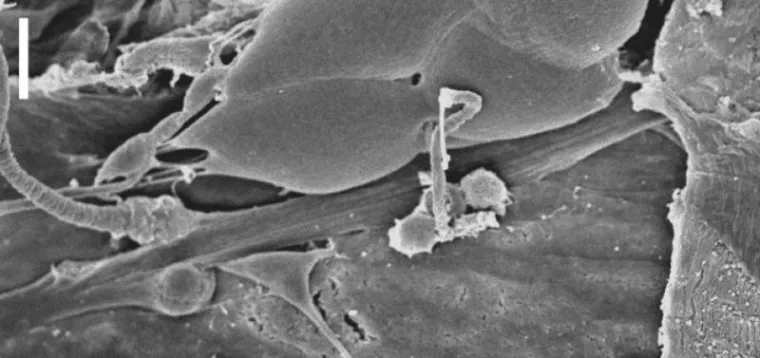
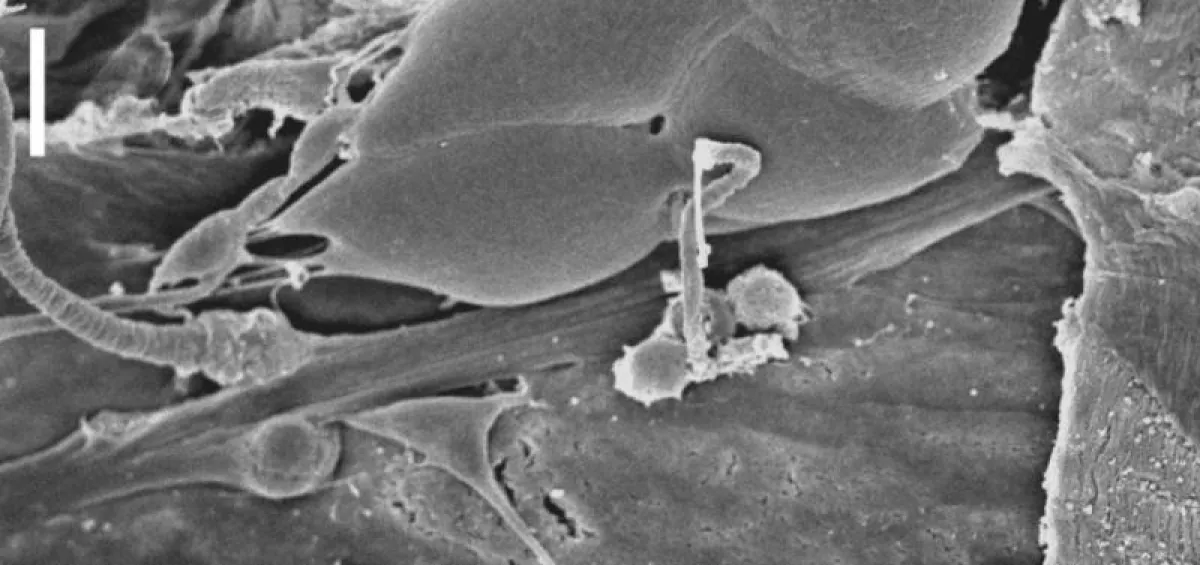
Bild: Molecular volume control
The larval Drosophila chordotonal organ seen under the scanning electron microscope. This sensory functional unit modulates the processing of mechanical stimuli by means of the latrophilin receptor. (

(openPR) About two years ago, scientists from the University of Würzburg discovered that a certain class of receptors is capable of perceiving mechanical stimuli. Now they have begun to unravel the molecular mechanisms behind the discovery.

---
The receptor studied by scientists from the universities of Würzburg and Leipzig over the past years works similarly to the volume control of a stereo which enhances or attenuates the incoming signal. The receptor in question is called latrophilin/CIRL.


A little more than two years ago, the researchers had surprised the scientific community by proving that certain receptors, including latrophilin, respond to mechanical stimuli from the environment for example vibration, sound waves or expansion. By doing so, the receptors help organisms to hear, perceive movements and control their own movements.

How the information gets inside the cell

At the time, however, the details of the receptors' contribution were still unclear, i.e. how the process works at the molecular level. In the meantime, the researchers have been able to shed light on some crucial details. They present their results in the current issue of the scientific journal eLife. The lead authors of the study are Dr Robert Kittel, who heads a working group at the Institute of Physiology/Department of Neurophysiology at the University of Würzburg, and Professor Tobias Langenhan, who recently relocated from Würzburg to the University of Leipzig.

"In order for cells to perceive and respond to external stimuli, the information must somehow get inside the cell," Robert Kittel explains the central aspect of the study. This may be accomplished through ion channels where a mechanical stimulus is converted into an electrical response in a very straightforward and fast process.

With the latrophilin receptor things are different: "It does not form a channel and it does not forward the stimulus electrically," Kittel says. Instead, it activates intracellular messengers that trigger special signal cascades inside the cell which ultimately also affect the ion channels. According to Kittel, the receptor thus has a modulating effect on stimulus perception like some kind of volume controller.

Collaboration with numerous experts

The study just published is the result of collaborating with specialists from various domains at the University of Würzburg – an aspect which Robert Kittel particularly appreciates.

One of the contributing experts is the plant physiologist Professor Georg Nagel who was one of the scientists who discovered a celebrated technique which became known as "optogenetics". The underlying principle: Nagel characterizes ion channels and enzymes that can be controlled with light. Robert Kittel and Tobias Langenhan used the larvae of Drosophila, the fruit fly, for their experiments which are almost transparent so that the researchers were able to study the functioning of the receptors with simple flashes of light.

The second expert involved was Professor Markus Sauer, head of the Department of Biotechnology and Biophysics at University of Würzburg's Biocenter. With his team, Sauer developed special forms of high-resolution fluorescence microscopy. This "super resolution" microscopy allows imaging cellular structures and molecules with up to tenfold increased resolution compared to conventional optical microscopes. "By using super-resolution microscopy, we were able to pinpoint the position of the cell membrane where the receptor is located," Robert Kittel says.

Dr. Isabella Maiellaro and Professor Esther Asan are also specialists in the field of imaging procedures. By teaming up with Isabella Maiellaro from the Department of Pharmacology, the researchers were able to directly visualize the intracellular receptor signal. Esther Asan, Professor at the Institute of Anatomy and Cell Biology II at the University of Würzburg, also contributed to the success of the study with her expertise in electron microscopy.

Moreover, the project was supported by the extensive experience of Professor Matthias Pawlak at the Institute of Physiology of the University of Würzburg in the field of sensory physiology and Dr Simone Prömel, a pharmacologist at the University of Leipzig. Robert Kittel sees these collaborations as a good example of how modern biotechnological methods can help answer physiological questions.

A very important molecular family

Latrophilin/CIRL is a member of a family of molecules that has more than 30 members in humans: the so-called adhesion GPCRs, a subgroup of the G protein-coupled receptors (GPCRs). Hundreds of them are encoded in the human genome; their importance is underpinned among others by the fact that around half of all prescription drugs target these receptors and help treat common diseases such as high blood pressure, asthma or Parkinson's.

This shows just how important the research results of the scientists from Würzburg and Leipzig are. After all, knowing what is going on inside the cells is a prerequisite for developing a better understanding of pathological processes and designing new therapies. "The cell biology processes are well conserved in terms of evolution," Robert Kittel says. Similar mechanisms are also at work in human cells.

Robert Kittel and Tobias Langenhan are also members of a research unit funded by Deutsche Forschungsgemeinschaft (DFG FOR 2149) which studies the signalling behaviour of adhesion GPCRs. The current study harnesses the good experimental accessibility of Drosophila to bring new technologies into a biomedical context more quickly. This allows basic molecular mechanisms to be described for the first time. These mechanisms are now to be studied in further organisms and physiological contexts in collaboration with other scientists.

Mechano-dependent signaling by Latrophilin/CIRL quenches cAMP in proprioceptive neurons. Nicole Scholz, Chonglin Guan, Matthias Nieberler, Alexander Grotemeyer, Isabella Maiellaro, Shiqiang Gao, Sebastian Beck, Matthias Pawlak, Markus Sauer, Esther Asan, Sven Rothemund, Jana Winkler, Simone Prömel, Georg Nagel, Tobias Langenhan, Robert J Kittel. eLife 2017;6:e28360. DOI: 10.7554/eLife.28360

Contact

Dr Robert J. Kittel, T: +49 931 31-86046; E-Mail

Prof. Tobias Langenhan, T: +49 341 97-22100; E-Mail

Quelle: idw

Diese Pressemeldung wurde auf openPR veröffentlicht.

Verantwortlich für diese Pressemeldung:

News-ID: 964592
 460

Kostenlose Online PR für alle

Jetzt Ihren Pressetext mit einem Klick auf openPR veröffentlichen

Jetzt gratis starten

Pressebericht „Molecular volume control“ bearbeiten oder mit dem "Super-PR-Sparpaket" stark hervorheben, zielgerichtet an Journalisten & Top50 Online-Portale verbreiten:

PM löschen PM ändern
Disclaimer: Für den obigen Pressetext inkl. etwaiger Bilder/ Videos ist ausschließlich der im Text angegebene Kontakt verantwortlich. Der Webseitenanbieter distanziert sich ausdrücklich von den Inhalten Dritter und macht sich diese nicht zu eigen. Wenn Sie die obigen Informationen redaktionell nutzen möchten, so wenden Sie sich bitte an den obigen Pressekontakt. Bei einer Veröffentlichung bitten wir um ein Belegexemplar oder Quellenennung der URL.

Pressemitteilungen KOSTENLOS veröffentlichen und verbreiten mit openPR

Stellen Sie Ihre Medienmitteilung jetzt hier ein!

Jetzt gratis starten

Weitere Mitteilungen von Julius-Maximilians-Universität Würzburg

Bild: Georg Gasteiger erforscht das ImmunsystemBild: Georg Gasteiger erforscht das Immunsystem
Georg Gasteiger erforscht das Immunsystem
Seit Juni 2017 hat Georg Gasteiger den Lehrstuhl für Systemimmunologie II an der Universität Würzburg inne. Diese neu geschaffene Professur ist Teil der Max-Planck-Forschungsgruppe für Systemimmunologie, die an der Universität aufgebaut wird. --- Der Typ von Zellen, für die sich Georg Gasteiger interessiert, existiert nicht! So lautete die vorherrschende Meinung in der Wissenschaft über viele Jahre. Erst als Forscher an den richtigen Stellen im Körper danach suchten, wurden neue Zelltypen des angeborenen Immunsystems entdeckt, sogenannten In…
Wann ist ein Fan ein Fan?
Nicht nur im Sport gibt es begeisterte Anhänger; auch in anderen Bereichen zeigen Fans, für wen oder was ihr Herz schlägt. Fanforscher der Uni Würzburg stellen sie in den Mittelpunkt eines neuen Forschungsprojekts. --- Fußball wäre ohne Fans kaum denkbar. Und auch in anderen Sportarten sorgen begeisterte Anhänger für die passende Stimmung. Kein Wunder, dass in der öffentlichen Wahrnehmung Fans häufig nur mit Sport in Verbindung gebracht werden. Dabei gibt es Fans heutzutage in allen denkbaren Bereichen: Von der 14-Jährigen, die für Justin …

Das könnte Sie auch interessieren:

Bild: cADDis - der weltweit einfachste Weg zur Bestimmung von cAMPBild: cADDis - der weltweit einfachste Weg zur Bestimmung von cAMP
cADDis - der weltweit einfachste Weg zur Bestimmung von cAMP
… kommt in allen Organismen vor. In Eukaryoten aktiviert cAMP Protein-Kinasen vom Typ A, was zu einer Phosphorylierung zahlreicher zellulärer Proteine führt. Die Firma Montana Molecular, USA, ist ein Spezialist auf dem Gebiet genetisch kodierter Biosensoren und Reagenzien für zell-basierte Nachweissysteme und Live Cell Imaging. Die Hauptanwendung für derartige …
Bild: Change at the Helm of the Leibniz Institute of Plant BiochemistryBild: Change at the Helm of the Leibniz Institute of Plant Biochemistry
Change at the Helm of the Leibniz Institute of Plant Biochemistry
… years as scientist and teacher at the University of California (USA), the biochemist returned to Halle. In July of 2009, Steffen Abel established the Department for Molecular Signal Processing at the Leibniz Institute of Plant Biochemistry. This department fabulously integrated in the scientific concepts at the institute. The research topics in this …
Bild: ABP Biosciences, USA, Hersteller preisgünstiger High-End Fluorophore, autorisiert MoBiTec GmbH als DistributorBild: ABP Biosciences, USA, Hersteller preisgünstiger High-End Fluorophore, autorisiert MoBiTec GmbH als Distributor
ABP Biosciences, USA, Hersteller preisgünstiger High-End Fluorophore, autorisiert MoBiTec GmbH als Distributor
… -detektionstechnologien spezialisiert. Die MoBiTec GmbH bietet seit mehr als 20 Jahren als erster offiziell zugelassener Importeur von Fluoreszenzsonden und Forschungschemikalien von Molecular Probes fluoreszierende Reagenzien an. Nachdem die Firma ThermoFisher Molecular Probes übernommen hat, wurden alle Verträge mit externen Partnern gekündigt. Die …
Bild: Molecular Health und FDA verlängern Zusammenarbeit um weitere 5 JahreBild: Molecular Health und FDA verlängern Zusammenarbeit um weitere 5 Jahre
Molecular Health und FDA verlängern Zusammenarbeit um weitere 5 Jahre
Cambridge, MA, USA/ Heidelberg – 20. November 2017 – Molecular Health (MH), ein Unternehmen, das computergestützte biomedizinische Lösungen vermarktet, die Entscheidungen im Gesundheitswesen anhand klinischer und molekularer Daten unterstützen, und das Center for Drug Evaluation and Research (CDER) der US-Gesundheitsbehörde FDA haben ihre bestehende …
Stabilizing TREM2 – a potential strategy to combat Alzheimer’s disease
Heidelberg, 30 August 2017 – Uncovering the molecular mechanism behind a rare genetic risk factor of Alzheimer’s disease points to a new therapeutic target. --- A gene called triggering receptor expressed on myeloid cells 2, or TREM2, has been associated with numerous neurodegenerative diseases, such as Alzheimer's disease, Frontotemporal lobar degeneration, …
From a memory too strong to a memory too weak
Heidelberg, 2 August 2017 – Researchers discover a molecular link between post-traumatic stress disorder and Alzheimer’s disease: There is increasing evidence that post-traumatic stress disorder (PTSD) increases the risk of developing dementia later in life. Researchers at the University Medical Center Göttingen, Germany, now shed light on the molecular …
Maximum Precision in Protein Synthesis
Researchers from the Center for Molecular Biology of Heidelberg University (ZMBH) and the German Cancer Research Center (DKFZ) have investigated the mode of action of a molecular chaperone vital to protein synthesis. Together with colleagues from the University of Cologne and the Penn State University (USA), they were able to demonstrate that the speed …
EMC übernimmt Kosten für Tumoranalyse bei an Krebs erkrankten Mitarbeitern sowie deren Angehörigen
„Corporate Oncology Program for Employees“ mit Molecular Health Schwalbach/Heidelberg, 23.09.2015. EMC hat in Deutschland zusammen mit Molecular Health ein „Corporate Oncology Program for Employees“ (COPE) gestartet: Wird bei einem EMC-Mitarbeiter, dessen Ehepartner oder Lebensgefährten oder dessen Kind Krebs diagnostiziert, ermöglicht das Programm dem …
Bild: Dr. Patrick Müller mit „EMBO Young Investigator“ Award ausgezeichnetBild: Dr. Patrick Müller mit „EMBO Young Investigator“ Award ausgezeichnet
Dr. Patrick Müller mit „EMBO Young Investigator“ Award ausgezeichnet
Tübingen, 25. Oktober 2017. Die European Molecular Biology Organisation (EMBO) hat heute die Wahl von 28 neuen „EMBO Young Investigators“ bekannt gegeben. Dr. Patrick Müller, Forschungsgruppenleiter am Friedrich-Miescher-Laboratorium (FML), ist einer der Preisträger. Mit dem prestigeträchtigen „EMBO Young Investigator“ Award würdigt die Organisation …
Not all fish are created equal - Having a fish allergy does not mean you have to avoid eating fiish
… important scientific journal for allergic diseases, the “Journal of Allergy and Clinical Immunology”. ‘The research done in Luxembourg has been most valuable. Without LIH’s expertise in molecular allergology, it would not have been possible to perform the study’, stresses Dr Sørensen. Fish is an important source of digestible protein and provides the body …
Sie lesen gerade: Molecular volume control