openPR Recherche & Suche
Presseinformation

Study: Europe’s Demographic Future. Where the Regions Are Heading after a Decade of Crises

10.08.201712:00 UhrWissenschaft, Forschung, Bildung
Bild: Study: Europe’s Demographic Future. Where the Regions Are Heading after a Decade of Crises
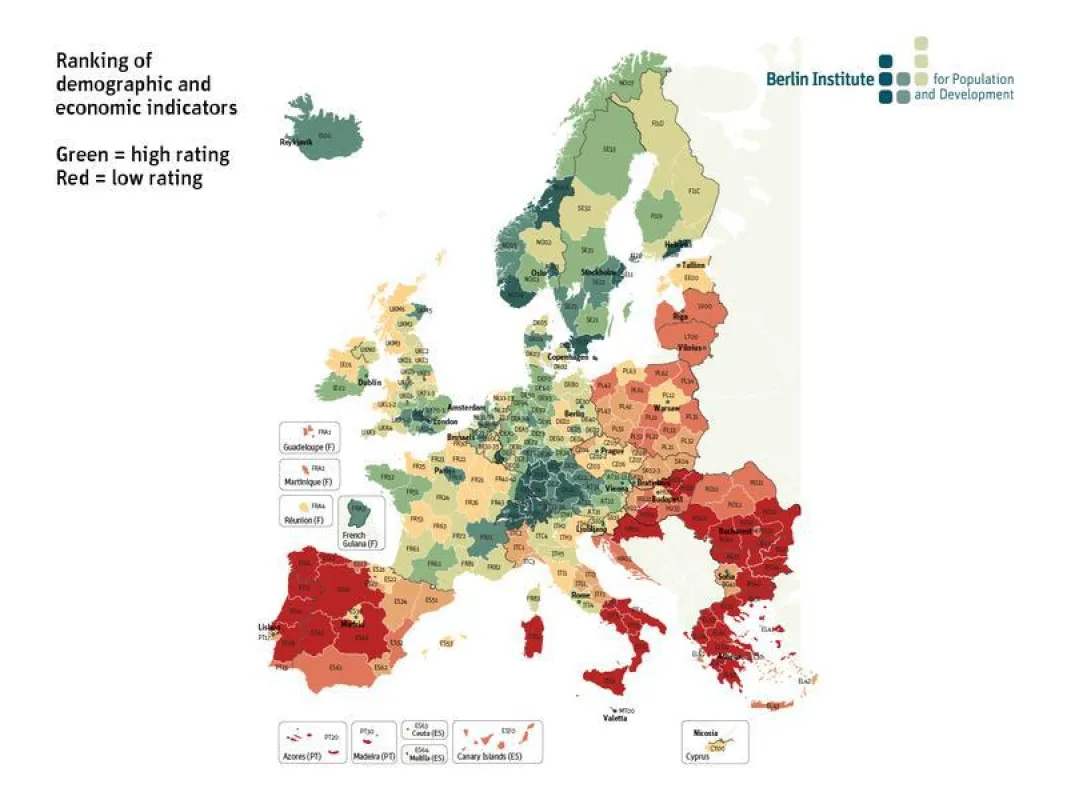
Ranking of demographic and economic indicators (Berlin Institute for Population and Development)

(openPR) Europe is demographically divided. In the north, west and centre of the continent, comparatively high fertility rates and immigration are ensuring population growth for the foreseeable future. By contrast, many regions in southern and Eastern Europe are threatened with accelerated aging processes and marked population losses.


---
Europe is not just the proverbial “old” continent. Its populations are also on average older than elsewhere in the world. Even now, there are only some three persons of working age to every pensioner. By the middle of the century, this ratio may fall to one to two. This will have consequences for the economy and social systems. It will become more difficult to finance social benefits, and companies will find it harder to find suitable personnel. “This is all the more serious in view of the fact that the economies of the twenty-first century require well-qualified people rather than major industrial plants”, says Reiner Klingholz, Director of the Berlin Institute for Population and Development.

Just how well prepared Europe is to meet these demographic challenges differs from one region to another. This is shown by the Berlin Institute’s study, which analysed a total of 290 regions. The highly developed regions of Switzerland, southern Germany and Scandinavia are in particularly good shape – in some places, including the north of the continent, because of their high fertility rates and good education systems; in others, especially Germany, because of immigration from both European and non-European countries. On the other hand, the prospects of the peripheral regions – in southern and Eastern Europe, which are in any case economically weaker – are further dimmed by the exodus of young people. By the middle of the century, the average age of the population is likely to be highest in Greece and Portugal – and those countries’ populations will also be smaller than they are today. “In many parts of southern and Eastern Europe, only the regions in and around the capital cities are managing to stabilise demographically, while rural areas are increasingly losing people”, explains Stephan Sievert, one of the authors of the study.

The demographic situation is also a consequence of the numerous crises and upheavals that Europe has experienced over the past decade. For example, the economic crisis triggered a new wave of migration from south to north. The so-called refugee crisis has led in many places to an unexpected rise in the number of inhabitants. “The integration of the new arrivals will thus be a major future task for Europe”, Stephan Sievert adds. “Only if countries succeed in quickly getting immigrants and refugees into employment will the latter be able to participate fully in society”. In addition, immigrants who have successfully integrated can help to cushion the effects of these demographic challenges. Many European states have recognised this fact and are gradually expanding their immigration channels. Others are more sceptical. Particularly in the post-socialist states many people reject immigrants, especially those from outside Europe. But these countries, too, will have a great need for immigration in the medium term. In the Czech Republic, for example, there is already almost full employment today, and employers are likely to urge a more liberal immigration policy in future.

Demographic problems can also be mitigated by better integrating previously disadvantaged groups, such as women, into working life. Northern Europe has been particularly successful at doing this. “In Scandinavia, but also in the Baltic states, there is now scarcely any difference between male and female employment”, says Reiner Klingholz. “In southern Italy, by contrast, not even one woman in two of working age is engaged in paid work.” This has to do not only with cultural differences but also with the availability of childcare, which allows mothers to go back to work soon after the birth of a child. A good family policy would be important precisely in these regions, since fertility rates have fallen here in parallel with the economic crisis in many places.

So how do Europe’s regions stand in demographic terms? The Berlin Institute for Population and Development has examined this issue in its latest study, “Europe’s Demographic Future”. The overall findings, which are based on various indicators of demographic and economic development, show that the challenges are greater in the south and the east of the continent than they are in the north and the west.

You can download the study as a PDF free of charge from:

http://www.berlin-institut.org/en/publications/studies-in-english/europes-demographic-future.html

Please address all enquiries to:
Berlin Institute for Population and Development
Schillerstr. 59
10627 Berlin
Stephan Sievert (E-Mail, T. 030-31 10 26 98)
Dr. Reiner Klingholz (E-Mail, T. 030-31 01 75 60)

The Berlin Institute for Population and Development is an independent think tank that focuses on regional and global demographic change. The Institute was founded in 2000 as a non-profit foundation. Its mission is to raise awareness of demographic change, to promote sustainable development, to introduce new ideas to policymakers and to develop concepts to solve demographic and development problems. The Berlin Institute publishes studies as well as discussion and background papers and compiles scientific data to be used in the political decision-making process. For further information or to subscribe to our free regular newsletter “Demos” (in German), please visit http://www.berlin-institut.org.

Founded in 1934, the GfK Verein is a non-profit organisation for the promotion of market research. It comprises some 550 companies and individuals. The purpose of the Verein is to develop innovative research methods in close cooperation with scientific institutions, to promote the training and further education of market researchers and to follow the structures and developments in society, the economy and politics that form the basis for private consumption and to study their impact on consumers. Study findings are made available to members of the Verein free of charge. The GfK Verein is the majority shareholder of GfK SE. For more information, please visit: http://www.gfk-verein.org.
Twitter: GfK_Verein /// facebook: GfK Verein

The Berlin Institute would like to thank the GfK Verein for funding the study.

Quelle: idw

Diese Pressemeldung wurde auf openPR veröffentlicht.

Verantwortlich für diese Pressemeldung:

News-ID: 963003
 550

Kostenlose Online PR für alle

Jetzt Ihren Pressetext mit einem Klick auf openPR veröffentlichen

Jetzt gratis starten

Pressebericht „Study: Europe’s Demographic Future. Where the Regions Are Heading after a Decade of Crises“ bearbeiten oder mit dem "Super-PR-Sparpaket" stark hervorheben, zielgerichtet an Journalisten & Top50 Online-Portale verbreiten:

PM löschen PM ändern
Disclaimer: Für den obigen Pressetext inkl. etwaiger Bilder/ Videos ist ausschließlich der im Text angegebene Kontakt verantwortlich. Der Webseitenanbieter distanziert sich ausdrücklich von den Inhalten Dritter und macht sich diese nicht zu eigen. Wenn Sie die obigen Informationen redaktionell nutzen möchten, so wenden Sie sich bitte an den obigen Pressekontakt. Bei einer Veröffentlichung bitten wir um ein Belegexemplar oder Quellenennung der URL.

Pressemitteilungen KOSTENLOS veröffentlichen und verbreiten mit openPR

Stellen Sie Ihre Medienmitteilung jetzt hier ein!

Jetzt gratis starten

Weitere Mitteilungen von Berlin-Institut für Bevölkerung und Entwicklung

Neue Studie „Education first! Bildung entscheidet über die Zukunft Sahel-Afrikas“
Warum wächst die Bevölkerung Afrikas so stark und weshalb machen sich so viele Menschen aus Not auf den gefährlichen Weg nach Europa? Ein Grund dafür ist die unzureichende Entwicklung in vielen Ländern Subsahara-Afrikas, wohinter vor allem erhebliche Defizite im Bildungsbereich stehen. In einigen Ländern der Sahelregion lernen selbst die Nachwuchsjahrgänge nur zur Hälfte lesen, schreiben und rechnen. Wie es um die Bildungssysteme dieser Länder bestellt ist und welcher Handlungsbedarf dort besteht, zeigt die neue Studie des Berlin-Instituts. …
Education first! Einladung zur Pressekonferenz und Studienpräsentation
Das Berlin-Institut für Bevölkerung und Entwicklung stellt am 29. November in Berlin eine neue Studie vor: „Education first! Bildung entscheidet über die Zukunft Sahel-Afrikas“. --- Warum wächst die Bevölkerung Afrikas so stark und weshalb machen sich so viele Menschen aus Not auf den gefährlichen Weg nach Europa? Ein Grund dafür ist die unzureichende Entwicklung in den meisten afrikanischen Ländern südlich der Sahara und dahinter stehen erhebliche Defizite im Bildungsbereich, besonders in den frankophonen Ländern der Sahelzone und in Nigeri…

Das könnte Sie auch interessieren:

Bild: J. v. G. Thoma GmbH Increases Shares for DESERT Panel ProductionBild: J. v. G. Thoma GmbH Increases Shares for DESERT Panel Production
J. v. G. Thoma GmbH Increases Shares for DESERT Panel Production
… direct sales to the JV company in Poland to save costs and speed up the production process. This represents an exciting opportunity for investors to capitalise in the technology of the future. J. v. G. Thoma GmbH are set to increase shares specifically in the Joint Venture panel production in Poland. The new name of the JV company is "J. v. G. Revolution …
Bild: Human behavior in the face of environmental risks: Schröder brings Central German forest regions into focusBild: Human behavior in the face of environmental risks: Schröder brings Central German forest regions into focus
Human behavior in the face of environmental risks: Schröder brings Central German forest regions into focus
nd norms underlying risk-related behavior. For this purpose, Schröder conducted a postal survey in ten counties in Central Germany. Her results are presented in the study Motives and beliefs influencing economic preferences for functional biodiversity and ecosystem services in Central German forest regions. More information www.ibidem-verlag.de
Bild: Police Violence Depends on Community-level Racial BiasBild: Police Violence Depends on Community-level Racial Bias
Police Violence Depends on Community-level Racial Bias
… police officers against different racial groups, they focused on the context in which police work normally takes place. The scientists combined data from police databases with demographic factors from different areas, along with the implicit and explicit biases of people living in those areas. “We expected certain economic and demographic factors to play …
Bild: Emerging infectious disease threatens Darwin’s frog with extinctionBild: Emerging infectious disease threatens Darwin’s frog with extinction
Emerging infectious disease threatens Darwin’s frog with extinction
… have remained relatively stable in the face of the disease that has ravaged many amphibian species worldwide, but the frogs may have been infected over a decade ago, with the impacts only recently observed. Led by scientists from Chile’s Universidad Andres Bello (UNAB), NGO Ranita de Darwin, and international conservation charity ZSL (Zoological Society …
Life in the city: Living near a forest keeps your amygdala healthier
… A research team led by psychologist Simone Kühn has examined which effects nature near people’s homes such as forest, urban green, or wasteland has on stress-processing brain regions such as the amygdala. „Research on brain plasticity supports the assumption that the environment can shape brain structure and function. That is why we are interested in …
Bild: The USA threatened by more frequent floodingBild: The USA threatened by more frequent flooding
The USA threatened by more frequent flooding
The East Coast of the United States is threatened by more frequent flooding in the future. This is shown by a recent study by the Universities of Bonn, South Florida, and Rhode Island. According to this, the states of Virginia, North Carolina, and South Carolina are most at risk. Their coastal regions are being immersed by up to three millimeters per …
Study reveals new threat to the ozone layer
… Taoyuan, Taiwan), Angela Baker (MPIC), Carl Brenninkmeijer (MPIC), and David Sherry (Nolan Sherry & Associates, Kingston upon Thames, UK). The European Geosciences Union (www.egu.eu) is Europe’s premier geosciences union, dedicated to the pursuit of excellence in the Earth, planetary, and space sciences for the benefit of humanity, worldwide. It …
New Study „A Long Lifespan, But Not for All: How social divisions affect life expectancy“
… 49) and Reiner Klingholz (, +49 30-31 01 75 60) The Berlin Institute for Population and Development is an independent think tank concerned with regional and global demographic change. The Institute was founded in 2000 as a non-profit foundation. Its mission is to raise awareness of demographic change, to promote sustainable development, to introduce …
The theme “Health in all politics” at European Health Forum Gastein 2017
… genomes, she commented on “how some aspects of the futures thinking presented in the scenarios were already reality in some parts of Europe”. “This demonstrates clearly that Europe’s diversity is a huge strength, and the Forum’s goal of sharing and drawing lessons from health policy successes and failures is hugely important for fast-tracking much-needed …
Bild: Light Vehicles Forecast 2050 for Europe: Driven by 48VBild: Light Vehicles Forecast 2050 for Europe: Driven by 48V
Light Vehicles Forecast 2050 for Europe: Driven by 48V
… improvement. By 2050, 78% of light vehicle production will be based on highly efficient ICE traction combined with different stages of electrification. Total production 2050 Considering recent demographic and socio-economic factors, European light vehicle production will further increase over the coming decade, reaching a volume of 26 M units in 2030. Age …
Sie lesen gerade: Study: Europe’s Demographic Future. Where the Regions Are Heading after a Decade of Crises