openPR bei Google bevorzugen.
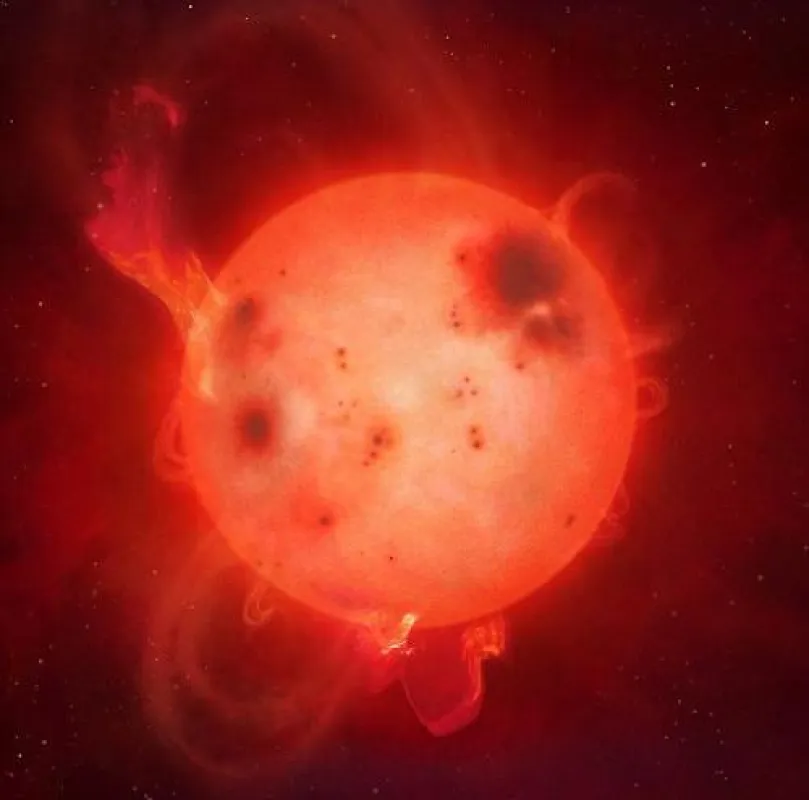
(openPR) An international group of astronomers lead by scientists from the University of Göttingen has detected unexpectedly strong magnetic fields on the surface of a few fast rotating M dwarf stars. For a long time it was thought that the dynamo in these stars saturates with a maximum magnetic field strength of about four kilogauss (kG) if a star rotates faster than a particular rotation rate. Using accurate observations and up-to-date models, the researchers discovered that some fully convective M dwarfs generate even stronger fields of up to about seven kG.
---
Press release No. 147/2017
A new level of magnetic saturation
Scientists from Göttingen University detect strongest magnetic fields ever in low mass stars
(pug) An international group of astronomers lead by scientists from the University of Göttingen has detected unexpectedly strong magnetic fields on the surface of a few fast rotating M dwarf stars. For a long time it was thought that the dynamo in these stars saturates with a maximum magnetic field strength of about four kilogauss (kG) if a star rotates faster than a particular rotation rate. Using accurate observations and up-to-date models, the researchers discovered that some fully convective M dwarfs generate even stronger fields of up to about seven kG. Stars with strongest fields also have simplest dipole dominant magnetic field geometry, while stars with more complex geometries cannot generate average fields stronger than about four kG. The study provides the first observational evidence that the dynamo in fully convective M dwarfs generates magnetic fields that can differ not only in the geometry of their large scale component but also in the total magnetic energy. The results were published in Nature Astronomy.
M dwarfs are the most numerous stars in our Galaxy with masses between approximately 0.5 and 0.1 solar masses. Many of them show surface activity qualitatively similar to our Sun and generate flares, high X-ray fluxes, and large-scale magnetic fields. All these phenomena are driven by a dynamo powered by stellar rotation and convective motions inside the stars. Most stars with convective envelopes follow a so-called rotation-activity relationship, where various activity indicators (for example X-ray flux) saturate in stars with rotation periods shorter than a few days. The activity gradually declines with the rotation rate in stars rotating more slowly. It is thought that due to a tight empirical correlation between X-ray and magnetic flux, the stellar magnetic fields will also saturate to values of around four kG. “Magnetic fields stronger than this have not been detected in any low mass star, which was seen as an evidence for the magnetic field saturation,” says Dr. Denis Shulyak from Göttingen University’s Institute for Astrophysics.
Using extensive data sets of accurate observations and improved analysis methods researchers detected the strongest magnetic field of about seven kG in the M dwarf star WX UMa, and fields between five kG and six kG in three more stars. All these fields are well beyond the currently presumed saturated value of four kG. “WX UMa is ten times smaller than the Sun, but it generates an average magnetic field which is a factor of hundred stronger,” says Prof. Dr. Ansgar Reiners from Göttingen University’s Institute for Astrophysics. “This is because WX UMa rotates about thirty times faster than the Sun and its fully convective envelope provides a large amount of kinetic energy. Both these factors are essential for the efficient dynamo action. Fast rotating M dwarfs are therefore very active and very magnetic stars, and we now know that some of them can generate magnetic fields much stronger than we thought before.”
The researchers also found a connection between the strength and the geometry of surface magnetic fields. Stars with strongest magnetic fields are those having simple dipole dominant magnetic fields, while stars with more complex multipole dominant magnetic geometries do not generate fields stronger than four kG. “This is itself a very interesting result because it tells us that the dynamo in fully convective M dwarfs generates magnetic fields that can differ not only in the geometry of their large scale component, which was already known from previous studies, but also in the total magnetic energy,” says Shulyak. “In addition, we are starting to observe that dynamo processes behave differently with rotation rate in these stars. Stars with multipole fields saturate below periods of about four days with the saturated magnetic field strength of about four kG, while some stars with dipole dominant geometries exhibit surface fields unambiguously stronger and demonstrate no obvious saturation effect. Yet this requires additional observations and we hope to address this question in future studies. Nevertheless, our findings provide important constraints and challenges for the existing dynamo models.”
Original publication: Denis Shulyak et al. Strong dipole magnetic fields in fast rotating fully convective stars. Nature Astronomy 2017. DOI: 10.1038/s41550-017-0184.
Contact:
Dr. Denis Shulyak
University of Göttingen – Institute for Astrophysics
Phone +49 551 39-5055
Email:
Prof. Dr. Ansgar Reiners
University of Göttingen – Institute for Astrophysics
Phone +49 551 39-13825
Email:
Weitere Informationen:
- http://www.uni-goettingen.de/en/3240.html?cid=5882 photos
- http://www.astro.physik.uni-goettingen.de/~areiners/AR/AR.htm research group
Quelle: idw