openPR Recherche & Suche
Presseinformation

Researchers develop chip-scale optical abacus

02.11.201712:00 UhrWissenschaft, Forschung, Bildung
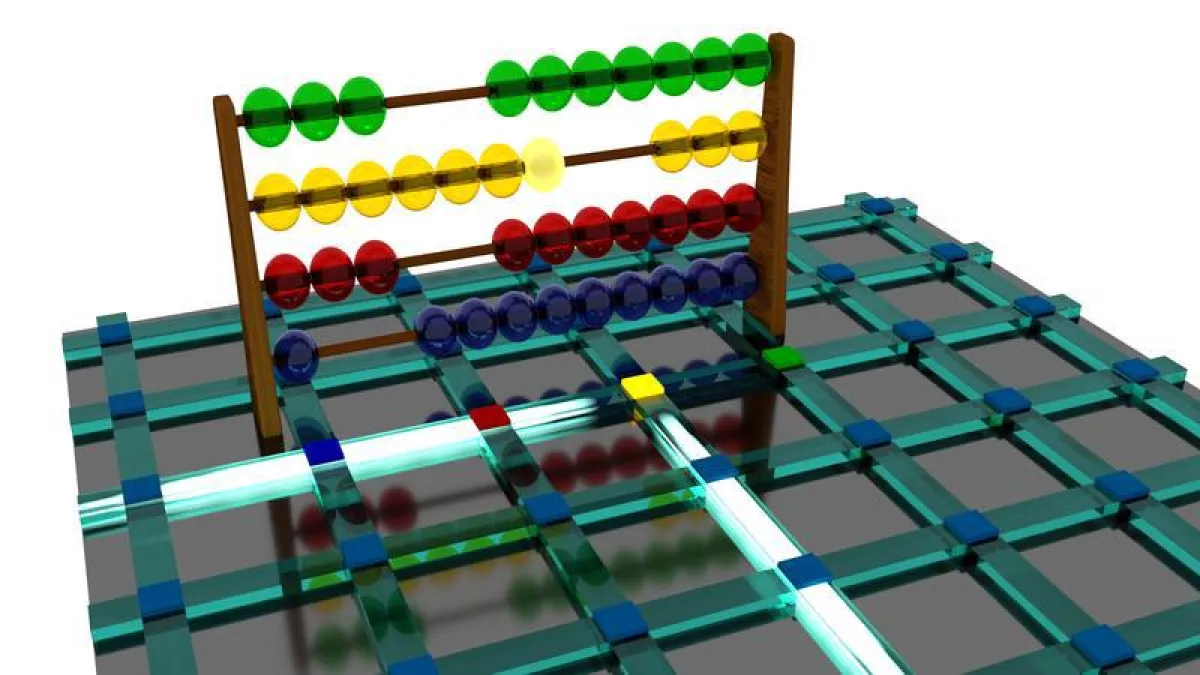
Bild: Researchers develop chip-scale optical abacus
Illustration of a chip-scale optical abacus with integrated optical waveguides. The memory cells are located at the crossings. The abacus is shown for demonstration. (Illustration: WWU/Johannes Feldma

(openPR) A team of researchers led by Prof. Wolfram Pernice from the Institute of Physics at Münster University has developed a miniature abacus on a microchip which calculates using light signals. With it they are paving the way to the development of new types of computer in which, as in the human brain, the computing and storage functions are combined in one element.


---
Researchers at the universities of Münster, Exeter and Oxford have developed a miniature “abacus” which can be used for calculating with light signals. With it they are paving the way to the development of new types of computer in which, as in the human brain, the computing and storage functions are combined in one element – in contrast to conventional computers, in which the two are separated in line with the so-called Von Neumann Principle. The study has been published in the latest issue of the journal “Nature Communications”.

“In the article we describe for the first time the realization of an abacus which operates in a purely optical way,” explains Prof. Wolfram Pernice from the Institute of Physics at Münster University who lead the team. “Instead of having wooden beads on a wire, our abacus counts light pulses and stores them in a phase-change material such as is used for rewriteable DVDs.” The optical abacus is installed on a microchip and can be easily manufactured. Using integrated photonic circuits the researchers can store data on it, read the data, and do all the basic arithmetical operations with it. So far, the researchers have succeeded in calculating with two-digit numbers using two photonic phase-change cells, but the extension to large multi-digit numbers simply involves the use of more cells.

The long-term aim that the researchers have is the creation of so-called neuromorphic computer architectures – i.e. computers which replicate the human brain. One central feature is the elimination of the separation between processor and data storage. “We are also computing with light – and not with electrons, as is the case with traditional computers,” says co-author Prof. Harish Bhaskaran from the University of Oxford. “This means that we can develop much faster systems which can be connected using integrated optical waveguides.”

To this end, the researchers need a variety of components, including artificial neuron type cells and artificial synapses, i.e. the “connection points” between neurons. The researchers already created the artificial synapses just recently as part of another study. “If we are successful in developing a complete photonic computer system, we could process large amounts of data very quickly – without making a detour via electronic systems,” says Prof. David Wright, a co-author from the University of Exeter.

The work involves basic research. Whether and when it can be put into practice is not yet certain, but according to the scientists these initial results are very promising indeed. The study was funded by the German Research Foundation.

Original publication:

Feldmann J., Stegmaier M. et al. (2017): Calculating with light using a chip-scale all-optical abacus. Nature Communications 8, Article number: 1256 (2017) doi:10.1038/s41467-017-01506-3

Quelle: idw
Diese Pressemeldung wurde auf openPR veröffentlicht.

Verantwortlich für diese Pressemeldung:

News-ID: 977738
 358

Kostenlose Online PR für alle

Jetzt Ihren Pressetext mit einem Klick auf openPR veröffentlichen

Jetzt gratis starten

Pressebericht „Researchers develop chip-scale optical abacus“ bearbeiten oder mit dem "Super-PR-Sparpaket" stark hervorheben, zielgerichtet an Journalisten & Top50 Online-Portale verbreiten:

PM löschen PM ändern
Disclaimer: Für den obigen Pressetext inkl. etwaiger Bilder/ Videos ist ausschließlich der im Text angegebene Kontakt verantwortlich. Der Webseitenanbieter distanziert sich ausdrücklich von den Inhalten Dritter und macht sich diese nicht zu eigen. Wenn Sie die obigen Informationen redaktionell nutzen möchten, so wenden Sie sich bitte an den obigen Pressekontakt. Bei einer Veröffentlichung bitten wir um ein Belegexemplar oder Quellenennung der URL.

Pressemitteilungen KOSTENLOS veröffentlichen und verbreiten mit openPR

Stellen Sie Ihre Medienmitteilung jetzt hier ein!

Jetzt gratis starten

Weitere Mitteilungen von Westfälische Wilhelms-Universität Münster

Bild: Zellschicksal: Protein sorgt dafür, dass Urkeimzellen sich zu Spermien und Eizellen entwickelnBild: Zellschicksal: Protein sorgt dafür, dass Urkeimzellen sich zu Spermien und Eizellen entwickeln
Zellschicksal: Protein sorgt dafür, dass Urkeimzellen sich zu Spermien und Eizellen entwickeln
Wenn sich ein Organismus entwickelt, muss sich jede Zelle für ihre spätere Aufgabe spezialisieren. Forscher des Exzellenzclusters „Cells in Motion“ der Universität Münster zeigen nun: Ein bestimmtes Protein sorgt dafür, dass Urkeimzellen sich zu Spermien und Eizellen entwickeln. --- Wenn sich ein Embryo entwickelt, muss sich jede einzelne Zelle für ihre spätere Aufgabe spezialisieren. Das „Schicksal“ einer Zelle ist dabei festgelegt: Die früh ausgebildeten Urkeimzellen wandern innerhalb des Embryos zu den entstehenden Geschlechtsorganen, wo …
Bild: Forscher der Universität Münster entschlüsseln das Genom des BeutelwolfsBild: Forscher der Universität Münster entschlüsseln das Genom des Beutelwolfs
Forscher der Universität Münster entschlüsseln das Genom des Beutelwolfs
In einem internationalen Konsortium um Professor Andrew Pask von der Universität Melbourne lüfteten nun Forscher der Universität Munster die Geheimnisse der Abstammung des ausgestorbenen Beutelwolfes. --- Münster (mfm / ls) - Der vermutlich letzte starb 1936 in einem australischen Zoo in Tasmanien. Rund fünfzig Jahre später, 1982, wurde die Art offiziell fur ausgestorben erklärt – Maßnahmen zu seinem Schutz kamen zu spät. Der Beutelwolf, wegen seiner dunklen Streifen auch Tasmanischer Tiger genannt, war das größte fleischfressende Beuteltier…

Das könnte Sie auch interessieren:

With clear criteria to a professorship
“Bund-Länder-Programm zur Förderung des wissenschaftlichen Nachwuchses” (Federal and State Programme for the Promotion of Junior Researchers) funds the expansion of tenure-track professorships at the University of Konstanz --- The University of Konstanz plans to systematically expand tenure-track professorships in all of its thirteen departments in order …
Technische Informationsbibliothek (TIB) publishes results of survey
Information procurement and publishing behaviour in science and technology // Researchers would like more advisory services on Open Access, research data and the handling of non-textual material --- HANNOVER, 25 September 2017 – How do researchers in the natural sciences and engineering find out about the latest developments and trends in their discipline? …
SchülerInnen machen Forschung
Citizen-Science-Projekt der FH St. Pölten im Rahmen der European Researchers‘ Night - am 26.9. erstmals in Wien Im Vorfeld der European Researchers‘ Night entwickeln SchülerInnen unter Anleitung von jungen ForscherInnen der FH St. Pölten in Workshops Ideen für die Zukunft. Die Ergebnisse werden im Rahmen der Veranstaltung am 26.9. in der Aula der Wissenschaften …
Bild: Europäische Nacht der Wissenschaft - Forschung zum Anfassen bei der European Researchers‘ NightBild: Europäische Nacht der Wissenschaft - Forschung zum Anfassen bei der European Researchers‘ Night
Europäische Nacht der Wissenschaft - Forschung zum Anfassen bei der European Researchers‘ Night
… Institut für jüdische Geschichte werden Klanginstallationen und Schautafeln zum Leben von vertriebenen WissenschaftlerInnen ausgestellt. St. Pölten, 17.07.2013 – Das Programm der European Researchers‘ Night unterstreicht die unabdingbare Rolle der Forschung für die Gesellschaft, ihre Entwicklung und Innovation, und bringt sie auf informativ unterhaltsame …
Bild: F.I.T. for Future – European Researchers‘ NightBild: F.I.T. for Future – European Researchers‘ Night
F.I.T. for Future – European Researchers‘ Night
Forschungsfest zum Staunen und Entdecken am 26.09.2014 Jährlich präsentieren wissenschaftliche Institutionen in Europa bei der European Researchers‘ Night eine Nacht lang ihre Forschungsarbeit der breiten Öffentlichkeit. Am 26. September ist es in ca. 300 Städten wieder so weit. Die Fachhochschule St. Pölten gestaltet gemeinsam mit dem Bundesministerium …
From a memory too strong to a memory too weak
Heidelberg, 2 August 2017 – Researchers discover a molecular link between post-traumatic stress disorder and Alzheimer’s disease: There is increasing evidence that post-traumatic stress disorder (PTSD) increases the risk of developing dementia later in life. Researchers at the University Medical Center Göttingen, Germany, now shed light on the molecular …
24 new tenure track professorships at FAU
With its commitment to supporting young researchers, FAU is strategically expanding its key research priorities, whilst at the same time giving up-and-coming young researchers the best possible opportunities for professional development. The Federal Ministry of Education and Research (BMBF) is now funding 24 new tenure track professorships at FAU. ‘This …
Bild: Scientists from Hannover develop a novel lightweight production processBild: Scientists from Hannover develop a novel lightweight production process
Scientists from Hannover develop a novel lightweight production process
… of Welding and Machining (ISAF) of TU Clausthal, the Institut für Integrierte Produktion Hannover (IPH) gGmbH is developing a novel forging process for lightweight car manufacturing. The researchers' aim is to create a material bond between steel sheets and bulk aluminium parts already during the forming process – without the need for an extra joining …
Bild: New method of analysing lymphoedema - Making digital 3D images of tissueBild: New method of analysing lymphoedema - Making digital 3D images of tissue
New method of analysing lymphoedema - Making digital 3D images of tissue
Researchers at the Cells-in-Motion Cluster of Excellence have developed a new method for producing digital 3D reconstructions of blood and lymphatic vessels from tissue samples and then creating images of them for analysis. The study has been published in the “JCI Insight” journal. --- When researchers and physicians analyse tissue, for example in order …
Distant Relatives: TOR Protein Regulates Cell Growth in Plants and Animals
… plants and humans developed from a common precursor cell. Traces of this over one-billion-year kinship remain anchored in the genetic material of both organisms. An international team of plant researchers led by Dr Markus Wirtz and Prof. Dr Rüdiger Hell of Heidelberg University has looked more closely into one such trace – the TOR protein. In human and …
Sie lesen gerade: Researchers develop chip-scale optical abacus