openPR Recherche & Suche
Presseinformation

The Far Side of the Milky Way

12.10.201721:00 UhrWissenschaft, Forschung, Bildung
Bild: The Far Side of the Milky Way
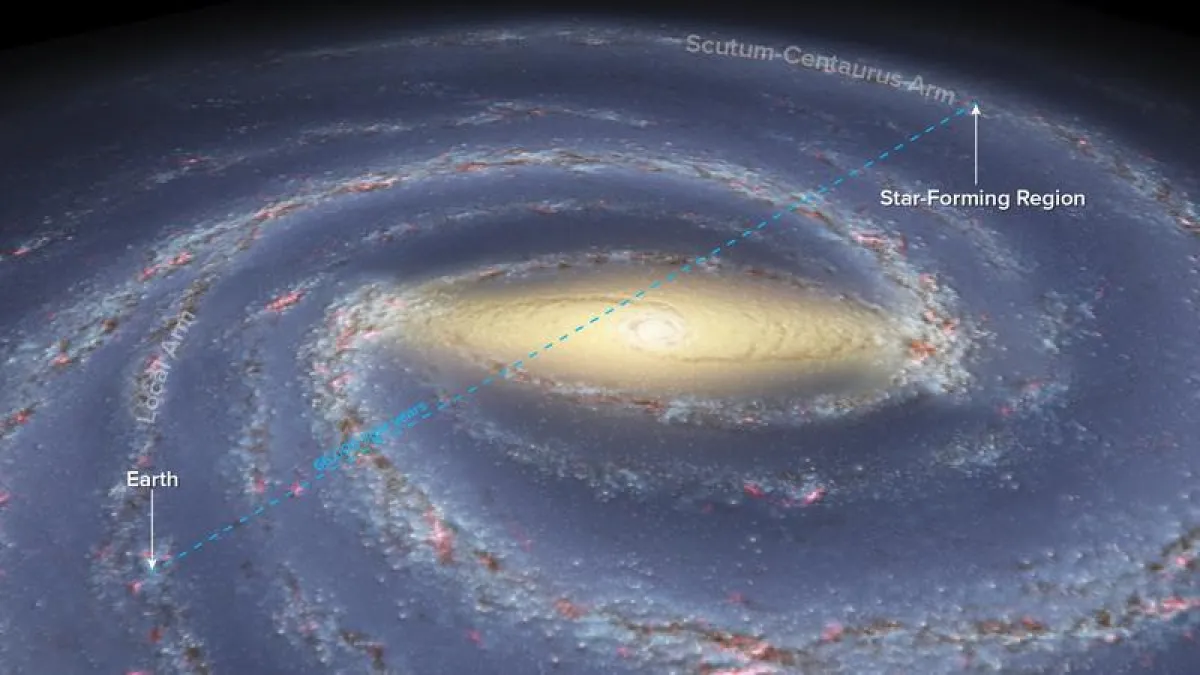
Artist’s view of the Milky Way with the location of the Sun and the star forming region (maser source G007.47+00.05) at the opposite side in the Scutum-Centaurus spiral arm.    (Bill Saxton, NRAO/AUI/
Artist’s view of the Milky Way with the location of the Sun and the star forming region (maser source G007.47+00.05) at the opposite side in the Scutum-Centaurus spiral arm. (Bill Saxton, NRAO/AUI/

(openPR) Astronomers from the Max Planck Institute for Radio Astronomy in Bonn, Germany, and the Harvard-Smithsonian Center for Astrophysics have directly measured the distance to a star-forming region on the opposite side of our Milky Way Galaxy from the Sun, using the Very Long Baseline Array. Their achievement reaches deep into the Milky Way’s terra incognita and nearly doubles the previous record for distance measurement within our Galaxy.


---
Distance measurements are crucial for an understanding of the structure of the Milky Way.
Most of our Galaxy's material, consisting principally of stars, gas, and dust, lies within a flattened disk, in which our Solar System is embedded. Because we cannot see our
Galaxy face-on, its structure, including the shape of its spiral arms, can only be mapped by measuring distances to objects elsewhere in the Galaxy.

The astronomers used a technique called trigonometric parallax, first applied by Friedrich Wilhelm Bessel in 1838 to measure the distance to the star 61 Cygni in the constellation of the Swan. This technique measures the apparent shift in the sky position of a celestial object as seen from opposite sides of the Earth's orbit around the Sun. This effect can be demonstrated by holding a finger in front of one's nose and alternately closing each eye -- the finger appears to jump from side to side.

Measuring the angle of an object's apparent shift in position this way allows astronomers to use simple trigonometry to directly calculate the distance to that object. The smaller the measured angle, the greater the distance is. In the framework of the Bar and Spiral Structure Legacy (BeSSeL) Survey, it is now possible to measure parallaxes a thousand times more accurate than Friedrich Bessel. The Very Long Baseline Array (VLBA), a continent-wide radio telescope system, with ten dish antennas distributed across North America, Hawaii, and the Caribbean, can measure the minuscule angles associated with great distances. In this case, the measurement was roughly equal to the angular size of a baseball on the Moon.

"Using the VLBA, we now can accurately map the whole extent of our Galaxy," says Alberto Sanna, of the Max Planck Institute for Radio Astronomy in Germany (MPIfR).

The new VLBA observations, made in 2014 and 2015, measured a distance of more than 66,000 light-years to the star-forming region G007.47+00.05 on the opposite side of the Milky Way from the Sun, well past the Galaxy's center in a distance of 27,000 light-years. The previous record for a parallax measurement was about 36,000 light-years.

"Most of the stars and gas in our Galaxy are within this newly-measured distance from the Sun. With the VLBA, we now have the capability to measure enough distances to accurately trace the Galaxy's spiral arms and learn their true shapes," Sanna explains.

The VLBA observations measured the distance to a region where new stars are being formed.
Such regions include areas where molecules of water and methanol act as natural amplifiers of radio signals -- masers, the radio-wave equivalent of lasers for light waves. This effect makes the radio signals bright and readily observable with radio telescopes.

The Milky Way has hundreds of such star-forming regions that include masers. "So we have plenty of 'mileposts' to use for our mapping project. But this one is special: Looking all the way through the Milky Way, past its center, way out into the other side", says the MPIfR's Karl Menten.

The astronomers' goal is to finally reveal what our own Galaxy looks like if we could leave it, travel outward perhaps a million light-years, and view it face-on, rather than along the plane of its disk. This task will require many more observations and much painstaking work, but, the scientists say, the tools for the job now are in hand. How long will it take?

"Within the next 10 years, we should have a fairly complete picture," predicts Mark Reid of the Harvard-Smithsonian Center for Astrophysics.

[DF/njn]

-----------------------------------------------------

The research team consists of Alberto Sanna of the Max Planck Institute for Radio Astronomy (MPIfR), the first author, along with colleagues Mark Reid and Thomas Dame of the Harvard-Smithsonian Center for Astrophysics and Karl Menten and Andreas Brunthaler, also of the MPIfR. They report their findings in the 13 October issue of the journal Science.

The Long Baseline Observatory (LBO) runs the “Very Long Baseline Array” (VLBA) as a facility of the National Science Foundation, operated under cooperative agreement by Associated Universities, Inc.

The BeSSeL Survey (Bar and Spiral Structure Legacy Survey) is a VLBA Key Science project. The survey is named in honor of Friedrich Wilhelm Bessel (1784-1846) who measured the first stellar parallax in 1838. The goal of the survey is to study the spiral structure and kinematics of the Milky Way.

Original Paper:

Mapping Spiral Structure on the far side of the Milky Way, Alberto Sanna, Mark J. Reid, Thomas M. Dame, Karl M. Menten, Andreas Brunthaler, 2017, Science (October 13 issue)

Contact:

Dr. Alberto Sanna
Max Planck Institute for Radio Astronomy, Bonn.
Fon +49 228 525-304
E-Mail: E-Mail

Prof. Dr. Karl M. Menten
Director and Head of Research Department Millimeter and Submillimeter Astronomy
Max Planck Institute for Radio Astronomy, Bonn.
Fon +49 228 525-297
E-Mail: E-Mail

Dr. Norbert Junkes,
Press and Public Outreach
Max Planck Institute for Radio Astronomy, Bonn.
Fon: +49 228 525-399
E-mail: E-Mail

Weitere Informationen:
- http://www.mpifr-bonn.mpg.de/pressreleases/2017/9

Quelle: idw
Diese Pressemeldung wurde auf openPR veröffentlicht.

Verantwortlich für diese Pressemeldung:

News-ID: 973980
 191

Kostenlose Online PR für alle

Jetzt Ihren Pressetext mit einem Klick auf openPR veröffentlichen

Jetzt gratis starten

Pressebericht „The Far Side of the Milky Way“ bearbeiten oder mit dem "Super-PR-Sparpaket" stark hervorheben, zielgerichtet an Journalisten & Top50 Online-Portale verbreiten:

PM löschen PM ändern
Disclaimer: Für den obigen Pressetext inkl. etwaiger Bilder/ Videos ist ausschließlich der im Text angegebene Kontakt verantwortlich. Der Webseitenanbieter distanziert sich ausdrücklich von den Inhalten Dritter und macht sich diese nicht zu eigen. Wenn Sie die obigen Informationen redaktionell nutzen möchten, so wenden Sie sich bitte an den obigen Pressekontakt. Bei einer Veröffentlichung bitten wir um ein Belegexemplar oder Quellenennung der URL.

Pressemitteilungen KOSTENLOS veröffentlichen und verbreiten mit openPR

Stellen Sie Ihre Medienmitteilung jetzt hier ein!

Jetzt gratis starten

Weitere Mitteilungen von Max-Planck-Institut für Radioastronomie

Bild: Die ferne Seite der MilchstraßeBild: Die ferne Seite der Milchstraße
Die ferne Seite der Milchstraße
Astronomen vom Max-Planck-Institut für Radioastronomie in Bonn und vom amerikanischen Harvard-Smithsonian Center for Astrophysics haben mit dem „Very Long Baseline Array“ die Entfernung zu einem Sternentstehungsgebiet vermessen, das sich jenseits des Galaktischen Zentrums auf der anderen Seite der Milchstraße befindet. Ihr Messresultat bringt sie tief in den „Terra Incognita“-Bereich unserer Galaxis und verdoppelt den bisherigen Rekordwert für eine Entfernungsbestimmung innerhalb der Milchstraße. --- Entfernungsbestimmungen sind entscheidend…
Bild: Discovery of the most accelerated binary pulsarBild: Discovery of the most accelerated binary pulsar
Discovery of the most accelerated binary pulsar
Fifty years after Jocelyn Bell discovered the first pulsar, students are no longer going through reams of paper from pen chart recorders but instead search through 1,000s of terabytes of data to find these enigmatic pulsating radio stars. The most extreme binary pulsar system so far, with accelerations of up to 70 g has been discovered by researchers at the Max Planck Institute for Radio Astronomy (MPIfR) in Bonn. At their closest approach the orbit of the pulsar and its companion neutron star would easily fit inside the radius of the Sun. -…

Das könnte Sie auch interessieren:

The circular economy – resource-efficient and digital
Recently published “in brief”: Can the digital transformation pave the way for resource-efficient materials cycles? --- As yet, only around 14 per cent of the raw materials used in German industry are derived from recycling processes. But how can this proportion be increased and waste disposed of in a way that is safer and more environmentally friendly? …
A Trace of Galaxies at the Heart of a Gigantic Galaxy Cluster
… University (ZAH). The results have been published in the “Monthly Notices of the Royal Astronomical Society”. Our solar system is located amid an enormous galaxy composed of billions of stars, the Milky Way. About 3,000 stars can be seen with the naked eye. However, if Earth were located in an ultra-diffuse galaxy, only a few dozen stars and a "trace" of …
Helpful tips on using the correct breathing techniques during running
… can be trained also during the retirement phase. The lung volume cannot be fully exhausted during a shallow chest breathing, which results in a reduced performance capacity. Stitches in the side can be also a negative side effect of the wrong breathing technique. A maximum oxygen supply of the body can be granted by breathing deeply into the belly. …
Bild: Lippstädter Lichtpromenade – Lippstadt läd ein zur Führung durch die NachtBild: Lippstädter Lichtpromenade – Lippstadt läd ein zur Führung durch die Nacht
Lippstädter Lichtpromenade – Lippstadt läd ein zur Führung durch die Nacht
Lippstadt steht für Licht – Wasser – Leben. Durch die Lichtpromenade in Lippstadt wird dieses Motto besonders gut symbolisiert. Vom „Milky Way“ bis zur „Arche“ - entlang der Lippe können Sie verschiedenste Lichtobjekte mit Geschichte entdecken. Mit der Stadtführung „Durch die Nacht“ erfahren Sie mehr zu dem Kunstprojekt wie auch zur Stadt Lippstadt selbst. …
Bild: New Publication: The Dark Side of European IntegrationBild: New Publication: The Dark Side of European Integration
New Publication: The Dark Side of European Integration
… immigration rates are not the only factors that determine the far right's success. Across Europe, radical right-wing parties are winning increasing electoral support. The Dark Side of European Integration Social Foundations and Cultural Determinants of the Rise of Radical Right Movements in Contemporary Europe by Alina Polyakova argues that this rising …
Bild: Grid Stability for Wind EnergyBild: Grid Stability for Wind Energy
Grid Stability for Wind Energy
… necessary. Fully Satisfying all Standard Requirements The generator of a wind turbine will normally feed the major share of the energy produced directly into the grid. Whenever the line-side voltage drops, the whole plant system needs to feed reactive current into the grid (low voltage ride through, LVRT). The Green Line 1000 splendidly copes with these …
Bild: Dr. Kranck "Haus 13" release on 28.10.2011Bild: Dr. Kranck "Haus 13" release on 28.10.2011
Dr. Kranck "Haus 13" release on 28.10.2011
… a period of 4 years. Remixes of the album can be found on the Körperschall Records Remix Sampler Vol 2. For risks and side effects: make a little louder. Tracklisting: 01. Isolation 02. Antisuizidtänzer 03. Strippenzieher 04. Trauma Traum 05. Weißes Rauschen 06. Menschen mit Visionen 07. Wurzelbehandlung 08. Zukunftsvision 09. MDMA 10. Sirius delta 9 11. …
Bild: Romance Of Love & Sweetness Concert: Michel Montecrossa's Live-CD mit New-Topical und Dance-Electronica HitsBild: Romance Of Love & Sweetness Concert: Michel Montecrossa's Live-CD mit New-Topical und Dance-Electronica Hits
Romance Of Love & Sweetness Concert: Michel Montecrossa's Live-CD mit New-Topical und Dance-Electronica Hits
… elektronischen Hit-Songs ‘Romance Of Love & Sweetness’, ‘Festival Of The Bright Earth’, ‘Love & Sweetness Song’, ‘Way Of Love’, ‘My Highlife Topical Are You, My Love!’, ‘Side By Side’, ‘Cruisin’’, ‘Love Rising’, ‘What You Wanna Do, Do It Now’, ‘Helicopter Baby’, ‘With You In Heaven’, ‘Romantic Barbarians’ und ‘Cyberviking & Oriental Girl’. Das …
Bild: Usage of foreign trademarks as keywords/adwordsBild: Usage of foreign trademarks as keywords/adwords
Usage of foreign trademarks as keywords/adwords
… search engine Google a company can take out an ad the way that if a specific search item is entered into the Google search mask, the ad will appear on the right side of the screen and the seeker can click on that ad, whereby per click Google will receive a predefined fee from the advertiser. In the present case companies, which partly offered imitations …
Bild: Mit gutem Beispiel voran - Mars reduziert gesättigte Fettsäuren in SchokoriegelnBild: Mit gutem Beispiel voran - Mars reduziert gesättigte Fettsäuren in Schokoriegeln
Mit gutem Beispiel voran - Mars reduziert gesättigte Fettsäuren in Schokoriegeln
… Anteil der gesättigten Fettsäuren in seinen beliebtesten Schokoladenriegeln entscheidend zu reduzieren. Ab Sommer 2010 können Verbraucher in Deutschland die Marken Mars, Snickers und Milky Way mit mindestens 15 Prozent weniger gesättigten Fettsäuren pro Riegel kaufen. Damit werden allein in Deutschland jährlich mehr als 387 Tonnen gesättigte Fettsäuren …
Sie lesen gerade: The Far Side of the Milky Way