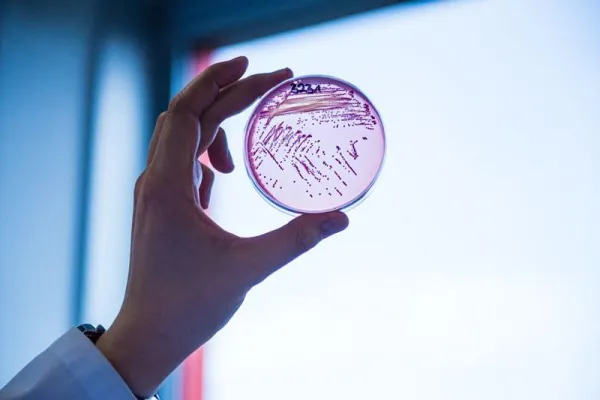

(openPR) Chronic lung infections caused by the bacterium Pseudomonas aeruginosa require complex and, in most cases, long-term treatment with antibiotics—new medication is badly needed. Scientists at the Helmholtz Institute for Pharmaceutical Research Saarland (HIPS) and the German Center for Infection Research (DZIF) are now improving an anti-infective active ingredient with a new mode of action.
---
The starting point is a substance that can block the pathogenicity of the bacterium and weaken its protective biofilm. The Helmholtz Validation Fund, the DZIF and the Helmholtz Centre for Infection Research (HZI) are contributing a joint investment of 2.7 million euros to improve this class of substance, aiming to achieve a preclinical candidate.
“We have high hopes for this drug candidate,” explained Dr Martin Empting, who is conducting the project at the HIPS/HZI together with Prof Rolf Hartmann and Dr Thomas Hesterkamp. Unlike antibiotics, the substance does not kill the bacterium, it disrupts its ability to harm the host and protect itself from the immune system by forming a biofilm. “This pathoblocker also makes the bacterium more vulnerable to parallel treatment with antibiotics,” added Empting.
The active ingredient that attacks the bacterial receptor PqsR (frequently also called “MvfR”), works selectively and specifically against Pseudomonas aeruginosa, thereby sparing other bacteria that could be of use. The bacterium, also feared as a hospital germ, is included on the “Priority Pathogens List” of the WHO as one of the three most important pathogens for developing new active ingredients. It affects the respiratory and urinary tracts or wounds and triggers dangerous infections that are very difficult to treat. Those frequently affected are patients who suffer from cystic fibrosis – in this case P. aeruginosa causes chronic lung infections that must be kept permanently under control with antibiotics. But also patients who suffer from obstructive respiratory diseases or widened bronchial tubes, so-called bronchiectasis, are not safe from this pathogen. Increasing resistance to antibiotics also makes successful treatment more difficult.
A molecule blocks virulence factors and biofilm structures
The scientists keep both patient groups in mind when improving the structure of their lead compound. As proven in various test systems, the starting molecule has good conditions for becoming a successful active ingredient: The pathoblockers inhibit the function of the PqsR receptor, which plays a key role in the infection of Pseudomonas aeruginosa. The bacterium uses this receptor to regulate its group-specific virulence and therefore factors that contribute to the severity of the infection. The drug candidate not only suppresses this virulence process, it has also been proven to reduce the mass of biofilm, a matrix formed by pseudomonads to protect the bacteria from attacks by the immune system. When a biofilm is formed, an infection generally becomes chronic and more difficult to treat.
Turning a molecule into a product
Now it’s over to the active ingredient designers. They will change the structure of the molecule until it has the properties necessary for an active ingredient. This includes, for example, a highly effective target structure, high selectivity and good availability at the site of action. The aim of the scientists for the next two years is to develop a pre-clinical candidate that can be enhanced in cooperation or as part of a start-up company. The project also meets the particular demands of DZIF of supporting translational research and paving the way to new medications.
“At the end of the development, we expect to achieve an active ingredient that can be inhaled by patients suffering from chronic lung infections,” explains Empting. The scientists currently see its use as a concomitant treatment to antibiotics as a promising initial application area. “The development of pathoblockers is an important option for controlling the problem of chronic infections that are difficult to treat in the long term,” continues Empting.
Contact:
Prof Rolf Hartmann
Helmholtz Institute for Pharmaceutical Research Saarland and
German Center for Infection Research
T: +49 681 98806 2001
E-mail:

Dr Martin Empting
HIPS and DZIF
T: +49 681 98806 2031
E-mail:

About the German Center for Infection Research
Approx. 500 scientists from 35 institutes around Germany work together at the German Center for Infection Research (DZIF) to develop new approaches for preventing, diagnosing and treating infectious diseases. The aim is so-called translation—quickly and effectively implementing research results into clinical practice. Thus, the DZIF paves the way for the development of new vaccines, diagnostics and medications against infections. More information: www.dzif.de.
About the Helmholtz Centre for Infection Research and HIPS
Scientists at the Helmholtz Centre for Infection Research (HZI) investigate the mechanisms of infections and their defence. What turns bacteria or viruses into pathogens: understanding this is key to developing new medications and vaccines. The Helmholtz Institute for Pharmaceutical Research Saarland (HIPS) in Saarbrücken is a HZI site that was created together with Saarland University and focuses on active ingredient research. www.helmholtz-hzi.de
Quelle: idw